


06.cat 2023 paper slot 1 dilr
Five restaurants, coded R1, R2, R3, R4 and R5 gave integer ratings to five gig workers – Ulla's, Vasu, Waman, Xavier and Yusuf, on a scale of 1 to 5. The means of the ratings given by R1, R2, R3, R4 and R5 were 3.4, 2.2, 3.8, 2.8 and 3.4 respectively.
The summary statistics of these ratings for the five workers is given below.
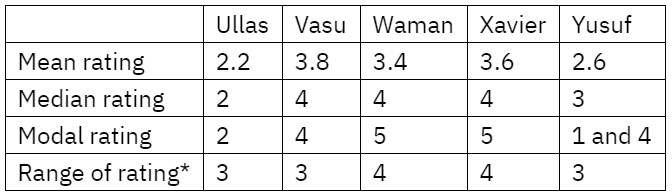 Range of rating* 3 3 4 4 3 * Range of ratings is defined as the difference between the maximum and minimum ratings awarded to a worker.
The following is partial information about ratings of 1 and 5 awarded by the restaurants to the workers.
(a) R1 awarded a rating of 5 to Waman, as did R2 to Xavier, R3 to Waman and Xavier, and R5 to Vasu.
(b) R1 awarded a rating of 1 to Ulla's, as did R2 to Waman and Yusuf, and R3 to Yusuf.
Range of rating* 3 3 4 4 3 * Range of ratings is defined as the difference between the maximum and minimum ratings awarded to a worker.
The following is partial information about ratings of 1 and 5 awarded by the restaurants to the workers.
(a) R1 awarded a rating of 5 to Waman, as did R2 to Xavier, R3 to Waman and Xavier, and R5 to Vasu.
(b) R1 awarded a rating of 1 to Ulla's, as did R2 to Waman and Yusuf, and R3 to Yusuf.How many individual ratings cannot be determined from the above information?
Type in the numerical answer when attempting this question.
Correct Answer
0
Detailed Explanation
Given that the means of the ratings given by R1, R2, R3, R4 and R5 were 3.4, 2.2, 3.8, 2.8 and 3.4 respectively.
=> The sum of ratings given by R1, R2, R3 R4, R5 are means , and 17 respectively.
Similarly the sum of ratings received by and Y are means , and 13 respectively.
Also capturing the absolute data given in the partial information (a) and (b) and representing as a table, we get:
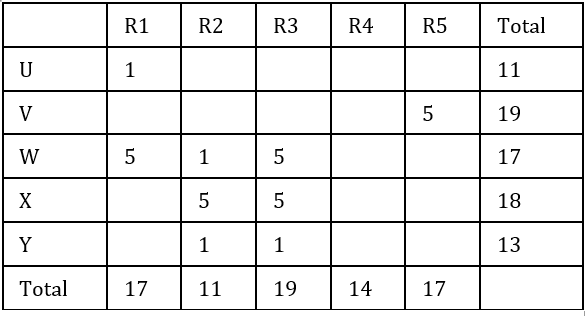 Now,
Consider U
Given median , mode and range
⇒ His ratings should be of the form 1, . For mode
⇒ U's ratings are 1, 2, 2, 2, 4.
Consider V
Given median , mode and range
⇒ His ratings should be of the form 2, For mode
=> V's ratings are 2, 4, 4, 4, 5.
Consider W
Given median , mode and range
=> His ratings should be of the form 1,
=> W's ratings are 1, 2, 4, 5, 5.
Consider Y
Given median , mode , Range => His ratings are 1, 1, 3, 4, 4.
Capturing this data in the table, we get:
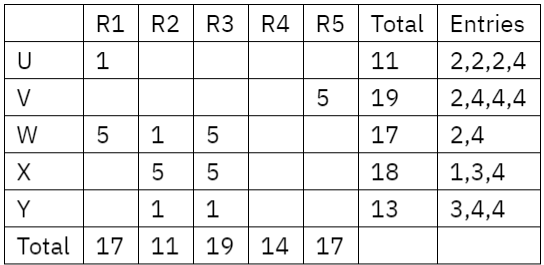 Now, consider column R3 => The two missing entries should add up to 19-1 - 5 - 5 = 8, (only possibility is 4 + 4) => We can fill the row " " and 4 in the row " "
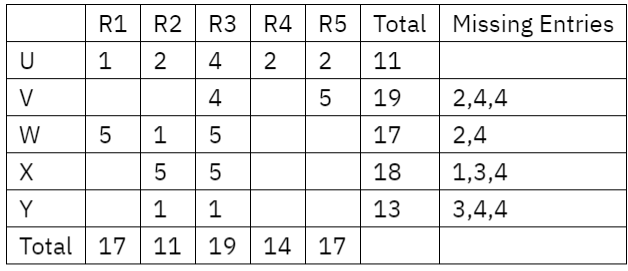 Now, consider column R2 => Missing entry should be 11-2 - 1-5 - 1 = 2
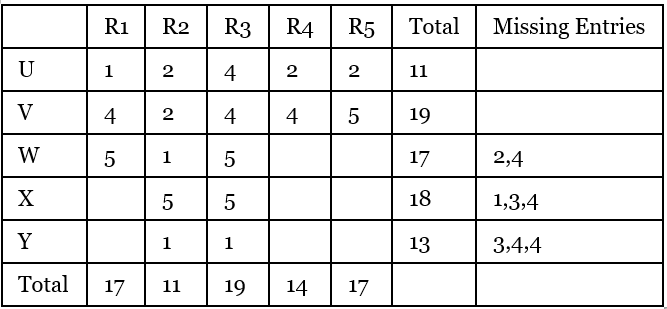 Consider column R1, the missing elements should add up to or ----(1)
Consider R5, the missing elements should add up to or (not possible) as (1) requires a 3 .
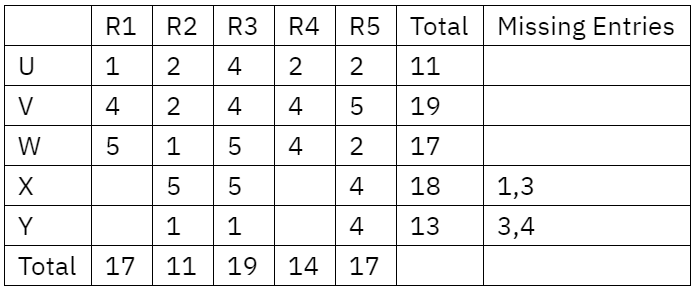 Now, we can fill column R1 as and the remaining in column R4 and we can get the complete table
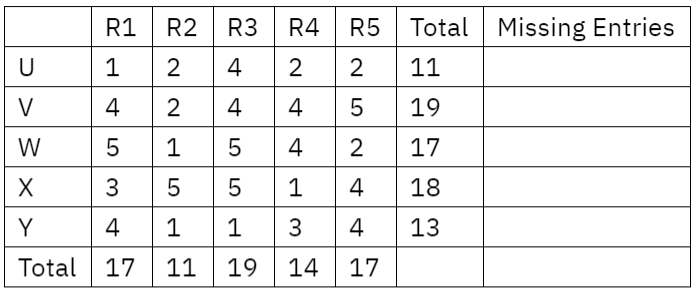 => All ratings can be determined uniquely => 0 .
Now,
Consider U
Given median , mode and range
⇒ His ratings should be of the form 1, . For mode
⇒ U's ratings are 1, 2, 2, 2, 4.
Consider V
Given median , mode and range
⇒ His ratings should be of the form 2, For mode
=> V's ratings are 2, 4, 4, 4, 5.
Consider W
Given median , mode and range
=> His ratings should be of the form 1,
=> W's ratings are 1, 2, 4, 5, 5.
Consider Y
Given median , mode , Range => His ratings are 1, 1, 3, 4, 4.
Capturing this data in the table, we get:
Now, consider column R3 => The two missing entries should add up to 19-1 - 5 - 5 = 8, (only possibility is 4 + 4) => We can fill the row " " and 4 in the row " "
Now, consider column R2 => Missing entry should be 11-2 - 1-5 - 1 = 2
Consider column R1, the missing elements should add up to or ----(1)
Consider R5, the missing elements should add up to or (not possible) as (1) requires a 3 .
Now, we can fill column R1 as and the remaining in column R4 and we can get the complete table
=> All ratings can be determined uniquely => 0 .