


02.cat 2025 paper slot 1 dilr
CAT 2025
A train travels from Station A to Station E, passing through stations B, C, and D, in that order. The train has a seating capacity of 200. A ticket may be booked from any station to any other station ahead on the route, but not to any earlier station.
A ticket from one station to another reserves one seat on every intermediate segment of the route. For example, a ticket from B to E reserves a seat in the intermediate segments B – C, C – D, and D – E.
The occupancy factor for a segment is the total number of seats reserved in the segment as a percentage of the seating capacity. The total number of seats reserved for any segment cannot exceed 200.
The following information is known.
1. Segment C – D had an occupancy factor of 95%. Only segment B – C had a higher occupancy factor.
2. Exactly 40 tickets were booked from B to C and 30 tickets were booked from B to E.
3. Among the seats reserved on segment D – E, exactly four-sevenths were from stations before C.
4. The number of tickets booked from A to C was equal to that booked from A to E, and it was higher than that from B to E.
5. No tickets were booked from A to B, from B to D and from D to E.
6. The number of tickets booked for any segment was a multiple of 10.
How many tickets were booked from Station A to Station E?
Type in the numerical answer when attempting this question.
Correct Answer
50
Detailed Explanation
First let’s note down all the given information.
Train maximum seating capacity = 200.
Segments are: A - B, B - C, C - D, D - E.
Segment C - D occupancy = 95% = 0.95*200 = 190
Only B - C had a higher occupancy factor, that is, its occupancy is greater than 190. The only possibility is 200.
Hence, B - C occupancy = 200.
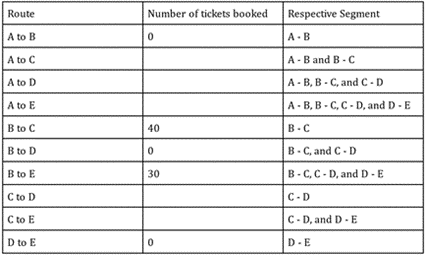 Let the number of tickets booked from A to C = A to E = ‘x’ and x > 30
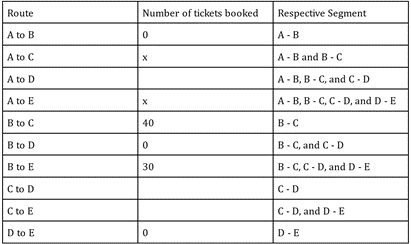 Let the reserved seats in the segment D - E = y
y = A to E+ B to E+ C to E+ D to E
A to E + B to E = 4y/7
x+30 = 4y/7 —------- 1
C to E + D to E = 3y/7—-------- 2
Since all the tickets are multiples of 10, then y must be a multiple of 7*5 = 35 and should be less than 200,
Possible values are: 35, 70, 105, 140, 175
y can’t be 35, because then x will be negative.
y can’t be 70, because then x will be less than 30
y can’t be 105, because then x will be equal to 30
y can be 140, then x = 50.
y can be 175, then x = 70
Now we have two cases.
From 2,
If y = 140
C to E + 0 = 60
C to E = 60
If y = 175
C to E + 0 = 75
C to E = 75 which is not possible bcz it should be a multiple of 10.
Hence the only valid case is y = 140.
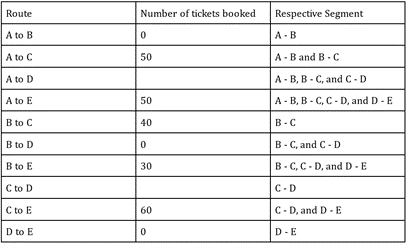 Occupancy of C - D = 190
Segment C - D = A to D + A to E + B to D + B to E + C to D + C to E = 190
A to D + 50+ 0+ 30+ C to D+ 60 = 190
A to D + C to D = 50
B - C = A to C + A to D+ A to E+ B to C+ B to E + B to D = 200
50+ A to D+ 50+ 40+30+ 0 = 200
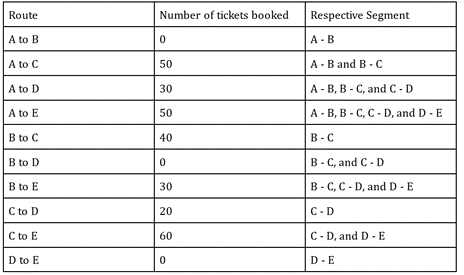
A to D = 30
C to D = 20
Hence, we get the final table as.
 Correct Answer 50
50 tickets were booked from A to E
Let the number of tickets booked from A to C = A to E = ‘x’ and x > 30
Let the reserved seats in the segment D - E = y
y = A to E+ B to E+ C to E+ D to E
A to E + B to E = 4y/7
x+30 = 4y/7 —------- 1
C to E + D to E = 3y/7—-------- 2
Since all the tickets are multiples of 10, then y must be a multiple of 7*5 = 35 and should be less than 200,
Possible values are: 35, 70, 105, 140, 175
y can’t be 35, because then x will be negative.
y can’t be 70, because then x will be less than 30
y can’t be 105, because then x will be equal to 30
y can be 140, then x = 50.
y can be 175, then x = 70
Now we have two cases.
From 2,
If y = 140
C to E + 0 = 60
C to E = 60
If y = 175
C to E + 0 = 75
C to E = 75 which is not possible bcz it should be a multiple of 10.
Hence the only valid case is y = 140.
Occupancy of C - D = 190
Segment C - D = A to D + A to E + B to D + B to E + C to D + C to E = 190
A to D + 50+ 0+ 30+ C to D+ 60 = 190
A to D + C to D = 50
B - C = A to C + A to D+ A to E+ B to C+ B to E + B to D = 200
50+ A to D+ 50+ 40+30+ 0 = 200
A to D = 30
C to D = 20
Hence, we get the final table as.
Correct Answer 50
50 tickets were booked from A to E