


22.cat 2025 paper slot 1 dilr
CAT 2025
Alia, Badal, Clive, Dilshan, and Ehsaan played a game in which each asks a unique question to all the others and they respond by tapping their feet, either once or twice or thrice. One tap means “Yes”, two taps mean “No”, and three taps mean “Maybe”.
A total of 40 taps were heard across the five questions. Each question received at least one “Yes”, one “No”, and one “Maybe.”
The following information is known.
1. Alia tapped a total of 6 times and received 9 taps to her question. She responded “Yes” to the questions asked by both Clive and Dilshan.
2. Dilshan and Ehsaan tapped a total of 11 and 9 times respectively. Dilshan responded “No” to Badal.
3. Badal, Dilshan, and Ehsaan received equal number of taps to their respective questions.
4. No one responded “Yes” more than twice.
5. No one’s answer to Alia’s question matched the answer that Alia gave to that person’s question. This was also true for Ehsaan.
6. Clive tapped more times in total than Badal.
How many “Yes” responses were received across all the questions?
Type in the numerical answer when attempting this question.
Correct Answer
6
Detailed Explanation
First let’s make a table and fill in the given values.
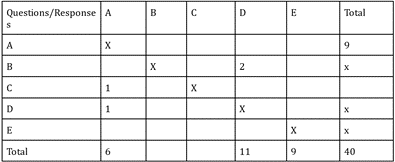 The rows represent the questions asked by the five people and the columns represent the responses given by the five people.
Alia gave a total of six responses and we already have two yeses so we can’t have any more yeses as her response, hence, the other two responses of her will be no.
It is given that Clive tapped more times than Badal, total responses of Clive and Badal = 40 - 11 - 9 - 6 = 14.
Number of taps of Clive and Badlal = (C, B) = (8, 6) or (9, 5), or (10, 4)
The minimum number of taps anyone can make = 1+1+2+2 = 6, hence the only possible pair for (C, B) = (8, 6).
Dilshan gave a total of 11 taps, and he gave two taps to B, so the remaining 9 taps, will be distributed between the A, C, and D, equally
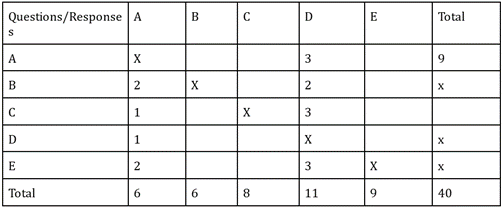 From statement 5, we can say that B’s response to A’s question should be either yes or maybe, C’s response to A’s question should be either No or Maybe, and E’s response to A’s question should be either yes or Maybe.
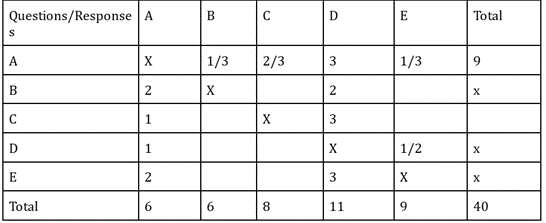 B’s total number of taps = 6, the only possible combination is (1,1,2,2)
So, B’s response to A’s question will be Yes, and C’s response to A’s question will be No, and E’s response to A’s question will be 3.
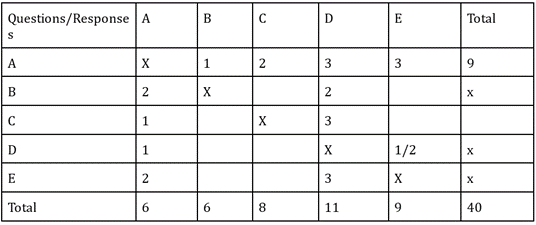 Each question got at least one Yes, one No, and one Maybe.
So, for B’s question the responses by C and E will be either Yes or Maybe.
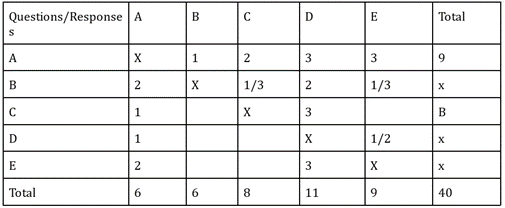 Column total = 9+x+ B+x+x = 40.
3x+B = 31
(x,B) = (7, 10), (8, 7)
It can only be (8, 7) because the total can’t be 10 for C.
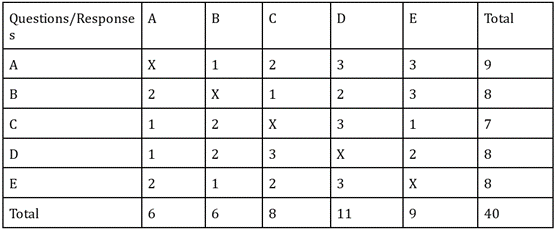 A total of six Yes responses were received across all the questions.
Correct Answer 6
The rows represent the questions asked by the five people and the columns represent the responses given by the five people.
Alia gave a total of six responses and we already have two yeses so we can’t have any more yeses as her response, hence, the other two responses of her will be no.
It is given that Clive tapped more times than Badal, total responses of Clive and Badal = 40 - 11 - 9 - 6 = 14.
Number of taps of Clive and Badlal = (C, B) = (8, 6) or (9, 5), or (10, 4)
The minimum number of taps anyone can make = 1+1+2+2 = 6, hence the only possible pair for (C, B) = (8, 6).
Dilshan gave a total of 11 taps, and he gave two taps to B, so the remaining 9 taps, will be distributed between the A, C, and D, equally
From statement 5, we can say that B’s response to A’s question should be either yes or maybe, C’s response to A’s question should be either No or Maybe, and E’s response to A’s question should be either yes or Maybe.
B’s total number of taps = 6, the only possible combination is (1,1,2,2)
So, B’s response to A’s question will be Yes, and C’s response to A’s question will be No, and E’s response to A’s question will be 3.
Each question got at least one Yes, one No, and one Maybe.
So, for B’s question the responses by C and E will be either Yes or Maybe.
Column total = 9+x+ B+x+x = 40.
3x+B = 31
(x,B) = (7, 10), (8, 7)
It can only be (8, 7) because the total can’t be 10 for C.
A total of six Yes responses were received across all the questions.
Correct Answer 6