


05.cat 2025 paper slot 1 dilr
CAT 2025
A train travels from Station A to Station E, passing through stations B, C, and D, in that order. The train has a seating capacity of 200. A ticket may be booked from any station to any other station ahead on the route, but not to any earlier station.
A ticket from one station to another reserves one seat on every intermediate segment of the route. For example, a ticket from B to E reserves a seat in the intermediate segments B – C, C – D, and D – E.
The occupancy factor for a segment is the total number of seats reserved in the segment as a percentage of the seating capacity. The total number of seats reserved for any segment cannot exceed 200.
The following information is known.
1. Segment C – D had an occupancy factor of 95%. Only segment B – C had a higher occupancy factor.
2. Exactly 40 tickets were booked from B to C and 30 tickets were booked from B to E.
3. Among the seats reserved on segment D – E, exactly four-sevenths were from stations before C.
4. The number of tickets booked from A to C was equal to that booked from A to E, and it was higher than that from B to E.
5. No tickets were booked from A to B, from B to D and from D to E.
6. The number of tickets booked for any segment was a multiple of 10.
How many tickets were booked to travel in exactly one segment?
Type in the numerical answer when attempting this question.
Correct Answer
60
Detailed Explanation
First let’s note down all the given information.
Train maximum seating capacity = 200.
Segments are: A - B, B - C, C - D, D - E.
Segment C - D occupancy = 95% = 0.95*200 = 190
Only B - C had a higher occupancy factor, that is, its occupancy is greater than 190. The only possibility is 200.
Hence, B - C occupancy = 200.
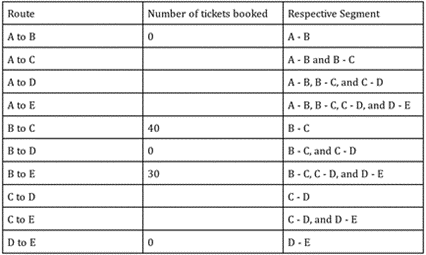 Let the number of tickets booked from A to C = A to E = ‘x’ and x > 30
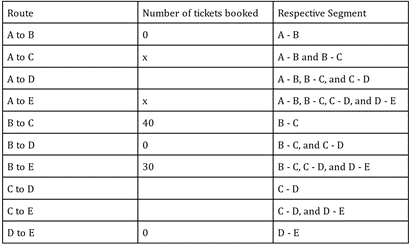 Let the reserved seats in the segment D - E = y
y = A to E+ B to E+ C to E+ D to E
A to E + B to E = 4y/7
x+30 = 4y/7 —------- 1
C to E + D to E = 3y/7—-------- 2
Since all the tickets are multiples of 10, then y must be a multiple of 7*5 = 35 and should be less than 200,
Possible values are: 35, 70, 105, 140, 175
y can’t be 35, because then x will be negative.
y can’t be 70, because then x will be less than 30
y can’t be 105, because then x will be equal to 30
y can be 140, then x = 50.
y can be 175, then x = 70
Now we have two cases.
From 2,
If y = 140
C to E + 0 = 60
C to E = 60
If y = 175
C to E + 0 = 75
C to E = 75 which is not possible bcz it should be a multiple of 10.
Hence the only valid case is y = 140.
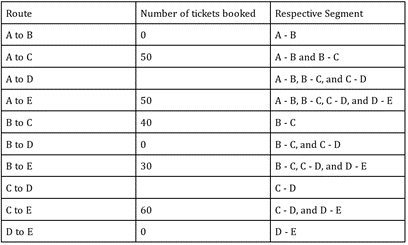 Occupancy of C - D = 190
Segment C - D = A to D + A to E + B to D + B to E + C to D + C to E = 190
A to D + 50+ 0+ 30+ C to D+ 60 = 190
A to D + C to D = 50
B - C = A to C + A to D+ A to E+ B to C+ B to E + B to D = 200
50+ A to D+ 50+ 40+30+ 0 = 200
A to D = 30
C to D = 20
Hence, we get the final table as.
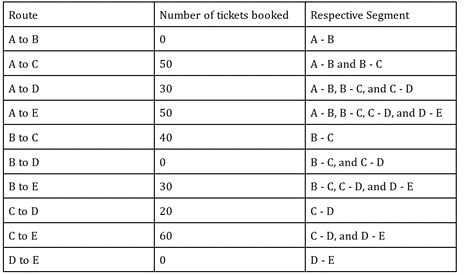 Tickets booked in exactly one segment = A to B + B to C + C to D + D to E = 60
Hence, the correct answer is 60.
Let the number of tickets booked from A to C = A to E = ‘x’ and x > 30
Let the reserved seats in the segment D - E = y
y = A to E+ B to E+ C to E+ D to E
A to E + B to E = 4y/7
x+30 = 4y/7 —------- 1
C to E + D to E = 3y/7—-------- 2
Since all the tickets are multiples of 10, then y must be a multiple of 7*5 = 35 and should be less than 200,
Possible values are: 35, 70, 105, 140, 175
y can’t be 35, because then x will be negative.
y can’t be 70, because then x will be less than 30
y can’t be 105, because then x will be equal to 30
y can be 140, then x = 50.
y can be 175, then x = 70
Now we have two cases.
From 2,
If y = 140
C to E + 0 = 60
C to E = 60
If y = 175
C to E + 0 = 75
C to E = 75 which is not possible bcz it should be a multiple of 10.
Hence the only valid case is y = 140.
Occupancy of C - D = 190
Segment C - D = A to D + A to E + B to D + B to E + C to D + C to E = 190
A to D + 50+ 0+ 30+ C to D+ 60 = 190
A to D + C to D = 50
B - C = A to C + A to D+ A to E+ B to C+ B to E + B to D = 200
50+ A to D+ 50+ 40+30+ 0 = 200
A to D = 30
C to D = 20
Hence, we get the final table as.
Tickets booked in exactly one segment = A to B + B to C + C to D + D to E = 60
Hence, the correct answer is 60.