
CAT Non Engineer’s Strategy: There is a common myth that the CAT exam is difficult for non-engineering candidates. But the reality is completely different. Many non-engineers have secured 100%ile in the CAT exam over the years. Sometimes they do experience both advantages and challenges. One key benefit is that they get academic diversity points. This can maximise their chances during the interview and final shortlisting. On the contrary, non-engineers often find Quants and DILR more challenging. This is where the iQuanta CAT 2026 course helps you. It offers three essentials CAT module before live classes. If you are a beginner, this module will help you learn concepts from scratch. This allows you to stay on track throughout your preparation. These modules can be a game-changer if utilised well. Read ahead to know the CAT Non Engineer’s strategy across all the sections.
Join iQuanta’s diversified student community for free and prepare with other 4.1L+ peers. Get access to 24*7 doubt-solving, mentorship, free webinars, etc all at one single platform.

CAT Non Engineer’s Strategy
The CAT exam is divided into three sections: VARC, DILR, and Quant. Many candidates from non-engineering candidates struggle with these subjects due to unclear concepts. The good news? You have sufficient time to build concepts from scratch and enhance your chances of success in the CAT 2026 exam. Take a look at the CAT Non Engineer’s strategy across all the sections:
Build Your Basics
You need to first build a strong foundation across all the sections. The stronger your basics are, the higher you can score. CAT is not the same as other competitive exams like JEE Main or JEE Advanced. The CAT exam mainly tests your thinking ability and conceptual clarity. What it does is twist the basic questions a little and make it a bit difficult. You need to have strong fundamentals to score high marks in the exam. You need to first warm up your mind because you studied QA & DILR a long time ago. So, you may have forgotten the fundamentals. Now, what you can do to build the basics is utilise the iQuanta CAT course’s three essentials module.
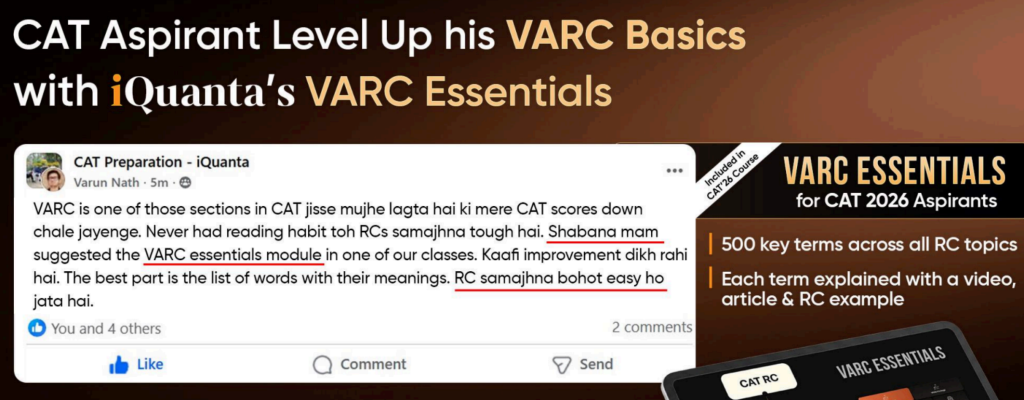
- VARC: RC passages occupy a major portion of the VARC section. The iQuanta VARC Essentials module offers 500 crucial terms for RC. There are many genres like Philosophy, Economics, Politics, Science, History, etc. So there are a lot of terms in all these RCs. It is not your basic English that you use in your day-to-day life. There are many such terms and tough words whose meaning you should know. Only then will you be able to understand RC Passages. This module also offers various examples and video explanations to strengthen your basics. It teaches you how to learn RCs, what skimming is, and how you can answer RC questions correctly. It also helps you master VA concepts by providing unlimited examples and video explanations.
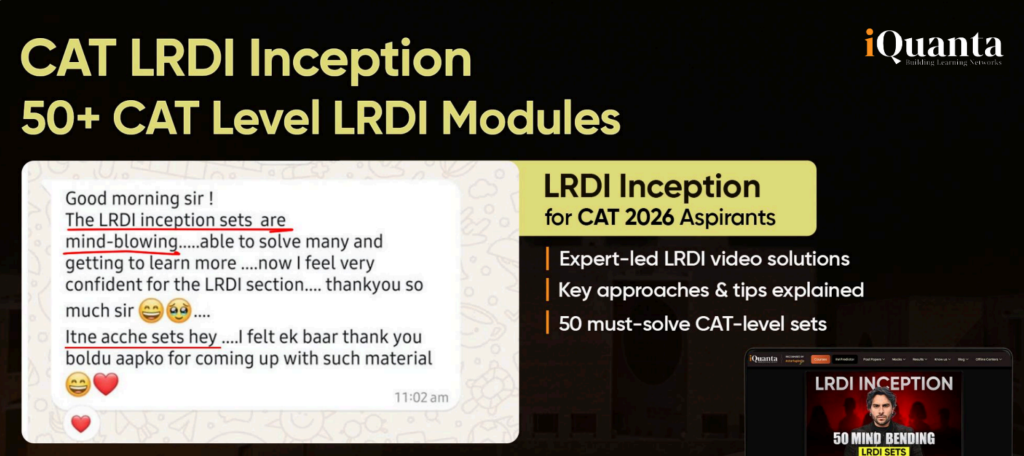
- DILR: Start by building concepts in all topics related to the DILR section. It has a lot of subtopics like Venn Diagrams, Game & Tournaments, etc. There are many DILR sets or DI Charts based on these topics. The iQuanta LRDI Essentials Module helps you learn concepts from zero level. It offers problem-solving shortcuts and proper visual representation. It offers 35+ videos (15 hours) to explain LRDI fundamentals. It also provides an in-depth explanation of each topic that covers basic terms, complex cases, and practice sets. This module helps you learn how to approach the sets and represent them on paper. It teaches you how to read the questions and how to interpret DILR questions. After covering LRDI essentials, you can also check iQuanta’s CAT LRDI Inception module. It offers unlimited CAT-level DILR sets with video explanations and text explanations.
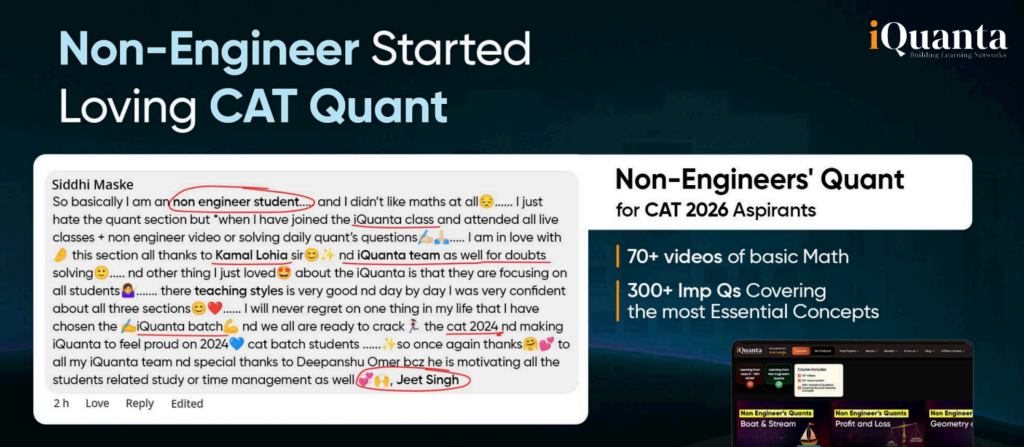
- Quant: Non-engineers may struggle with Quant since they last studied these topics a long time ago. To help, iQuanta CAT 2026 course has introduced Non Engineer’s Quant Module that can help you build the basics from the ground up. It covers all the concepts from class 6 to 10th NCERT to CAT-level fundamentals with practice sessions. This module helps you master concepts from topics like Arithmetic, Algebra, Number System, Modern Maths, Geometry, etc. Once you get comfortable with basic concepts, you will be able to solve high-level CAT questions. This module offers 70+ Videos and 300+ important questions that cover all the important concepts.
Rigorous Practice
The more you practice CAT-level questions, the better your accuracy will become. Just clearing the concepts is not enough. You need to know how to apply those concepts in solving the questions. And this is possible only when you consistently practice questions. It will also help you retain the concepts. You should try to solve at least 50-100 questions for every topic. Try to solve 2 LRDI sets per day. Regular practice can help you learn concepts and question selection skills.
Get Doubts Resolved
Make sure you resolve any doubts in concepts or questions at the earliest. But many traditional coaching institutes do not offer instant doubt-solving sessions. But iQuanta CAT 2026 course offers 24X7 doubt-solving support that gets your doubts cleared within 8 minutes. They ensure that no concept remains unclear on your journey to CAT 2026 success.
So, candidates from non-engineering background can easily crack the CAT exam with a high percentile. All they need is the right strategy, dedication, and willingness to learn. To help, iQuanta have launched the CAT 2026 course that offers unique features and flexible learning. It provides live and application-based classes, section-wise modules, assignments, mock tests with analysis & video solutions, doubt resolutions, and more. iQuanta CAT 2026 course ensures that non-engineers grasp concepts from scratch in all the sections. It is a one-stop solution for all candidates who are weak in Quant, VARC or DILR. So, why wait more! Enrol now and start your CAT prep journey.