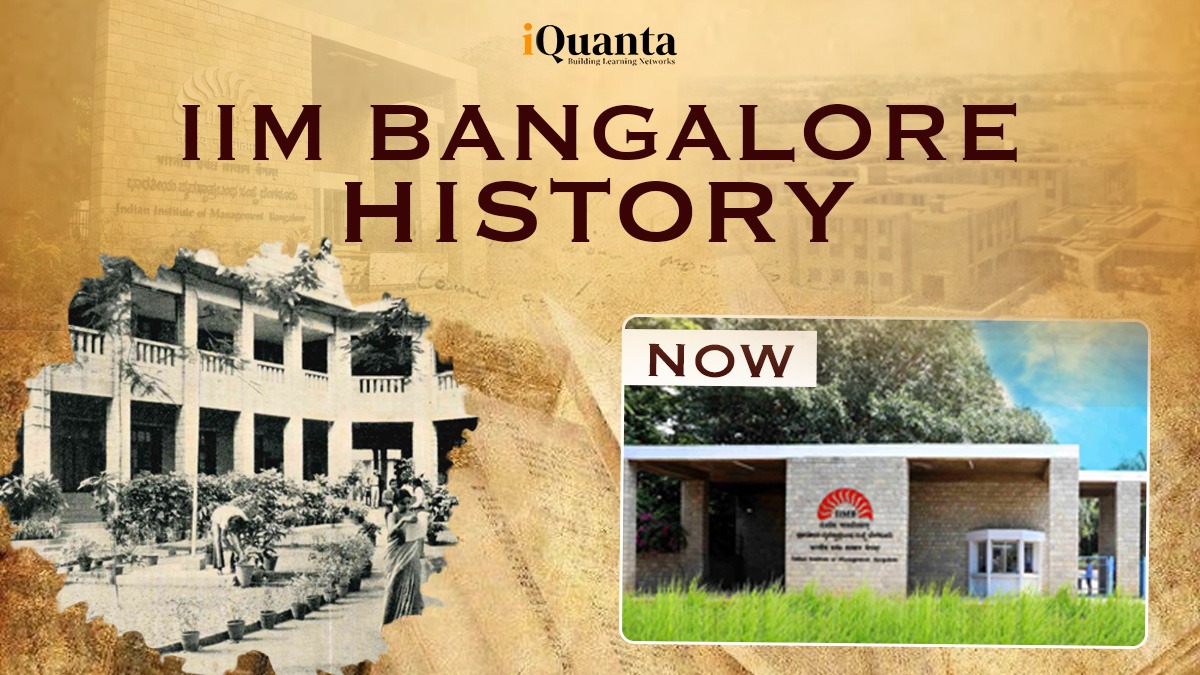
The Indian Institute of Management Bangalore (IIMB) is a leading B-school in India. They focus on both academic excellence and leadership growth. The institute has come a long way from its humble beginnings in 1973 to its current global presence. It grew from a vision of service, inclusiveness, and excellence. The journey of its success is truly inspiring. Look at IIM Bangalore’s history and understand the journey year by year from its birth to its popularity today.
Join iQuanta’s diversified student community for free and prepare with other 4.1L+ peers. Get access to 24*7 doubt-solving, mentorship, free webinars, etc all at one single platform.

The Beginning of a Vision (1960s-1973)
The 1960s have witnessed many developments in India. Many institutes in science and technology, like IITs, were already built in India. But with time, it became clear that the country also needs management talent and resources. After the establishment of IIM Ahmedabad and Calcutta, the government decided to start a similar institute in Bangalore. The first two B-schools could train students to become managers in the private sector. Graduates from these institutes could not be absorbed into public sector institutions. The key reason was low salary in the public sector. Thus, the decision to build an institute in Bangalore was made. They aimed to equip students with all the skills to meet the requirements of the public sector.
The Government of Karnataka provided 100 acres of land free of charge for the establishment. They even contributed a corpus of Rs. 30 lakhs. Mr T. A. Pai was the first chairman. N. S. Ramaswamy was appointed the first director. After years of planning, the IIMB society was registered under the Mysore Societies Registration Act on 27 March 1972. The institute was formally inaugurated by Prime Minister Smt Indira Gandhi on October 28. 1973.
Laying the Foundations (1974-1983)
The early years were not simple, yet motivating. The institute began its journey in St. Joseph’s College of Commerce and a few rented buildings. They faced many obstacles and resolved them with grace. The key challenge was the public sector’s unwillingness to hire IIMB graduates. Even though students were trained for the public sector. The state government allotted land on Bannerghatta Road in Bangalore to IIMB. It was given free of cost. Finally, the first FPM batch was launched on January 19, 1976. Thereafter, the first PGP batch was launched on July 10, 1976. Stein, Doshi and Bhalla were recruited as architects on July 10, 1976. In 1979, the separate section for PGP (sector) was formed. On 2nd May 1980, the first fellowship diploma was awarded.
Growth and Recognition (1984-1999)
IIM Bangalore expanded its influence and reputation in the 1980s and 1990s. The library, classrooms, and hostels were fully functional. The campus offered academic excellence and other top facilities to young minds. It began to attract talented faculty from across India and beyond. In 1986, the journal IIMB Management Review was launched. The 1990s saw a turning point. Admissions to the PGP programme rose to 198 students. The institute gradually adjusted to India’s changing realities. By 1991, India adopted liberalisation and globalisation as key development goals.
This influenced IIMB’s direction over the next several years. During the 1991-92 phase, the motto Tejaswi Navadhitamastu was adopted, and the logo was changed. Going forward, the management programme for Technologists (MPT) was also introduced. In December 1995, IIMB was the first institute that have full internet connectivity through ERNET. In 1998, the institute was selected by the Government of India to build the Centre for Public Policy. The PG programme in software enterprise management was successfully launched in August 1998. Some of the achievements of IIMB from 1996-98 are as follows:
- IIMB secured the 11th rank in the best business schools ranking in the Asia Pacific region by Asia Inc in September 1996.
- In November 1996, the institute joined the international master’s programme in Practising Management.
- IIMB secured 2nd place among the top 100 Indian Business Schools in the Business Today rankings.
A New Millennium, A Global Outlook (2000-2010)
In 1999-2000, Mr N. S. Raghavan of Infosys made a generous endowment to IIM Bangalore. It aimed to strengthen the Centre for Entrepreneurial Studies. This led to the establishment of the Nadathur S. Raghavan Centre for Entrepreneurial Learning (NSRCEL). In July 2000, the Centre for Public Policy (CPP) was set up. That same year, IIMB secured 1st rank among India’s top 100 business schools by Business Today. Going forward, the Post Graduate Programme in Public Policy and Management (PGPPM) was launched in June 2002. The institute also received the ‘Best IT User in the Education Category for 2005’ award from NASSCOM. The mid-2000s witnessed a few more expansions. Infrastructure, global links, and online programs increased. By the end of the decade, IIMB became a trusted brand globally in management education.
Expanding Impact (2011- 2020)
The 2010s witnessed innovation and digital growth. In 2011-12, the Karnataka government allocated 110 acres in Jigani to IIMB for expansion. During this phase, they began featuring in global rankings. IIMB collaborated with edX in 2014 to offer MOOCs. to host the IIMB MOOCS. This opened management education access to learners globally. In April 2016, IIMB secured 1st rank in MHRD’s NIRF in the inaugural year. In 2017-2018, new programmes were introduced. This included the Women Start-Up Programme and the Pre-Doctoral Fellowship Programme. By February 2020, the IIMB MOOCS secured the 3rd rank globally in MOOCLab’s Business School Ranking 2020.
Leading into the Future (2021- Present)
The COVID-19 pandemic challenged all institutions. But IIMB responded quickly to all the challenges. They shifted to online classes and launched various digital programs. The IIMB campus was featured in August 2021 by NYT Style Magazine as one of “The 25 Most Significant Works of Post-War Architecture”. The institute has maintained a spot among the top global management schools in recent years. They introduced a Professional Certificate in Hospital Management in 2022. Rising admissions and the inauguration of the second campus speak a lot. It reflects the institute’s growing popularity. The IIMB has a strong global presence now. But it still remains true to its core purpose. It aims to equip students with leadership skills to positively impact business and society.