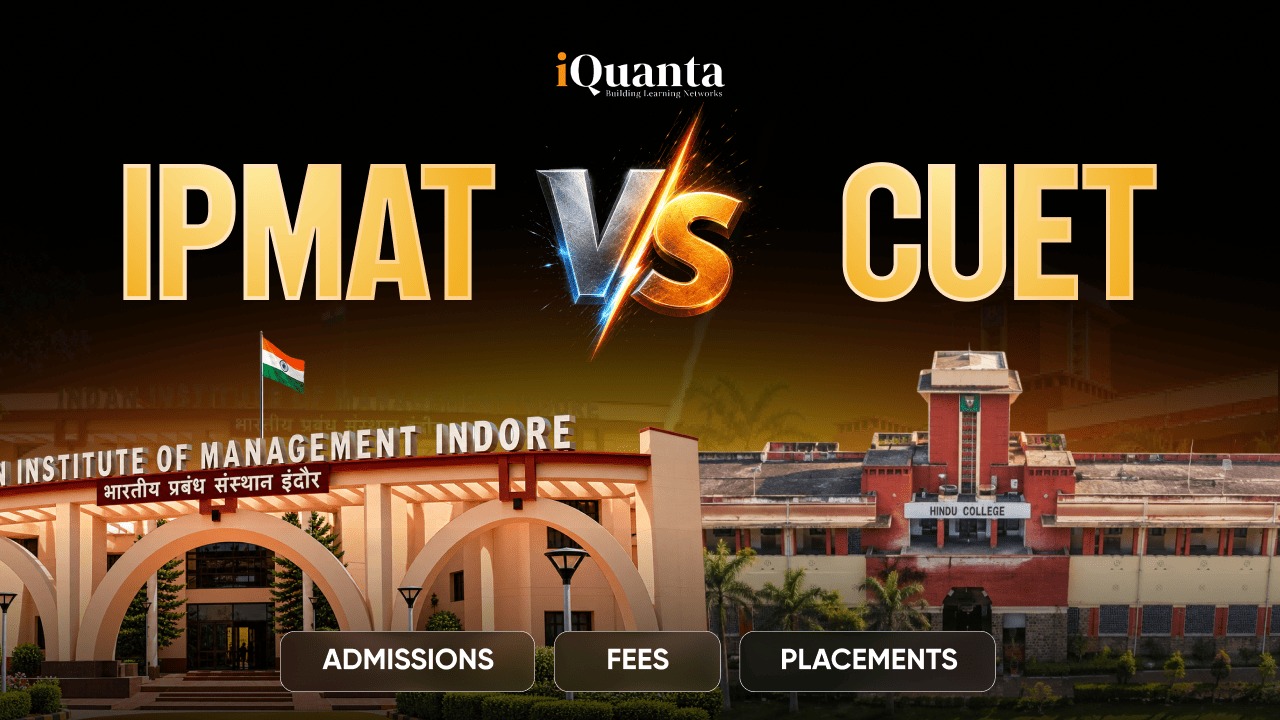
Choosing the right entrance exam after Class 12 is one of the most important decisions for students who want to build a career in management or business. With multiple entrance examinations available, students often get confused between IPMAT and CUET.
Both examinations provide opportunities to pursue undergraduate education from reputed institutions in India. However, their admission processes, exam patterns, college options and career opportunities are quite different.
If you are also confused about IPMAT vs CUET 2027, this guide will help you understand their differences and decide which entrance examination is more suitable for your career goals. Let’s explore everything you need to know about IPMAT and CUET.
Well, it is quite important to know for students that IPMAT Indore 2027 exam date is announced. The date of examination is 24 April 2027 (Saturday).
Join this free IPMAT preparation WhatsApp group to get free study material, strategies by toppers and experts, the latest updates and more
What is IPMAT?
IPMAT stands for Integrated Programme in Management Aptitude Test. It is commonly used to refer to entrance examinations for admission to five-year Integrated Programme in Management (IPM) courses offered by several institutions.
IIM Indore and IIM Rohtak conduct their own IPM aptitude tests. Meanwhile, IIM Jammu and IIM Bodh Gaya use JIPMAT (Joint Integrated Programme in Management Admission Test).
The five-year IPM programme combines undergraduate and postgraduate management education into one integrated course. It is designed for students who want to pursue management education immediately after Class 12.
There are three main examination through which various candidates can select colleges such as:
- IPMAT Indore
- IPMAT Rohtak
- JIPMAT
IPMAT 2027 Exam Pattern: Understand the Sections
Before starting IPMAT 2027 preparation, understand the difference between the IPMAT Indore and IPMAT Rohtak examination patterns.
IPMAT Indore Exam Pattern
- Quantitative Ability (MCQ)
- Quantitative Ability (Short Answer)
- Verbal Ability (MCQ)
- Total duration: 120 minutes
- Sectional duration: 40 minutes each
- Marking: +4 for correct answers and -1 for incorrect MCQs. No negative marking for Short Answer questions.
IPMAT Rohtak Exam Pattern
- Quantitative Ability: 40 questions
- Logical Reasoning: 40 questions
- Verbal Ability: 40 questions
- Total questions: 120
- Total duration: 120 minutes
- Marking: +4 for correct answers and -1 for incorrect answers.
Detailed Breakdown of IPMAT Indore 2027 Syllabus
Checking the IPMAT Indore syllabus can help you in your preparation. It helps you get familiar with the topics important for each section. There are a total of 3 sections in the exam, namely Quantitative Ability (MCQ), Quantitative Ability (SA) and Verbal Ability (MCQ). Mastering concepts of all these sections can help you perform well. Check the expected IPMAT Indore syllabus 2027 explained below.
IPMAT Indore Quantitative Aptitude Syllabus
| IPMAT Indore Quantitative Aptitude Syllabus | |
| Category | Topics |
| Number System | Finding Unit Digit, Cyclicity |
| Simplification, BODMAS | |
| Remainder Theorems | |
| HCF & LCM, HCF LCM of fractions | |
| Surds & Indices | |
| Concept of Factors | |
| Divisibility Rules in detail | |
| Factorials | |
| Mixed Questions with other topics | |
| Arithmetic | Percentages |
| Profit Loss & Discount | |
| Ratio & Proportion | |
| Partnerships | |
| Average | |
| Mixture & Alligation | |
| Simple & Compound Interest | |
| Time & Work | |
| Pipes & Cisterns | |
| Time, Speed & Distance | |
| Boats & Streams | |
| Relative Speed, Linear Races | |
| Trains | |
| Circular Tracks TSD | |
| Mixed Questions with other topics | |
| Algebra | Algebraic Identities |
| Linear Equations | |
| Quadratic and Cubic Equations | |
| Nature of Roots, Discriminant | |
| Inequalities | |
| Logarithms | |
| Functions | |
| Modulus Functions | |
| Arithmetic Progressions | |
| Geometric Progressions | |
| Maximum/Minimum Values of Functions | |
| Range & Domain of Functions | |
| Binomial Theorem | |
| Geometry & Mensuration | Lines & Angles |
| Triangles & Circles, Theorems | |
| Quadrilaterals & Areas | |
| Polygons and Internal, External Angles | |
| Regular Polygons | |
| Coordinate Geometry | |
| Mensuration (Surface Area and Volumes of 3D Figures) | |
| Higher Mathematics | Matrices & Determinants |
| Set theory & Venn Diagrams (3 set) | |
| Relations & Functions | |
| Sequence & Series (Arithmetic & Geometric Progressions) | |
| Permutation & Combination | |
| Inequalities, Domain & Range | |
| Probability | |
| Modulus Functions | |
| Binomial Theorem | |
| Equations of Lines & Circles | |
| Trigonometry, Height & distance-based questions | |
| Mean, Median & Mode | |
IPMAT Indore Verbal Ability & Reading Comprehension Syllabus
| IPMAT Indore Verbal Ability & Reading Comprehension Syllabus | |
| Category | Topics |
| Grammar | Noun & Pronoun |
| Adverb & Verb | |
| Prepositions | |
| Conjunctions | |
| Direct & Indirect Speech | |
| Figures of Speech | |
| Articles | |
| Sentence Correction | |
| Active – Passive Voice | |
| Poetic Devices | |
| Subject-Verb Agreement | |
| Reading Comprehension | The meaning of a particular word used in the passage |
| Tone of the author | |
| Tone of the passage | |
| Main Idea of the passage | |
| Reasoning based upon passage | |
| Idioms/Phrases from passage | |
| Other questions based on the Passage | |
| Verbal Ability | Error Spotting |
| Fill in the blanks | |
| Sentence Completion | |
| Para jumbles | |
| Sentence Improvement | |
| Vocabulary | Synonym & Antonyms |
| Spelling Errors | |
| One Word Substitution | |
| Phrasal Verbs | |
| Para completion | |
| Idioms & Phrases | |
| Odd one out | |
Detailed Breakdown of IPMAT Rohtak 2027 Syllabus
The IPMAT Rohtak syllabus is divided into three sections: Quantitative Ability, Logical Reasoning, and Verbal Ability. Identify important topics for every section and master them. You should clear the concepts of every topic so that you don’t get stuck on any question. The expected syllabus for all sections is shared below:
IPMAT Rohtak Quantitative Aptitude Syllabus
| IPMAT Rohtak Quantitative Aptitude Syllabus | |
| Category | Topics |
| Number System | Finding Unit Digit |
| Simplification | |
| Remainder Theorems | |
| HCF & LCM | |
| HCF LCM Of Fractions | |
| Surds & Indices | |
| Concept of Factors | |
| Divisibility Rules | |
| Factorial | |
| Arithmetic | Percentage |
| Average | |
| Age-based problems | |
| Partnership | |
| Profit Loss & Discount | |
| Ratio & Proportion | |
| Simple & Compound Interest | |
| Mixture & Alligation | |
| Time, Speed & Distance | |
| Boats & Streams | |
| Algebra | Algebraic Formulae |
| Linear Equations | |
| Cubic Equations | |
| Quadratic Equations | |
| Indices & Surds | |
| Trigonometry | |
| Logarithms | |
| Inequalities | |
| Geometry | Basics of Geometry |
| Lines & Angles | |
| Triangles | |
| Circles | |
| Quadrilaterals | |
| Polygons | |
| Coordinate Geometry | |
| Mensuration (Volume & Surface Area) | |
| Height & Distance based upon trigonometry | |
IPMAT Rohtak Verbal Ability & Reading Comprehension Syllabus
| IPMAT Rohtak Verbal Ability & Reading Comprehension Syllabus | |
| Category | Topics |
| Grammar | Noun & Pronoun |
| Adverb & Verb | |
| Prepositions | |
| Conjunctions | |
| Direct & Indirect Speech | |
| Figures of Speech | |
| Idioms & Phrases | |
| Etymology & Roots | |
| Articles | |
| Active – Passive Voice | |
| Subject-Verb Agreement | |
| Reading Comprehension | The meaning of a particular word used in the passage |
| Tone of the author | |
| Tone of the passage | |
| Main idea of the passage | |
| Inference-based questions | |
| Verbal Ability | Error Spotting |
| Fill in the blanks | |
| Sentence Completion | |
| Para jumbles | |
| Sentence Improvement | |
| Sentence Correction | |
| Vocabulary | Synonym & Antonyms |
| Spelling Errors | |
| One Word Substitution | |
| Odd one out | |
| Word Usage | |
| Analogy | |
IPMAT Rohtak Logical Reasoning Syllabus
| IPMAT Rohtak Logical & Verbal Reasoning Syllabus | |
| Category | Topics |
| Logical Reasoning | Number and Letter Series |
| Coding-Decoding | |
| Logical Sequence Series | |
| Cubes and Dices cutting and coloring | |
| Venn Diagrams | |
| Blood Relations | |
| Syllogism | |
| Clock and Calendars | |
| Input output | |
| Linear and Circular Seating Arrangement | |
| Bar Graphs and Table based DI Sets | |
| Line Charts & Pie Charts | |
| Data Sufficiency | |
| Mirror & Water Image | |
| Ranking | |
| Inequalities | |
| Distance & Direction | |
| Pattern based images | |
| Verbal Reasoning | Analogies |
| Statement & Conclusion | |
| Statement & Assumption | |
IPMAT vs CUET: Top Colleges in India
| S. No. | College / University | Location | Admission Exam / Route | Popular Programme |
|---|---|---|---|---|
| 1 | IIM Indore | Indore, MP | IPMAT Indore | Five-Year IPM |
| 2 | IIM Rohtak | Rohtak, Haryana | IPMAT Rohtak | Five-Year IPM |
| 3 | IIM Ranchi | Ranchi, Jharkhand | IPMAT Indore | Five-Year IPM |
| 4 | IIM Jammu | Jammu | JIPMAT | Five-Year IPM |
| 5 | IIM Bodh Gaya | Bodh Gaya, Bihar | JIPMAT | Five-Year IPM |
| 6 | University of Delhi | Delhi | CUET UG | B.Com, B.Com (Hons.), BA |
| 7 | Banaras Hindu University | Varanasi, UP | CUET UG | B.Com, BA, B.Sc |
| 8 | Jamia Millia Islamia | New Delhi | Programme-specific admission route | Selected UG programmes |
| 9 | Aligarh Muslim University | Aligarh, UP | Programme-specific admission route | Selected UG programmes |
| 10 | University of Allahabad | Prayagraj, UP | CUET UG | BA, B.Com, B.Sc |
| 11 | University of Hyderabad | Hyderabad, Telangana | Programme-specific admission route | Integrated and UG programmes |
| 12 | Babasaheb Bhimrao Ambedkar University | Lucknow, UP | CUET UG | BBA and other UG programmes |
| 13 | Dr. B.R. Ambedkar University Delhi | Delhi | CUET UG | BA and other UG programmes |
CUET Exam Pattern
According to the CUET UG 2026 information bulletin, the examination offered 37 subjects, including 13 languages, 23 domain-specific subjects and one General Aptitude Test.
The major components include:
- Language Test
- Domain-Specific Subjects
- General Aptitude Test
In 2026, candidates could select a maximum of five subjects. Each test paper contained 50 compulsory questions and had a duration of 60 minutes. The marking scheme awarded five marks for every correct answer and deducted one mark for every incorrect answer.
The CUET 2027 examination pattern should be confirmed through the upcoming NTA notification.
IPMAT or CUET: Which One Is Better?
Now comes the most important question: IPMAT or CUET, which is better?
The answer depends on your interests, academic strengths and long-term career goals.
Choose IPMAT if:
- You want to pursue management education immediately after Class 12.
- Your goal is to study at an IIM offering an integrated management programme.
- You are interested in business, finance, marketing or entrepreneurship.
- You are comfortable with quantitative aptitude and verbal ability.
Choose CUET if:
- You want to explore different undergraduate courses.
- You are interested in universities such as DU or BHU.
- You want flexibility while selecting your graduation programme.
- You are still exploring different academic and career options.
Final Words: IPMAT vs CUET 2027
Both IPMAT and CUET offer valuable opportunities for students after Class 12. However, neither examination is universally better than the other.
If you are clear about pursuing management education and want to enter an integrated programme at an IIM, IPMAT can be a suitable choice.
However, if you want to explore different undergraduate courses and universities before deciding on your career path, CUET can provide greater flexibility.
If you are eligible and interested in both pathways, consider preparing for both examinations. Understand their different syllabuses, check university eligibility requirements and create a preparation strategy accordingly.
Remember, the right entrance examination is not simply the one with the most popular college names. It is the one that takes you closer to your academic and career goals.