
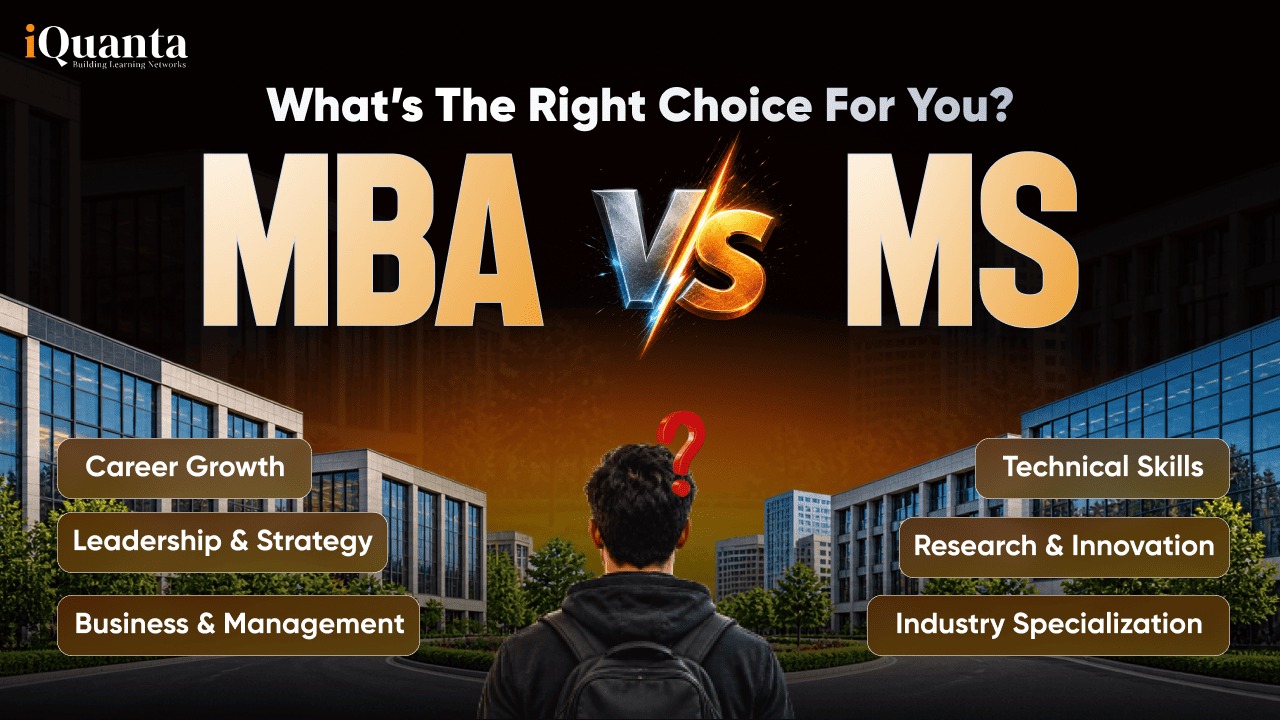
Choosing a postgraduate degree is a major life decision for any candidate. Both degrees offer stable career growth, good salary and professional development. However, it totally depends on the students which course to pursue as both are completely different from each other.
An MBA (Master of Business Administration) forms the backbone of business management, leadership and strategic decision-making. On the other hand, an MS (Master of Science) helps one to gain specialised expertise or knowledge in a particular academic, scientific, technical field. In this blog we have shared the details about which is better between an MBA and an MS, what is the career scope for the two, course duration, which offers better salary, and much more.
Join iQuanta’s diversified student community for free and prepare with other 4.1L+ peers. Get access to 24/7 doubt-solving, mentorship, free webinars, etc., all at one single platform.

MBA vs MS: Key Differences at a Glance
Before we discuss the major differences between MBA and MS, let us look at the major differences between the two on the basis of eligibility, duration of course, job opportunity, and more.
| Comparison Parameter | MBA | MS |
| Full Form | Master of Business Administration | Master of Science |
| Primary Focus | Business management and leadership | Specialized technical or academic knowledge |
| Employment Opportunities | Opens doors to finance, consulting, operations, investment banking, private equity, etc. | Provides opportunities in engineering, math and sciences, and computer science |
| Duration | Usually 2 years in India | Usually 1–2 or 3 years |
| Eligibility | Bachelor’s degree in any discipline | Bachelor’s degree, generally in a relevant field |
| Entrance Exams Accepted | CAT, XAT, GMAT, NMAT, CMAT, etc. | GRE, GMAT, GATE, or university-specific tests, depending on the programme |
| Work Experience | Preferred or required for specific programs | Usually optional |
| Learning Approach | Case studies, projects, internships, presentations, and group discussions | Technical coursework, laboratory work, research, and projects |
| Career Opportunities | Business management, product management, investment banking, consulting | Software engineering, data science, research, engineering, and specialist roles |
What is an MBA?
An MBA, or Master of Business Administration, is an advanced degree obtained after completing graduation. During the course of MBA, one gains hands- on knowledge through practical experiences, case studies, and internships. It gives an understanding of business disciplines such as finance, marketing, operations, economics, business analytics and much more. It nables students to gain knowledge and skills necessary to excel in organisational leadership roles. MBA in India is a two year programme that combines classroom learning, internships, live projects and much more.
What is the MBA Course Curriculum in India?
Students can choose an MBA specialisation based on their interests, academics, and long-term career goals in the following disciplines:
- Finance
- Marketing
- Operations
- Business Ethics
- Human Resource Management
- Entrepreneurship
- Business Law
- Information Technology
- Supply Chain Management
- International Business
MBA Entrance Exams in India
Candidates need to be a graduate in any discipline from a recognised university to pursue an MBA. Candidates can take the following given MBA entrance tests:
- CAT (Common Admission Test): Primarily accepted by IIMs and several leading B-schools.
- XAT (Xavier Aptitude Test): Accepted by XLRI and several other management institutes.
- GMAT (Graduate Management Admission Test): Accepted by various Indian and international business schools. It is the best for those who are willing to pursue an MBA abroad.
- NMAT: Accepted by NMIMS and other participating institutions.
- CMAT: Accepted by several AICTE-approved management institutions.
The admission to leading MBA programmes may also involve Written Ability Tests (WAT), Group Discussions (GD), Personal Interviews (PI), academic performance, and work experience depending upon the B school they are willing to take admission in.
What is an MS Degree?
An MS, or Master of Science, is a postgraduate degree that is offered after graduation. Students who wish to develop advanced knowledge and skills in a particular subject often pursue this. One can pursue an MS in scientific fields such as biology, mathematics, statistics, engineering, economics, etc. In the business realm, MS degrees focus on finance, data analytics, accounting, management, etc. MS programmes are usually offered by universities in India and abroad.
Popular MS Specialisations
Some of the most popular MS specialisations include the following:
- MS in Computer Science
- MS in Data Science
- MS in Mathematics and Statistics
- MS in Mechanical Engineering
- MS in Electrical Engineering
- MS in Biotechnology
- MS in Finance
MS Entrance Exams
The MS eligibility usually depends upon the university and specialization that one wants to pursue. Some universities may also consider Statements of Purpose (SOP), Letters of Recommendation (LOR), research experience, and relevant work experience during admission.
Some commonly accepted entrance examinations include:
- GRE: Accepted by several international universities for postgraduate admissions, depending on the programme.
- GMAT: Required or accepted by certain business and management-oriented MS programmes.
- GATE: Accepted by several Indian and well as foreign institutes for postgraduate engineering and technical programmes.
- IELTS/TOEFL: English proficiency examinations commonly required by universities abroad.
MBA vs MS: Salary Comparison
Salary is one of the most important factors that students usually look for while choosing between an MBA and MS. Apart from other factors also play a key role such as long term career prospects, one’s interest, job profile, etc.
An MBA from a reputed B-school offers demanding opportunities in consulting, investment banking, product management, strategy, and general management. Similarly, an MS in a specialised field can lead to lucrative technical and analytical positions.
MBA Salary in India
The salary after an MBA varies based on the B schools from where he/she has graduated from. Most often an MBA from tier 1 colleges such as IIMs usually attradct huge salaries along with international placements.
Here is an indicative comparison of MBA salary outcomes:
| B-School | Placement Year | Median/Reported Average Salary |
| IIM Ahmedabad | 2025 | ₹34.59 LPA (Median) |
| IIM Bangalore | 2025 | ₹34.88 LPA (Average) |
| IIM Bodh Gaya | 2026 | ₹14.80 LPA (Average) |
| IIM Ranchi | 2025 | ₹19.29 LPA (Average) |
MS Salary in India
The salary for an MS graduate in India heavily depends on the college and chosen specialisation. Students who graduate with an MS in Computer Science, Data Science, Artificial Intelligence, or Engineering often find job opportunities in technology companies, research organisations, financial institutions,etc.
Career Opportunities After an MBA
After completing an MBA from a top B school, one can find job opportunities in the related fields. Graduates can get opportunities across consulting, banking, finance, technology, healthcare, e-commerce, manufacturing, and other sectors. Some of the most popular career roles after an MBA include the following:
- Management Consultant
- Investment Banker
- Marketing Manager
- Financial Analyst
- Business Development Manager
- Operations Manager
- Product Manager
- HR Manager and so on
Some of them even reach the position of General Manager or CFO levels.
Career Opportunities After an MS
After completing an MS degree in the relevant field, one can get the following roles.
- Software Engineer
- Data Scientist
- AI/ML Engineer
- Research Scientist
- Mechanical Engineer
- Cybersecurity Analyst
- Researcher, and so on
MBA vs MS: Which Degree Has Better Career Scope?
When it comes to comparing career scope between MBA and MS, it is important to understand one’s professional flexibility and long term interest.
A degree in MBA opens up opportunities across multiple industries and business functions while an MS degree leads to building a career around a particular technical and academic field.
Thus, one should select the one which is best suited for long term goals rather than chasing salary.
Choose an MBA If:
- You want to build a career in business management, consulting, finance, or marketing.
- You want to move into a business-oriented position.
- You want to develop an understanding of different business functions.
- You are interested in entrepreneurship, business strategy, or general management.
Choose an MS If:
- You want to specialise in academics or technical discipline.
- You enjoy research, experimentation, and technical problem-solving.
- You want to build a career in software engineering, AI, data science
- You are interested in pursuing a PhD or an academic career
- You want to build your career in research
Conclusion
When it comes to choosing between an MBA and an MS, one should consider their long term career goals, interest and skills. An MBA gives understanding of business functions and prepares students to take up roles in management, consulting, finance, marketing, entrepreneurship, and leadership. An MS, on the other hand, is best suited for those who want to gain specialised knowledge and build careers in technical, scientific, analytical, or research-oriented fields.
Indian students who are looking to build a career in management can pursue an MBA. Ultimately, the choice depends upon the student. One should not only consider the salary package while choosing between an MBA and MS, but also how it aligns with long term professional goals and growth.