
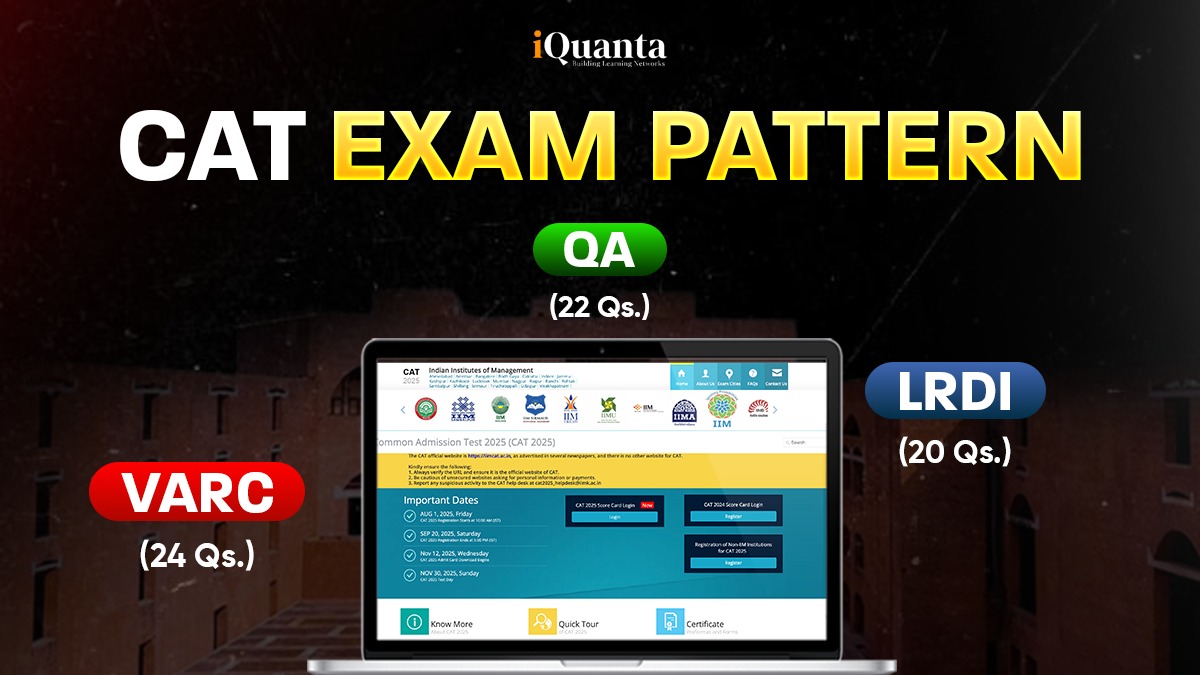
CAT Exam Pattern: Preparing for the Common Admission Test requires a strategic approach because the competitive exam tends to be more focused towards a problem-solving approach. Candidates should start with understanding the CAT exam pattern, and this will definitely help them later in covering further components. The CAT exam is a combination of three sections which are aligned in the respective order where VARC comes initially, followed by DILR and QA. We have seen slight changes in both number of questions and time duration by comparing the past seven years’ CAT exam papers. So, relatively, candidates should capture good knowledge about the types of questions asked in the CAT exam, what topics are carrying high weightage across sections overall as well as sectional time limits, and most importantly, what should be the marking scheme for attempting the Common Admission Test?
These relevant questions will be good starting points for candidates if captured early for CAT preparation. This blog is a comprehensive guide about the CAT exam pattern and important facts related to the key topics across VARC, DILR and QA. Let’s discuss this part in a detailed manner which will be helpful for the candidates if they are planning to target CAT 2026.
Join iQuanta’s diversified student community for free and prepare with other 4.1L+ peers. Get access to 24*7 doubt-solving, mentorship, free webinars, etc all at one single platform.

What is the CAT exam pattern?
The CAT exam pattern will be judged based on various components like total sections, mode of giving the CAT examination, tenure of attempting all the sections, slots & exam timings, total number of questions expected in the CAT 2026 exam, and distribution of questions in the form of MCQs and non-MCQs. The details about all the important factors for the CAT exam pattern are specified in the table given below. Candidates should refer to the table.
| Total Sections in the CAT Exam | 3 VARC (Verbal Ability & Reading Comprehension) DILR (Data Interpretation & Logical Reasoning) QA (Quantitative Ability) |
| Mode of CAT Examination | Computer Based Test |
| CAT Exam Duration | 120 minutes 40 minutes per section |
| CAT Exam Slot Timings | Morning: 8:30 AM to 10:30 AM Afternoon: 12:30 PM to 2:30 PM Evening: 4:30 PM to 6:30 PM |
| Total Questions in CAT 2026 (expected) | 68 |
| Total marks in the CAT Exam | 204 |
| Medium of CAT Exam Paper | English |
| Type of Question in CAT Exam | MCQ and non-MCQ |
Different Components in the CAT Exam Pattern
It is quite important for the candidates to understand the exam pattern for the CAT exam to go with the streamlined flow. This entire structure covers several components, including total sections such as Verbal Ability & Reading Comprehension, Data Interpretation & Logical Reasoning and Quantitative Ability. Let’s discuss all the important components of the CAT exam pattern specified separately.
Total Sections in the CAT Exam
The CAT exam pattern has three major sections divided across Verbal Ability & Reading Comprehension, Data Interpretation & Logical Reasoning and Quantitative Ability.
| Total Sections in the CAT Exam | Full Form |
| VARC | Verbal Ability & Reading Comprehension |
| DILR | Data Interpretation & Logical Reasoning |
| QA | Quantitative Ability |
Number of Questions Asked as per the CAT Exam Pattern
As per the past year’s CAT exam paper analysis, VARC covers 24 questions, and DILR & QA both cover 22 questions. We are expecting the same CAT exam pattern in CAT 2026.
| Total Sections in the CAT Exam | Number of Questions Asked |
| VARC | 24 |
| DILR | 22 |
| QA | 22 |
Overall and Sectional Time Limit in the CAT Exam
This section covers the overall and section time limits, which again turned out to be an important component of the CAT exam pattern.
| Section in the CAT Exam | Time Limit |
| Quantitative Aptitude | 40 Minutes |
| Verbal Ability and Reading Comprehension | 40 Minutes |
| Data Interpretation and Logical Reasoning | 40 Minutes |
| Total | 120 Minutes |
CAT Exam Pattern: Timings & Slots
| CAT Exam Slot Timings | Morning: 8:30 AM to 10:30 AM Afternoon: 12:30 PM to 2:30 PM Evening: 4:30 PM to 6:30 PM |
CAT Marking Scheme 2026
If we are talking about the marking scheme for the CAT exam, the consistency for the same has already been maintained, where candidates will be assigned +3 marks for every correct response, -1 will be marked as the incorrect response and no points in case of unattempted. Candidates should practise questions during mock tests to better understand the marking scheme of the Common Admission Test. The detailed information about the same is specified below.
| Section | Number of Questions | Time Limit | Every Correct Response | CAT Marking Scheme For Incorrect Response | Unanswered Questions |
| Quantitative Aptitude | 22 | 40 Minutes | +3 | -1 | 0 |
| Verbal Ability and Reading Comprehension | 24 | 40 Minutes | +3 | -1 | 0 |
| Data Interpretation and Logical Reasoning | 22 | 40 Minutes | +3 | -1 | 0 |
| Total | 68 | 120 Minutes | – | – | – |
CAT Exam Pattern & Detailed Syllabus Across Sections
When we are talking about capturing in-depth knowledge about a particular section in the CAT exam, then major consideration will be given to the CAT exam pattern across sections and the in-depth CAT syllabus. Let’s discuss all the sections separately to clarify components.
CAT Exam Pattern for Verbal Ability & Reading Comprehension
The very first section which is taken into consideration is Verbal Ability & Reading Comprehension, where the sectional time limit is fixed at 40 minutes and the number of questions asked, as per the updated information, is 24. The detailed topic should be carefully covered by the candidates who are termed as Reading Comprehensions (with varied genres), Para Summary, Para Completion, Odd One Out and Para Jumbles.
| Particulars | Details |
| VARC Section Time Limit | 40 minutes |
| Number of Questions Asked (Updated) | 24 |
CAT Exam Pattern for Data Interpretation & Logical Reasoning
DILR covers the 40-minute sectional time limit and 22 questions asked in this section as per the latest information. Candidates should cover topics such as tables, line & bar graphs, pie charts, quant-based DI, cubes, linear arrangements, circular arrangements, Venn diagrams, distribution, selection, binary logic, games & tournaments, and network flow diagrams to get done with the syllabus of DILR alongside practice sessions.
| Particulars | Details |
| DILR Section Time Limit | 40 minutes |
| Number of Questions Asked (Updated) | 22 |
CAT Exam Pattern for Quantitative Ability
Quantitative Ability covers the CAT exam pattern where 40 minutes refer to the sectional time limit and a total of 22 questions are asked as per the updated information. The major topics covered in Quantitative Ability are Number System, Modern Maths, Arithmetic, Algebra, and Geometry. Candidates should have a look at the detailed information specified in the table below.
| Particulars | Details |
| QA Section Time Limit | 40 minutes |
| Number of Questions Asked (Updated) | 22 |
CAT Exam Pattern Over the Years: Comparative Analysis
This section covers the comparative analysis of the CAT exam pattern by considering factors such as the total number of questions asked in the CAT exam as well as the total time duration. The detailed table about the same is specified below.
| Year | Total Questions in the CAT Exam | Time Duration |
| CAT 2026 (Tentative) | 68 | 2 hours |
| CAT 2025 | 68 | 2 hours |
| CAT 2024 | 68 | 2 hours |
| CAT 2022 | 66 | 2 hours |
| CAT 2021 | 66 | 2 hours |
| CAT 2020 | 76 | 2 hours |
| CAT 2019 | 100 | 3 hours |
| CAT 2018 | 100 | 3 hours |
| CAT 2017 | 100 | 3 hours |
| CAT 2016 | 100 | 3 hours |
| CAT 2015 | 100 | 3 hours |
| CAT 2014 | 100 | 2.50 hours |
Conclusion: CAT Exam Pattern
So, overall, the CAT exam pattern is an integral part of your exam preparation journey, where understanding the various components, such as total sections; the mode of CAT examinations; sectional as well as overall time limits; the total number of questions; and more will create a significant impact. It is indispensable for the students to clarify different parts as a strategic move.
If you are targeting a 99+%ile in CAT 2025, iQuanta has got you covered. Get highly relevant content along and prepare right from the very basics with iQuanta’s CAT course. iQuanta has made a record with 600+ 99 percentilers in CAT 2025.

CAT Exam Pattern 2026 FAQs
There are three major sections covering VARC, DILR & QA.
The total time for the CAT exam is 2 hours or 120 minutes.
The updated CAT paper pattern involves a total of 68 questions with a total time duration of 2 hours or 120 minutes.
There are a total of 22 questions asked in the Quantitative Ability section.
The CAT exam paper is conducted as a Computer Based Test (CBT).
The questions are classified as MCQs and non-MCQs as per the exam paper pattern of CAT.
The sectional time limit is equally divided across VARC, DILR and QA in the CAT exam. The time duration for each section is 40 minutes.
The sections in the CAT examination are VARC, DILR and QA. Although, these are aligned in the same order.