Getting 99+ percentile in the CAT exam is not an easy game although requires a consistent efforts across all the sections whether it is Verbal Ability & Reading Comprehension, Data Interpretation & Logical Reasoning and Quantitative Ability. The CAT topper started his journey with ambition, confusion and overwhelming syllabus and initially underestimate the exam thinking raw intelligence would be enough but later he joined iQuanta and the mock test series became a turning point. According to the CAT topper, the biggest difference was not just content, but direction. The structured approach to Quant rebuilt his fundamentals, while DILR practice trained him to think in terms of set selection rather than blind solving. This blog is an inspiring journey of a iQuanta’s CAT topper Rajan Nathani who initially struggled with mocks and later scored an impressive 99.90 percentile with iQuanta.
Join iQuanta’s diversified student community for free and prepare with other 4.1L+ peers. Get access to 24*7 doubt-solving, mentorship, free webinars, etc all at one single platform.

CAT Topper Scored Overall 99.90 Percentile & 99.95 in VARC !
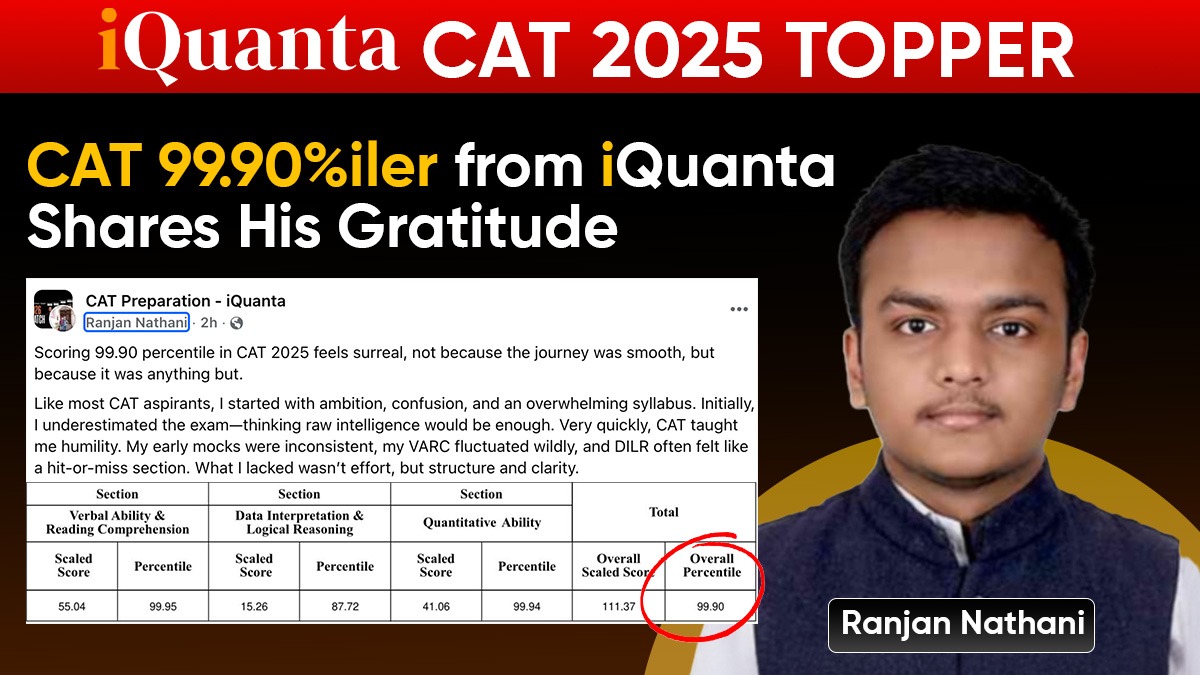
Getting such an impressive result in CAT 2025 is a perfect combination of consistent efforts, dedication, and hardwork. The overall percentile scored is 99.90 with a scaled score of 111.37. Now, let’s talk about the sectional percentile, where he scored 99.95 in Verbal Ability & Reading Comprehension, 87.72 percentile in Data Interpretation & Logical Reasoning and 99.94 percentile in Quantitative Ability. The detailed result is mentioned of a CAT topper is mentioned below.

CAT Topper 2025 – Rajan Nathani’s Success Story
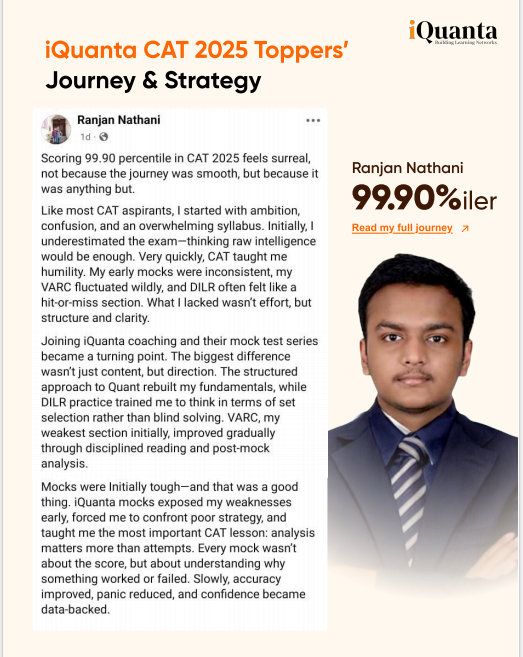
CAT Topper: “Scoring 99.90 percentile in CAT 2025 feels surreal, not because the journey was smooth, but because it was anything but.
Like most CAT aspirants, I started with ambition, confusion, and an overwhelming syllabus. Initially, I underestimated the exam but thinking raw intelligence would be enough. Very quickly, CAT taught me humility. My early mocks were inconsistent, my VARC fluctuated wildly, and DILR often felt like a hit-or-miss section. What I lacked wasn’t effort, but structure and clarity.
Joining iQuanta coaching and their mock test series became a turning point. The biggest difference wasn’t just content, but direction. The structured approach to Quant rebuilt my fundamentals, while DILR practice trained me to think in terms of set selection rather than blind solving. VARC, my weakest section initially, improved gradually through disciplined reading and post-mock analysis.
Mocks were Initially tough and that was a good thing. iQuanta mocks exposed my weaknesses early, forced me to confront poor strategy, and taught me the most important CAT lesson: analysis matters more than attempts. Every mock wasn’t about the score, but about understanding why something worked or failed. Slowly, accuracy improved, panic reduced, and confidence became data-backed.
There were phases of self-doubt, days when scores dipped, and moments where quitting felt tempting. What kept me going was trusting the process showing up daily, refining strategy, and learning from mistakes rather than reacting emotionally.
On CAT day, the exam felt familiar. Not easy but manageable. I wasn’t chasing attempts; I was executing a plan.
This 99.90 percentile is not just a number. It represents discipline over motivation, consistency over intensity, and learning over ego. The journey taught me far more than aptitude it taught me patience, resilience, and belief in structured preparation.
To every aspirant reading this: progress is rarely linear, but it is inevitable if the process is right.”