

Are you preparing for CAT 2026 but finding Quant tough? You are not alone in this. Many students with a non-math background face this obstacle. They find formulas confusing. It seems impossible for a few students to balance speed and accuracy. But the right approach and guidance can change the game. This is where iQuanta steps in. It offers a customised Quant module that helps you build strong fundamentals. They provide practice sessions and 24X7 doubt-solving support. Solid preparation can improve your chances of excelling in this section. Look below for the CAT Quants strategy for non-math students. It covers a detailed approach and the best course to ace the CAT Quant 2026.
Join this free WhatsApp group to get the latest information about CAT exam along with the strategies by CAT experts

Why are Aspirants Weak in CAT Quant?
Many Non-Math aspirants find the CAT Quants section challenging. The key reasons are a gap in concepts, low accuracy, a lack of strategy, etc. Look below to know why students are weak in the CAT Quant section:
- Gaps in Foundation: Many non-math students fail to revise basic topics from classes 6 to 10. It includes numbers, basic geometry, algebra, etc. That is why they find CAT-level questions complicated.
- Fear: Students feel underconfident during the preparation. They think, “I’m just not good at it.” This often makes them avoid studying maths. This fear leads to inconsistency and skipping topics at minor inconvenience.
- Low Accuracy under Time Pressure: Students make silly mistakes under time pressure. Those who don’t analyse their mistakes tend to repeat them.
- No Feedback: Confusion grows when students fail to resolve their doubts. Practising mistakes without reviewing them can lower your progress.
CAT Quants Strategy for Non Math Students
Non-Math students should adopt a smart approach to prepare well for the CAT Quant section. Look at the detailed CAT Quants Strategy to maximise your chances of success in the exam.
Analyse the CAT Exam Syllabus
The first CAT Quants Strategy is to examine the CAT syllabus. This allows you to find relevant chapters. Focusing only on exam-specific topics helps you get enough study time for revision and practice. Look at the CAT Quant syllabus based on previous paper analysis and question papers:
| Topic Category | Sub-topics Covered |
| Arithmetic | Percentages, Profit & Loss, Ratio, Time-Speed-Distance, Time & Work |
| Algebra | Linear/Quadratic Equations, Inequalities, Functions |
| Geometry | Lines, Angles, Triangles, Circles, Mensuration |
| Number System | HCF & LCM, Remainders, Base Systems |
| Modern Math | Permutations & Combinations, Probability, Set Theory |

Develop Phase-Wise Strategy
You should build an effective CAT Quants Strategy to prepare well. You can divide your preparation plan into 3 phases. This includes Foundation & Concept Building, Application & Problem Solving and Mocks & Revision. If you start the CAT 2026 preparation now, you can easily allocate 12 months to your studies. Here is the best strategy for the CAT Quant section:
| Phase | Duration | Focus |
| Foundation & Concept Building | 4 to 5 months | Rebuild school-level math. Cover easy topics. Build speed in solving basic questions. |
| Application & Problem Solving | 4 months | Apply concepts when solving topic-wise questions. Solve medium and advanced CAT questions. Practice mixed topics and sectional tests. |
| Mock Integration & Refinement | 3 to 4 months | Attempt Full mocks. Analyse your performance. Improve weak areas. |
CAT Quant Study Plan
A solid CAT Quant study plan can simplify your preparation. It can help you maintain a proper balance between learning and practice. The sample 6-month plan for students weak in Quant is as follows:
| Month 1 | Week 1-2: Focus on Numbers and Basic Mathematics Topics |
| Watch conceptual videos, prepare notes, and practice topic-wise questions. | |
| Week 3: Focus on Rato, Proportion, Decimals, | |
| Week 4: Percentages, Averages | |
| Utilise Sunday for revision and practicing questions. | |
| Month 2 | Week 5-6: Simple & Compound Interest, Clocks, Discount |
| Week 7: Time, Speed, Work, Profit & Loss | |
| Week 8: Calendar, Pipes & Cisterns | |
| Weekly topic-wise tests + error analysis | |
| Month 3 | Week 9-10: Algebra basics |
| Week 11: Quadratic equations, Geometry basics | |
| Week 12: Logarithms and advanced problem-solving | |
| Begin solving small quizzes every weekend | |
| Month 4 | Week 13: Geometry basics and advanced questions |
| Week 14: Circles, coordinate geometry | |
| Week 15: Mensuration | |
| Week 16: Basic and advanced trigonometry | |
| Solve One sectional quant test every week | |
| Month 5 | Week 17-18: Number systems |
| Week 19: Permutation & Combination, Probability | |
| Week 20: Modular arithmetic, set theory | |
| Mixed topic tests every weekend | |
| Month 6 | Week 21-22: Algebraic manipulations, inequalities |
| Week 23: Geometry & Algebra topics, mixture problems | |
| Week 24: Mixed mocks, start practicing moderate difficulty questions | |
| 1-2 full quant sectional mocks every week |
Note: You can slowly move to challenging questions in the 7th week of preparation. You must also increase the frequency of taking mocks.
Concept Building
The CAT QA Section cover basic maths topics based on the Class 9th and 10th syllabus. Thus, you should achieve mastery in every topic to perform well in this section. This is where iQuanta excels. They provide interactive live sessions that help you clarify concepts of every topic. They also offer topic-wise assignments and instant doubt-solving support.
Application-Based Classes
Clearing only the Quant concepts is not enough. You should also know how to apply concepts and solve questions accurately under time pressure. iQuanta offers application-based sessions in its course. Students first revise the concepts covered in the live sessions. Then, solve CAT-level questions in the application classes. This approach can make their concepts strong.

Understand Topic-Wise Weightage
You must review the topic-wise weightage of the CAT Quant section. This helps you recognise chapters with maximum questions and difficulty level. The CAT Quant section consists of 22 questions, with more focus on Arithmetic and Algebra. Look at the CAT topic-wise weightage over the years shared below.
| Topic Name | Slot 1 | Slot 2 | Slot 3 |
| Number System | 3 | 2 | 3 |
| Logarithms, Surds and Indices | 2 | 2 | 3 |
| Inequalities and linear equations | 1 | 2 | 2 |
| PnC and Probability | 0 | 1 | 0 |
| Quadratic Equations | 2 | 2 | 0 |
| Averages, Ratios and Proportion | 5 | 4 | 3 |
| Time, Work and Distance | 2 | 2 | 3 |
| Profit, Loss and Interest | 2 | 2 | 3 |
| Geometry | 3 | 2 | 3 |
| Progressions and Series | 2 | 1 | 2 |
| Functions and Graphs | 1 | 2 | 2 |
Take Sectional Tests
Start attempting sectional mocks after building the basics and completing practice assignments. This will help you understand real test conditions and difficulty level. iQuanta offers 45 sectional mocks that mimic CAT-level questions. They also offer mock analysis and video solutions. After attempting sufficient sectional mocks, one can start attempting full-length mocks. This approach can improve your accuracy and time management skills.
Revision
The next CAT Quants Strategy is to maintain a weak topic bank. It helps you revisit all the topics that you are weak in. You should revise all the formulas regularly to solve complex questions accurately. Memorise shortcuts to improve your calculation skills.
iQuanta CAT Course 2026

How to Integrate the iQuanta Module in CAT Quants Strategy?
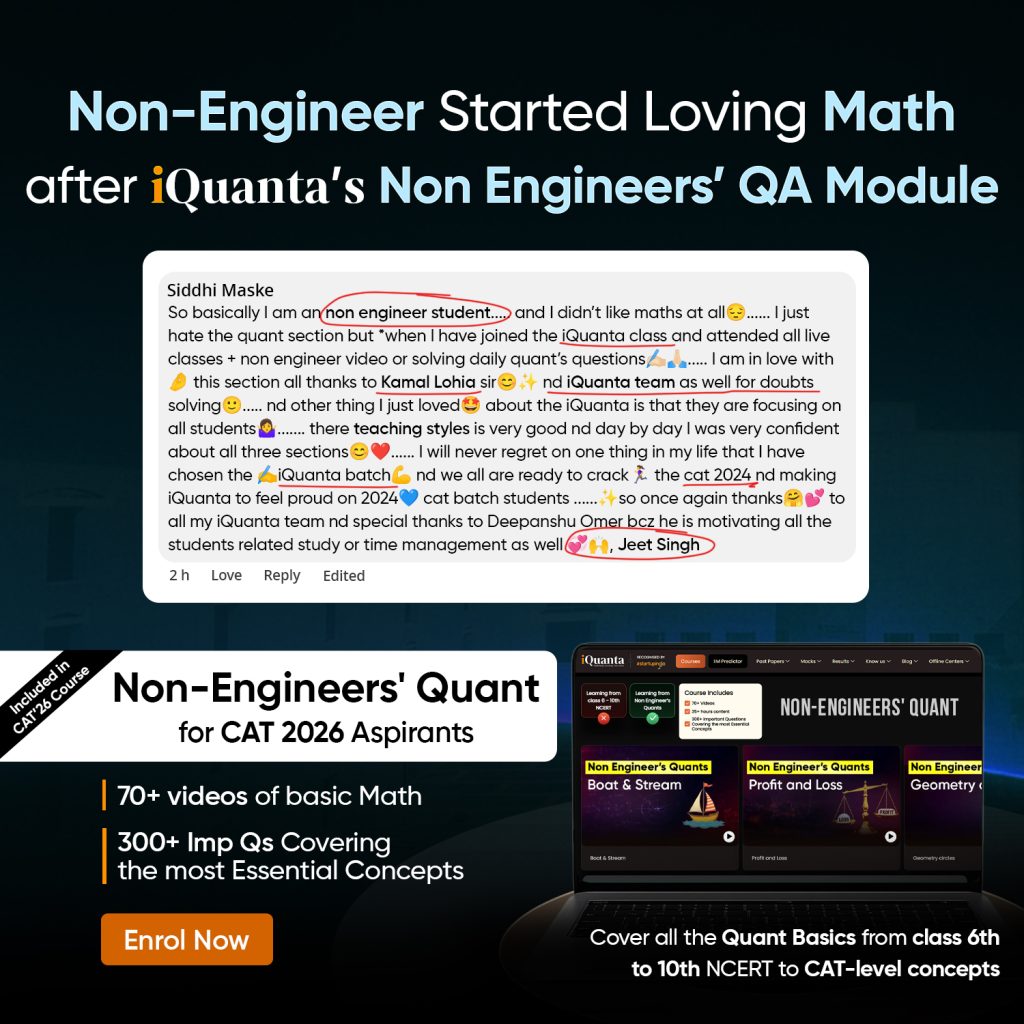
iQuanta Quant modules are a one-stop solution for students who are weak in Maths. This module covers both basic and advanced sessions. Their Non-Engineer CAT module offers 80+ hours of conceptual videos. It is ideal for students who wish to understand concepts from scratch. These modules are made available on the student’s dashboard upon enrolling in the iQuanta CAT course. They also offer the Quant advanced module that helps candidates master all the CAT-level questions. Learn how to integrate iQuanta Quant modules in your study plan:
- Start with their Non-Engineer QA videos for each topic. Jot down important concepts and solve their concept-level assignments. This can strengthen your fundamentals and problem-solving skills.
- Use iQuanta’s application class to learn how to apply concepts in solving exam-level questions.
- Solve iQuanta’s topic-wise assignments daily. This will help you track your progress level. It can also strengthen your weak areas.
- Begin sectional sets and practice sessions offered by iQuanta. Use their mock analysis and video solution to review your mistakes.
- Take full mocks after completing 60% of the Quant syllabus. Review the mock analysis report to discover your strengths and shortcomings.
- iQuanta also offers 24X7 doubt-solving sessions. If you are stuck on a concept or question, you can post your doubts. You will get the solution within seconds.