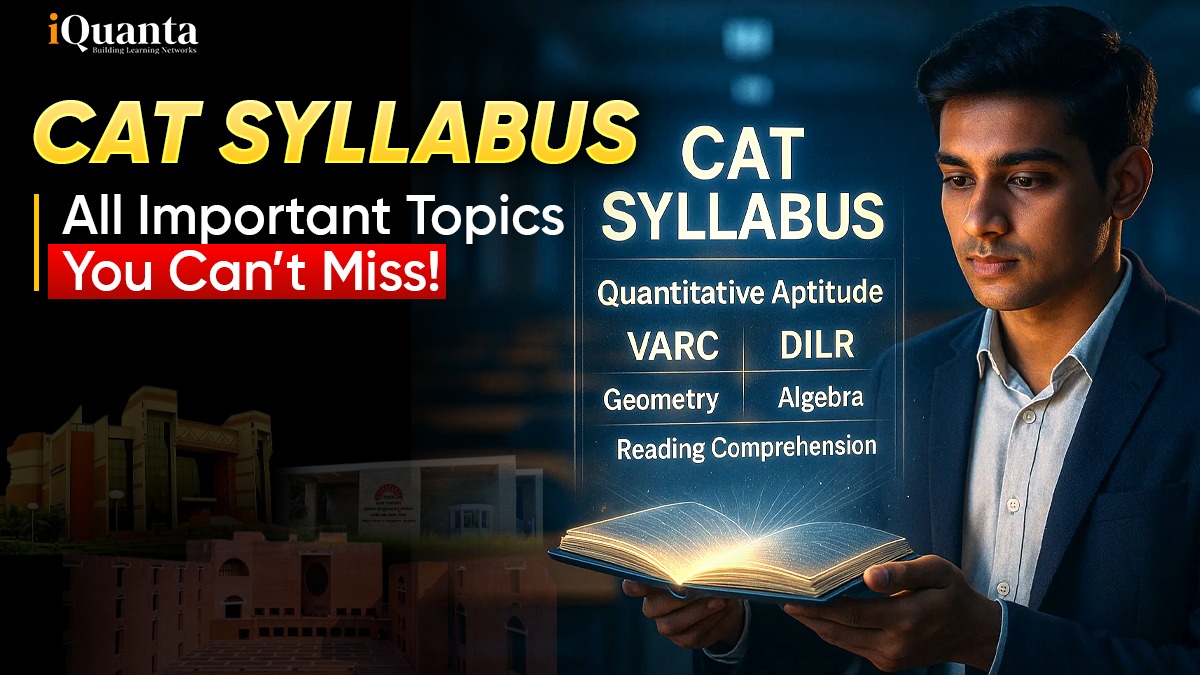
CAT Syllabus (Latest): Aspirants should integrate only the latest CAT exam syllabus when planning the strategy. It covers three subjects, namely Verbal Ability and Reading Comprehension (VARC), Data Interpretation and Logical Reasoning (DILR), and Quantitative Ability (QA). It enables candidates to cover only the topics that are important for the entrance test. The CAT syllabus PDF comprises all the exam-specific topics, chapter-wise weightage, recurring questions, and other details. As per the recent information in CAT exam pattern, VARC carries 24 questions, and DILR & QA carry 22 questions each. To excel in all the sections, it is important to make the most of the latest CAT syllabus for MBA. To help, we have shared below the latest syllabus for the CAT exam based on the latest exam format and previous year exam analysis.
This blog is a complete guide about CAT syllabus 2026 and the important topics that candidates should covered for the streamlined CAT preparation strategy and ofcourse for a good start.
Join iQuanta’s diversified student community for free and prepare with other 4.1L+ peers. Get access to 24*7 doubt-solving, mentorship, free webinars, etc all at one single platform.

What is the CAT Syllabus for MBA?
The CAT exam syllabus for MBA covers all the relevant topics across all the sections. You must check the latest syllabus and pattern before commencing your CAT preparation. Each section is divided into a wide range of topics that assess the candidate’s verbal skills, numerical aptitude and critical thinking ability. The CAT VARC syllabus includes RCs, Odd One Out, Para Summary, Para Jumbles, etc. However, the CAT Quant syllabus covers areas like Average, Ratio, Mixture & Alligation, Profit & Loss, SI CI, Percentages, TSD & Time and Work, Geometry, etc. While the CAT DILR syllabus involves areas like Tables, Cubes, Line & Bar Graphs, Linear Arrangements, Pie Charts, Circular Arrangements, Quant Based DI, Venn Diagrams, etc. You should build a strong grip in every chapter to maximize your chances of success in the exam. Continue reading to download the latest CAT Syllabus PDF on this page.
CAT Syllabus- Highlights
The CAT exam is one of the highly competitive entrance tests conducted every year. It is a gateway to get MBA admissions in IIMs and other leading colleges. Let’s discuss below the weightage and key topics covered in the CAT syllabus PDF based on past trends:
- VARC syllabus for CAT is often divided into two parts, i.e. Reading Comprehension (RC) and Verbal Ability. VA covers Para Jumbles, Para Summary, Odd Sentence Out, etc. RC comprises approximately 16 questions. Verbal Ability consists of nearly 8 to 9 questions approximately. The weightage of RC and VA is around 24% and 10%, respectively.
- DILR also has two sub-parts. Data Interpretation covers Graphs, Tables, Charts, Caselets, etc. Logical Reasoning covers Arrangements, Puzzles, Syllogism, etc. Each consists of about 11 questions with 16%.
- QA covers a wide range of topics. Arithmetic & Algebra covers Averages, Percentages, and Linear Equations. It also includes Geometry & Menstruation and Number Systems & Modern Math. About 14 questions were asked in Arithmetic & Algebra with nearly 34%. Geometry and Number System approximately comprises 3 questions each with 6% weightage.
Latest Changes in CAT Syllabus
The CAT syllabus has undergone many changes in recent years. However, there are no changes in the subject and marking scheme. It covers three main subjects. They are Verbal Ability and Reading Comprehension (VARC), Data Interpretation and Logical Reasoning (DILR), and Quantitative Ability (QA). Look at the latest changes in the CAT syllabus for MBA:
- The overall CAT questions as per the latest analysis are 68 and we are expecting the same pattern in CAT 2026 too.
- Expecting total 24 questions in VARC and 22 in both DILR & QA.
Note: The facts and figures are mentioned here as per the analysis of recent exam and this exam pattern might change in the future.
Types of Questions Covered in the CAT Syllabus
Knowing the high-priority topics in the CAT exam is crucial. It helps candidates identify high-weightage chapters across all the sections. This helps them plan their strategy accordingly. They should commence their preparation at the earliest to cover the syllabus on time. This helps them get sufficient time to practice high-priority topics with regular revision. Quantitative Aptitude (QA) section often carries questions from Averages, Percentages, Ratios, TSD, Time & Work, Geometry, etc. The VARC section includes questions from areas like Reading Comprehension, Para Jumbles, Para Summary, Odd One Out, etc. The high-priority topics of Data Interpretation (DI) are Tables, Line Graphs, Bar Graphs, Caselets, Quant-based DI, etc. Most of the questions in CAT LR are asked from Games & Tournaments, Arrangements, Distribution, etc. Check below the complete list of questions asked in the CAT syllabus:
| Sections | CAT Topics |
| Quantitative Aptitude (QA) | Arithmetic (Averages, Percentages, Ratio, TSD, Time & Work), Algebra (Equations, Inequalities) Geometry & Mensuration |
| Data Interpretation (DI) | Tables, Line, Graphs, Bar Graphs, Caselets, Quant-based DI |
| Logical Reasoning (LR) | Games & Tournaments, Arrangements (Linear/Circular), Distribution, Puzzles, Venn Diagrams |
| Verbal Ability & Reading Comprehension (VARC) | Reading Comprehension (Science, Philosophy, Economics, Culture)Para Jumbles, Para Summary, Odd One Out |
CAT Syllabus Quick Overview
The CAT Syllabus PDF serves as a valuable resource for your preparation. It helps you avoid irrelevant topics and focus only on the areas that can be asked in the entrance test. You must download the latest syllabus for the CAT exam to stay on track. This can help you master all the key chapters and achieve success in the test. Look below at the quick overview of the CAT syllabus (tentatively):
| Mode | Computer-based |
| Total Questions in CAT | 68 |
| Questions in Each Section for CAT | VARC: 24 DILR: 22 QA: 22 |
| CAT Exam Timing | 120 minutes (40 minutes per section) |
| Type of Questions in CAT | MCQs and TITA (Type In The Answer) |
| Marks Per Correct Answer | 3 |
| Negative Marking in CAT Exam | -1 for every wrong answer. No negative marking for TITA |
CAT VARC Syllabus: Weightage and Pattern
The VARC syllabus for CAT is typically divided into two parts. It involves Reading Comprehension (RC) and Verbal Ability. This section carries a total of 24 questions. It includes areas like RCs, Odd One Out, Para Summary, and Para Jumbles. It mainly assesses candidates’ verbal skills, grammar concepts and vocabulary knowledge. Aspirants should focus on speed and accuracy to perform well.
CAT Syllabus for VARC: Topic-wise Weightage
Master all topics of the CAT VARC syllabus. Review the past analysis to understand high-weightage topics. This helps you prioritise chapters accordingly. For example, RCs often consist of 4 sets with approximately 16 questions. Check the CAT syllabus for VARC in terms of topic-wise weightage below.
| Topics | Weightage |
| RCs | 16 Questions (4 sets) |
| Odd One Out | 2 Questions |
| Para Summary | 3 Questions |
| Para Jumbles | 3 Questions |
CAT Syllabus: Question Trends in VARC
You must analyze question trends in the CAT VARC section over the years. It provides a clear picture of different themes asked over the years. Passages asked in the CAT RC sections are from topics like philosophy, sociology, economics, history, technology, environmental issues, etc. To excel in CAT RC passages, candidates should build reading habits and solve previous year papers regularly. Consistency in your practice can make your preparation productive. Check the CAT syllabus for VARC in terms of question trends from 2017 to 2025. Candidates would practice these RC passages to prepare for CAT 2026 exam.
| Year & Slot | Name / Title |
| CAT 2017 Slot 1 | Map Making and Human Perception |
| Printed Text to iPhone: Evolution of Reading | |
| American Shopping Malls | |
| Evolutionary Diversity and Species Survival | |
| The Economics of the Olympics | |
| Tradition and Innovation in Culture | |
| Genetic Mutation Repair in Embryos | |
| Origins of the Plague | |
| Visual Turn in Social Media | |
| What Defines a Classic | |
| Translation and Cultural Understanding | |
| Global Warming and Storm Patterns | |
| Studying Children’s Language | |
| Exercise and Brain Function | |
| Mars and Loss of Water | |
| CAT 2017 Slot 2 | Creativity and the Social Process |
| The Subnivium: Life Beneath the Snow | |
| The Age of Electric Vehicles | |
| The Return of Typewriters | |
| The Early Trade Networks of the Vikings | |
| Nitrogen Cycle and Lightning | |
| The Placebo Effect and Healing | |
| Samuel Johnson and the English Language | |
| Retelling Indian Stories | |
| The Whistling Caterpillar | |
| Socrates and Bacon: Questioning as Method | |
| Wittgenstein and the Meaning of Language | |
| Communication and Listening Skills | |
| Roger Federer and Timelessness | |
| Branding and Hidden Meanings in Logos | |
| CAT 2018 Slot 1 | Plastic Pollution |
| Human–Elephant Conflict | |
| India and the World War | |
| Economy and Happiness | |
| Acquired Characteristics | |
| Algorithmic Transparency on Twitter | |
| Story of the Viola Player’s Cancer | |
| Swifts and Forest Canopy | |
| Inequality and Democracy in the US | |
| Artificial Embryo Twinning | |
| Sociology of Professions Approach | |
| Conceptualization of Landscape | |
| Displacement in Bengal | |
| Time Inconsistency and Immunization | |
| Translators and Bumblebees | |
| CAT 2018 Slot 2 | E-Governance |
| White-lipped Grove Snails | |
| Meritocracy | |
| Metric Fixation | |
| Rings of Saturn | |
| Phoenixing in Australia | |
| Self-management in Chronic Disease | |
| Business Elites and Virtue Signalling | |
| Universal Basic Income and Automation | |
| Sports and Delinquency | |
| Bad Samaritan Laws | |
| Genome Editing in Japan | |
| Urban Planning and Natural Disasters | |
| Bird Songs and Learning | |
| Sleep Tracking and Orthosomnia | |
| CAT 2019 Slot 1 | Tale of Aladdin |
| Choice Fatigue | |
| Emperor Penguins | |
| Folk Music | |
| Topophilia | |
| Mind-Reading and Print-Reading | |
| Collaborative Filtering Algorithms | |
| Social Media and Online Criticism | |
| Carpe Diem and Metaphors | |
| Hidden Persuaders and Advertising | |
| Displaced Reference in Language | |
| Physics vs Engineering | |
| Deafness and Sign Language | |
| Organizational Identity | |
| The Suffix “Tron” and Modernism | |
| CAT 2019 Slot 2 | Bureaucracy |
| Preservation | |
| Urban Settlements | |
| Linguistics | |
| British Colonial Policy | |
| Women’s Time | |
| Cognitive Categorisation | |
| Atonal Music | |
| Balance of Nature | |
| Language as Human Trait | |
| Hybrid Social Movements | |
| Open-Plan Offices | |
| Single-Panel Comics | |
| Illeism and Self-Reflection | |
| Ocean Plastic | |
| CAT 2020 Slot 1 | Anarchism and the State |
| Elephant Seal Dialects | |
| Tang Dynasty Currency System | |
| Grammar and Sentence Structure | |
| Southeast Asian Security and China’s Rise | |
| Intelligence and Heredity | |
| San Folktales and Shamanism | |
| Forensic Phonetics and the CSI Effect | |
| Evolution of Modern Europe | |
| Biological Weapons and Treaties | |
| Feminist Critique of Reading | |
| Slave Talk and Resistance | |
| CAT 2020 Slot 2 | Visual Culture and Seeing |
| History and Logic of Piracy | |
| Renewable Energy and Extractivism | |
| Theories of Aggression | |
| Atomic Energy and Radiation | |
| Change Blindness | |
| Theory of Sovereign States (Hobbes) | |
| Intuition vs Information in Decision Making | |
| Urban–Rural Continuum and Measurement | |
| Information Capitalism | |
| Narratives of Sexual Assault | |
| Very Large Telescope (VLT) | |
| CAT 2020 Slot 3 | Travel Writing and Empire |
| Human Nature — Hobbes vs Rousseau | |
| Screen Time and Class Divide | |
| Financial Crisis and Public Understanding | |
| Metabolic Theory and Ecology | |
| Aesthetic Political Representation | |
| Antitrust Law and Consumer Welfare | |
| Seven Gods of Fortune | |
| Feminine Beauty and Media | |
| Evolution of Language | |
| Exaptation and Central Nervous System | |
| Hate Speech Detection and Algorithms | |
| CAT 2021 Slot 1 | A Thirst for Empire (History of Tea) |
| Maya Personhood | |
| Utopia and Dystopia | |
| Cuttlefish and Self-Control | |
| McGurk Effect | |
| Asteroid Mining and Space Law | |
| Literary Work and Reader Interaction | |
| Global Warming and Trees | |
| Neuron Regeneration in Zebrafish | |
| Predatory Academic Journals | |
| Innovation in Developing Economies | |
| Foreign Peacekeepers and Local Trust | |
| CAT 2021 Slot 2 | The Scandal of Knowledge |
| Linguistic Diversity and Monolingualism | |
| Nationalism and Gender Roles in Colonial India | |
| Truth and Power | |
| Genetic Engineering and Moral Questions | |
| Industrialist–Worker Alliance | |
| Northwest Passage Dispute | |
| Vision of Development as Shared Responsibility | |
| Neuromarketing and Advertising | |
| Scientific Method and Invention | |
| Digital Preprints and Peer Review | |
| Creativity and Economic Progress | |
| CAT 2021 Slot 3 | History of the Unconscious |
| Accuracy, Entropy, and Time | |
| The Language Instinct (Chomsky–Pinker) | |
| Nano-Sentinels and Soft Robots | |
| Automation and Jobs | |
| Chinese Business Schools | |
| Relationships and Regimes of Truth | |
| Restitution of Artefacts | |
| Gender Bias in Technology | |
| Work, Leisure, and Idleness | |
| Brazilian Economic Growth | |
| Intuition and Decision-Making | |
| CAT 2022 Slot 1 | The Idea of the Copy in China and the West |
| Stoicism, Epicureanism, and Emotion | |
| Critical Theory of Technology | |
| The Undead and Human Imagination | |
| Petitioning and Democracy | |
| Animate vs Inanimate in Quantum Physics | |
| Office Commutes and Innovation | |
| Internet and Knowledge | |
| Creative Industries and Global Trade | |
| Secret Weddings and Modern Relationships | |
| Ethiopia and Medieval Diplomacy | |
| Fish Skin Collagen for Healing | |
| CAT 2022 Slot 2 | Camouflage in Cephalopods |
| Philosophy of Social Sciences | |
| Engineering Ethics and Social Justice | |
| Evolution of Musicking | |
| History of Cheerfulness | |
| Egalitarian Ancient Cities | |
| Aage Badhein App and Financial Literacy | |
| Environmental Collapse and Political Solutions | |
| Behavioural Control in the Age of Big Data | |
| Revival of Ghee and Slow Food Movement | |
| Inherent Vice in Artworks | |
| Food Choices, Neoliberalism, and Gender | |
| CAT 2022 Slot 3 | Human-Centered Automation |
| Logic of Bios and Technos | |
| Orientalism and the Indian Past | |
| Chicago School and Crime | |
| Beacon Technology and Retail Communication | |
| Comedy, Cancel Culture, and Free Expression | |
| Meritocracy and Luck | |
| Cultural Appropriation in Fashion | |
| Return to Office Post-Pandemic | |
| Dual-Inheritance and Social Learning | |
| History of Alphabetical Order | |
| Childhood, Freedom, and Parental Expectations | |
| CAT 2023 Slot 1 | Geographic Determinism and Human Phenomena |
| Indian Ocean Novels and Postcolonial Literature | |
| The Original Affluent Society – Marshall Sahlins | |
| Return of Wolves in France | |
| Reading Philosophy and Self-Doubt | |
| Genetic Link between Native Americans and Japanese | |
| Naming of Numbers in English | |
| Theory of Mind and Human Cognition | |
| Algorithmic Bias and Human Bias | |
| True Crime and Public Fascination | |
| Weaponization of Information | |
| European Colonialism and Navigation | |
| CAT 2023 Slot 2 | Second-Hand Fashion and Sustainability |
| Why Liberalism Failed – Patrick Deneen | |
| Positivism and the Nature of Historical Facts | |
| Netflix and the Cultural Integration of Europe | |
| Origins of Human Kissing | |
| Productive Dualism and Modern Economies | |
| Children in Self-Care | |
| Banning of Books and Moral Censorship | |
| African Writing and Cultural Conflict | |
| Human Consciousness and Emergence | |
| Heatwaves, Media, and Public Awareness | |
| Counterfactual Thinking and Human Reasoning | |
| CAT 2023 Slot 3 | The Nutmeg’s Curse – Amitav Ghosh |
| Rationality – Steven Pinker | |
| Cultural Property Laws and Archaeology | |
| Romantic Aesthetics and the Problem of Definition | |
| Definition of Arguments and Human Communication | |
| Linkages between Crime, Arms, and Conflict | |
| Soft Skills in Hiring | |
| Extinction of the Bo Language | |
| Recycling E-Waste through Microfactories | |
| The Printing Press and Universal Literacy | |
| Ecological Recovery on the Island | |
| Evolution of Perfectionism and Media Culture | |
| CAT 2024 Slot 1 | The Western Barred Bandicoot Revival |
| Economics, Human Behaviour, and Interdisciplinary Borrowing | |
| Crafts, Creativity, and the Modern Labour Market | |
| Streaming, Cultural Memory, and Digital Ownership | |
| Naturalization of Linguistic and Visual Codes | |
| Renaissance Music and Emotional Balance | |
| The Brain’s Evolutionary Architecture | |
| Animal Emotions and Shared Brain Structures | |
| Public Transport Decline in Western Cities | |
| The Silk Roads and Global Connectivity | |
| Peter Singer and Animal Rights | |
| usability | |
| CAT 2024 Slot 2 | Interdisciplinary Collaboration between Physicists and Other Scientists |
| The Ethics and Transparency of Peer Review in Academia | |
| Medieval Spice Trade and European Colonial Expansion | |
| Unintended Consequences of Technological Innovation | |
| Drivers of Carnivore–Human Conflicts | |
| Creativity and Freedom in Comedy | |
| Early Globalization before European Exploration | |
| Information Warfare and the DIME Model | |
| Louis Kervran and Elemental Transmutation in Chickens | |
| The Superiority of Night Owls | |
| The Biological and Social Basis of Gender | |
| Cultivated Meat and Innovation in Food Production | |
| CAT 2024 Slot 3 | Lyric Poetry and Marxism |
| The Napalm Girl Photograph | |
| Regulating Biotechnology | |
| Planetary Protection and Human Exploration of Mars | |
| Somalia’s Drought and Humanitarian Crisis | |
| Language Extinction and Liberal Arts Education | |
| Return-to-Office Costs and Inflation | |
| Moutai’s Marketing and Chinese Nationalism | |
| Synaptic Pruning and Visual Development | |
| Forecasting Accuracy and Intelligence Analysis | |
| The Tradwife and Cultural Performance | |
| AI, Language, and the Future of Democracy | |
| CAT 2025 Slot 1 | Complex Systems, Tail Events and Nonstationarity |
| The Bayeux Tapestry as Immersive Space | |
| Display Silver, Electric Light and Markets | |
| Zombie Cells, Inflammation and Aging | |
| Women, Anger and Socialisation | |
| Electronic Music, Communication and Inhumanity | |
| Mexican Instrument Making and Tradition | |
| Panoptic Mechanism and Power in Functions | |
| Freedom over Death and Assisted Dying | |
| Cultural Inspiration versus Appropriation | |
| Income Inequality and Economic Growth | |
| Insanity, Alienists and Criminal Responsibility | |
| CAT 2025 Slot 2 | Taste, Judgment and Early Modern Aesthetics |
| Literary Geography and Human Experience of Place | |
| Julio Torres, Colour Comedy and Taste | |
| Mexican Tetra Cavefish and Evolutionary Adaptations | |
| The Smell of Old Books and Paper Chemistry | |
| Dhaka Muslin and Woven Air | |
| Human Landscapes and Biodiversity Mosaics | |
| Elizabeth Magie, Monopoly and The Landlords Game | |
| PFAS Forever Chemicals and Gene Activity | |
| Big Tech, AI Language and Trust | |
| Instruments, Technoscience and Scientific Cultures | |
| Literature on Screen and Adaptation Studies | |
| CAT 2025 Slot 3 | Music, Brain Resources and Emotion |
| Deep Sea Oxygen and Polymetallic Nodules | |
| Tribal Imagination, Time and Hallucinatory Art | |
| Memory Beliefs and Knowledge of the Past | |
| AI, Formalised Ethics and Moral Judgment | |
| Latinx, Latina and Xicana Identities | |
| MAOA Mutation and Aggression | |
| Mindful Indian Shoppers and Return to Tailors | |
| Wealth, Inequality and Productivity Gains | |
| Photography, Candidates and Electoral Image | |
| Indian Forest Acts and State Monopoly | |
| Dams, Sacrifice Zones and Modernity |
VARC Syllabus for CAT
After combining expert analysis and previous year question papers, we have curated the latest VARC syllabus for CAT. It covers all the topics that can be asked in the upcoming exam. Thus, candidates are strictly advised to check the CAT syllabus and prioritise those chapters to excel. RC and Verbal Ability covers a wide range of topics. You should practice all the chapters from the basic to the advanced level to achieve mastery. Check the latest CAT VARC syllabus shared below.
| Reading Comprehension Genre | Verbal Ability |
| Science & Technology | Para Summary |
| Business & Economics | Para Completion |
| Arts, Society & Culture | Odd One Out |
| History & Politics | Para Jumbles |
| Philosophy & Psychology | – |
| Mixed | – |
How to Cover the CAT VARC Syllabus?
The CAT VARC preparation requires dedication and exam-level resources. You should first understand the CAT syllabus to identify key chapters. Look at the tips and tricks to excel in the VARC CAT exam:
- Examine the CAT syllabus for VARC to cover only essential topics.
- Prepare a study plan after considering the VARC syllabus for CAT. You must stick to it till the exam is over.
- Choose the best books to master topics from basic to core level.
- Practice CAT mocks that align with test standards and difficulty level. iQuanta covers all these features. They offer sectional and full-length mock tests with analysis.
- Revise all the crucial topics regularly to retain them in the long run.
CAT LRDI Syllabus: Weightage and Pattern
The CAT LRDI section is divided into two sub-sections. It covers Data Interpretation and logical reasoning. They cover areas like Circular Arrangements, Cubes, Games & Tournaments, Network Flow Diagrams, Pie Charts, Line & Bar Graphs, etc. A total of 22 questions are expected to ask in this section. This section aims to evaluate the candidate’s logical skills, analytical ability, and critical thinking. The LRDI section is the most scoring section of the CAT exam. Thus, you must practice endless questions to succeed. Learn about the CAT syllabus for LRDI in terms of important topics, types of questions, weightage, etc.
CAT Syllabus: Topics Asked in DI
The DI section of the CAT syllabus covers numerical and graphical data. It includes topics like pie charts, bar graphs, and caselets. These questions assess a candidate’s ability to review and interpret data quickly. Thus, candidates should check the CAT DI syllabus to identify all the relevant DI sets. You must learn time management and techniques to identify patterns behind the questions. The CAT syllabus for DI includes the following chapters:
- Tables
- Pie Charts
- Line & Bar Graphs
- Quant-Based DI, etc
CAT Syllabus for MBA: Topics Asked in LR
Topics in the CAT Logical Reasoning syllabus cover linear and circular arrangements, distribution, games, cubes, etc. They aim to evaluate candidates’ analytical and problem-solving abilities. You must build a strong grip on all the topics to easily solve tricky logical sets. The CAT syllabus for LR includes the following areas:
- Circular Arrangements
- Venn Diagrams
- Games & Tournaments
- Linear Arrangements
- Cubes
- Selection
- Network Flow Diagrams
- Distribution
- Binary Logics
Types of Questions Covered in the CAT Syllabus for DILR
You should be familiar with the types of questions asked in the CAT DILR syllabus. This helps you understand test requirements and strategise accordingly. You should dedicate equal time to DI and LR topics during the preparation. Data Interpretation covers areas like Graphs, Tables, Charts, Caselets, etc. While Logical Reasoning covers Arrangements, Puzzles, Syllogism, etc. Practising all these topics under timed conditions can help you perform well. Look at the types of questions covered in the CAT Syllabus for DILR:
| DI | LR |
| Tables | Cubes |
| Line & Bar Graphs | Linear Arrangements |
| Pie Charts | Circular Arrangements |
| Quant-Based DI | Venn Diagrams |
| – | Distribution |
| – | Selection |
| – | Binary Logics |
| – | Games & Tournaments |
| – | Network Flow Diagrams |
CAT Syllabus: Question Trends in LRDI
Aspirants should stay updated with the question trends in the CAT LRDI section. It is basically the distribution of questions in this section over the years. They should carefully analyze the changes and prepare accordingly. Based on the analysis, it is found that around 4 questions are asked in chart-based tests, bar graphs, Venn diagrams, etc. Nearly 5 questions are asked in Games and Tournaments, Number-Based Arrangement, etc. Look at the CAT syllabus in terms of LRDI question trends slot-wise:
| Set Number | SLOT 1: Set- Topic/Area | SLOT 2: Set- Topic/Area | SLOT 3: Set- Topic/Area | Total Questions |
| 1 | Candlestick chart based on stock price – DI | Rating Distribution – DI | Countries GDP – DI | 4 |
| 2 | People visiting different countries bar graph + Venn diagram – DI | 2 Graph Based DI – DI | OTT Subs, Bar Graph – DI | 4 |
| 3 | Web Surfers assign 30 stars – Distribution – LR | Diagram Based Calculation – LR | Content in Food Grains – LR | 4 |
| 4 | Games and Tournaments – Teams splitting in 2 groups – LR | Number Based Arrangement – LR | AC Temp, Line Graph – DI | 5 |
| 5 | Two candidates contesting election – DI | 8 Gymnasts and their Coaches – LR | ATM Network – LR | 5 |
How to Cover the CAT LRDI Syllabus?
The CAT LRDI preparation requires consistency and daily commitment. You must practice endless DILR sets from reliable sources. This can maximize your chances of success. Learn about the tips and tricks to excel in the CAT DILR section:
- Review the CAT syllabus for LRDI thoroughly.
- Master the basics first. Then apply theories to solve advanced topics.
- Solve previous year papers under timed conditions. This gives a clear picture of the real exam environment.
- Solve iQuanta sectional mocks to check where your preparation stands.
CAT Quant Syllabus: Weightage and Pattern
Quantitative Ability (QA) is the crucial section of the CAT exam. It carries a total of 22 questions in the recent exam pattern and expecting the same for CAT 2026 but this fact may change as per the exam authorities. It assesses test-takers’ knowledge of numbers, calculation skills, and ability to apply mathematical concepts in question-solving. QA section covers areas like number system, geometry, arithmetic, algebra and modern mathematics. They have a variety of topics and sub-topics. It is crucial to understand the fundamentals of all topics. This helps you get used to solving advanced chapters. This can enhance your chances of scoring well. Learn about the CAT syllabus for Quant in terms of important topics, types of questions, weightage, etc.
Quant Syllabus for CAT
The CAT syllabus for Quant covers various topics from Arithmetic, Algebra, Geometry and Higher Mathematics. This includes Ratio, Profit & Loss, Percentages, Average, Polynomials, Quadratic Equations, Progression, Probability, Logarithms, PnC, etc. Understanding the Quant Syllabus for CAT is crucial. It helps you formulate a strategy that focuses on both basic and advanced chapters. Practising unlimited quant questions will boost your speed, confidence, and efficiency. Look at the key topics covered in CAT Maths syllabus:
- Average
- Ratio
- Mixture & Alligation
- Number System
- Progression and Series
- Inequalities
- Profit & Loss
- SI CI
- Surds & Indices
- Percentages
- TSD & Time and Work
- Geometry
- Probability and P&C
- Logarithm
- Quadratic, Polynomials & Simple Equations
- Venn Diagrams
- Modulus & Functions, etc
How to Cover the CAT Quant Syllabus?
Quantitative Ability (QA) is one of the challenging sections of the CAT exam. Integrating the right strategy and resources can clear the basics for all the topics. Below are the tips to excel in the CAT Quant section:
- Review the CAT syllabus to study all key chapters.
- Formulate a study plan to balance learning and practice.
- Choose the top books to master concepts.
- Maintain short notes for formulas and shortcut tricks to solve questions correctly and accurately.
CAT Syllabus for MBA: Subject-Wise Analysis
Candidates should review the CAT previous year exam analysis of all the sections. It will help them determine weightage and difficulty level over the years. It provides an idea of the overall competition level and prepares accordingly. As per the past trends and analysis, the CAT exam is moderately difficult. The QA section tests your accuracy, LRDI can be uncertain, and VARC are lengthy. Check the difficulty level and weightage across all the CAT sections below (expected in CAT 2026):
CAT Quant Difficulty Level
| CAT Quantitative Aptitude Topics | No. of Questions | Difficulty Level |
| Geometry | 1-2 | Moderate to High |
| Arithmetic | 9-10 | Moderate to High |
| Modern Maths | 3-4 | Moderate to High |
| Algebra | 6-7 | Moderate to High |
| Overall | 22 | Moderate to High |
CAT DILR Difficulty Level
| CAT DILR Syllabus | No. of Questions | Difficulty Level |
| Data Interpretation | 11 | Easy to Moderate |
| Logical Reasoning | 11 | Moderate to Difficult |
| Overall | 22 | Moderate |
CAT VARC Difficulty Level
| VARC Topics for CAT | No. of Questions in CAT Exam | Difficulty Level |
| Reading Comprehension | 16 | Moderate to Difficult |
| Odd Sentence | 2 | Easy to Moderate |
| Parajumbles | 3-4 | Moderate to Difficult |
| Summary | 2-3 | Easy to Moderate |
| Overall | 24 | Moderate to Difficult |
CAT Syllabus PDF: Download Latest Syllabus PDF
Candidates can download the CAT Syllabus PDF for free on this page. It covers a list of all the chapters that are relevant from the exam point of view. The CAT exam syllabus covers VARC, DILR and Quant. Understanding the CAT topic-wise syllabus ensures you are in the right direction. You must learn, practice, and revise exam-specific topics to excel. Get the CAT Syllabus PDF download link on this page.
Join iQuanta’s diversified student community for free and prepare with other 4.1L+ peers. Get access to 24*7 doubt-solving, mentorship, free webinars, etc all at one single platform.

CAT Syllabus FAQs
The CAT syllabus mainly covers three subjects. They are Verbal Ability and Reading Comprehension (VARC), Data Interpretation and Logical Reasoning (DILR), and Quantitative Ability (QA).
In 2025, VARC consisted of 24 questions, and DILR & QA included 22 questions each. The overall question was 68. You must ensure you complete the CAT syllabus for every section to perform well.
IIMs do not officially release the syllabus for the CAT exam. You can download the CAT exam syllabus in a PDF file from the iQuanta website.
You should first understand the list of all important topics in the CAT exam syllabus. Master the basics and practice all the questions related to it to advance your preparation.
Yes. There is negative marking only for MCQs in the CAT exam.
The VARC syllabus for CAT covers topics like RCs, Odd One Out, Para Summary, Para Jumbles, etc.
The CAT Quant syllabus covers areas like Average, Ratio, Mixture & Alligation, Profit & Loss, SI CI, Percentages, TSD & Time and Work, Geometry, etc.
The CAT DILR syllabus covers topics like Tables, Cubes, Line & Bar Graphs, Linear Arrangements, Pie Charts, Circular Arrangements, Quant-Based DI, Venn Diagrams, etc.