
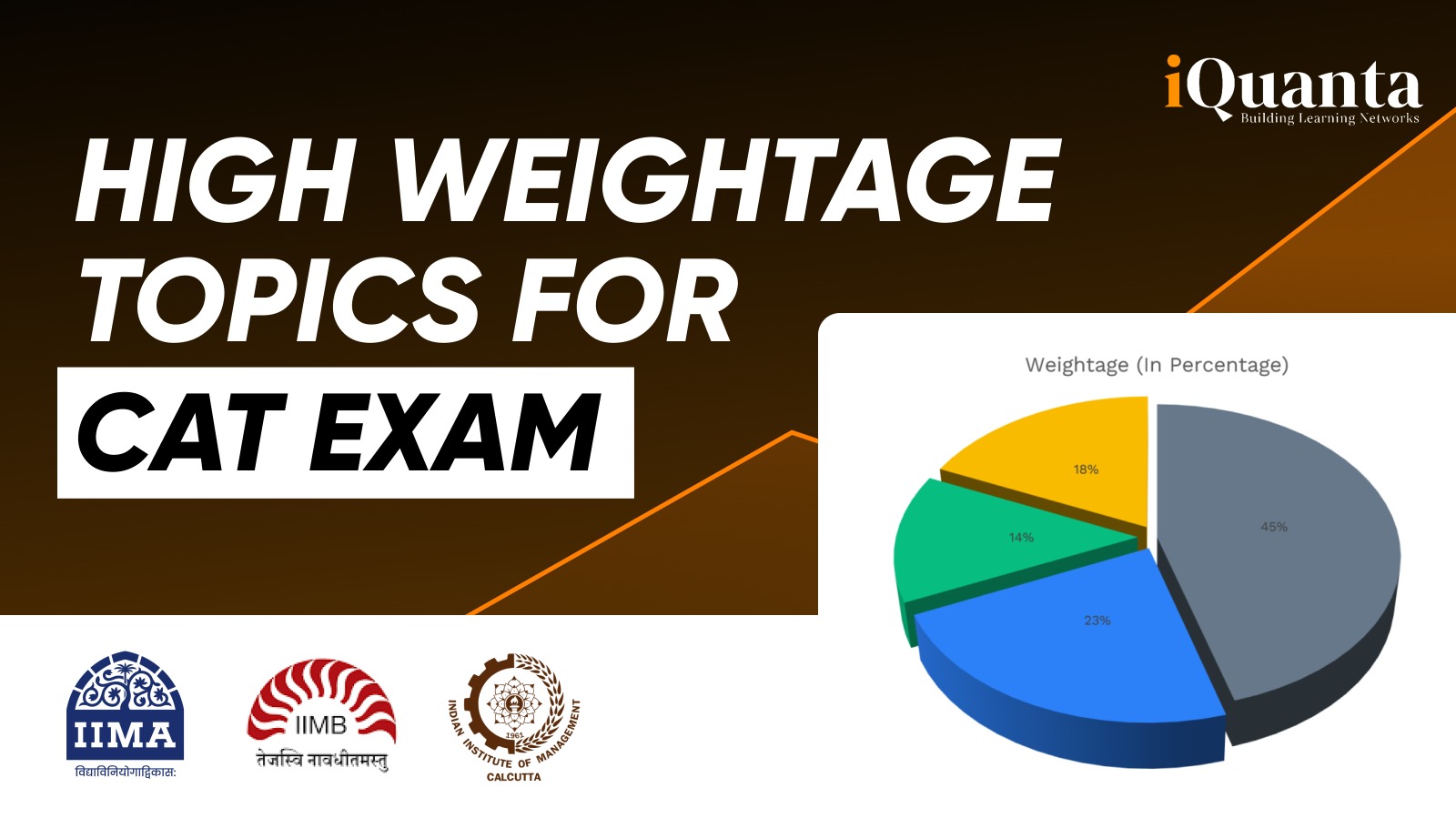
High Weightage Topics for CAT Exam: The CAT Exam is one of the toughest management entrance tests in the country. It attracts over 2 lakh applicants every year. This makes the exam highly competitive. If you are aiming for CAT 2026, you should be familiar with the CAT topic-wise weightage. This helps you focus more on topics from which most of the questions are asked. The CAT exam typically covers three sections and is usually moderately difficult. Knowing the CAT weightage topic-wise can simplify your exam preparation. Candidates can check the previous year exam analysis and syllabus to get an idea of the high weightage topics for CAT exam. This will improve their familiarity with the difficulty level and weightage over the years. This can help them refine their strategy accordingly. Mastering all the high-priority topics can maximise your chances of success. Continue reading to know the subject-wise High Weightage Topics for CAT Exam on this page.
Join iQuanta’s diversified student community for free and prepare with other 4.1L+ peers. Get access to 24*7 doubt-solving, mentorship, free webinars, etc all at one single platform.

High Weightage Topics for CAT Exam
Candidates should first understand all the aspects of the CAT exam. This can simplify their preparation and help them identify relevant topics easily. The CAT exam is a gateway for MBA admissions in IIMs and top B-schools. It includes three sections, i.e. Verbal Ability and Reading Comprehension (VARC), Data Interpretation and Logical Reasoning (DILR), and Quantitative Ability (QA). A total of 68 questions are asked in the CAT exam. The test duration is 120 minutes (160 minutes for PwD candidates).
The VARC section has 24 questions, while the DILR and QA sections have 22 questions each. Around 2.95 lakh candidates registered for the CAT 2025 exam. Out of which, nearly 2.58 lakh candidates appeared for the exam. The CAT weightage topic-wise has remained the same over the years. The CAT exam is usually moderately difficult in nature. Given below is the CAT section-wise weightage for the candidate’s reference:
| Section | No. of questions | Duration | Difficulty Level |
| Section I: Verbal Ability and Reading Comprehension (VARC) | 24 | 40 minutes | Moderate to Difficult |
| Section II: Data Interpretation and Logical Reasoning (DILR) | 22 | 40 minutes | Moderate to Difficult |
| Section III: Quantitative Ability (QA) | 22 | 40 minutes | Moderate to Difficult |
| Total | 68 | 120 minutes | Moderate |
CAT Syllabus with Weightage
The CAT syllabus is divided into three sections. VARC includes RC passages across various genres like Science and Technology, Economy and Business, History, Arts and Literature, Philosophy, Culture and Politics and Abstract Topics. Another section of VARC is Verbal Ability. It includes topics like Para Jumbles, Para Summary, Vocabulary and Odd One Out. LRDI CAT syllabus covers Blood Relations, Puzzles, Tables and Charts, Games and Tournaments, Venn Diagrams, and Seating Arrangements. QA covers topics like Arithmetic, Algebra, Number System, Geometry and Mensuration, and Modern Maths. Candidates should master all the topics outlined in the syllabus to achieve a higher percentile. Below is the CAT Topic-wise Weightage for all the sections.
CAT LRDI Topic-Wise Weightage
CAT LRDI cover areas like Tables and Charts, Games and Tournaments, Venn Diagrams, etc. It has been observed that Tables and Charts hold around 40-50% of weightage over the years. Given below is the CAT LRDI Topic-Wise Weightage for reference purposes.
| DI & LR Topics | No. of Questions | Approximate Weightage (%) |
| Tables and Charts | 4-6 | 40–50% |
| Games and Tournaments | 4-5 | 10-20% |
| Scheduling and Blood Relations | 3-4 | 5-10% |
| Venn Diagrams & Hybrid Sets | 2-3 | 5-10% |
| Puzzle and Seating Arrangements | 3-4 | 50-60% |
CAT VARC Topic-Wise Weightage
CAT VARC mainly covers RC Passages, Vocabulary, Para Jumbles, and other crucial topics. RC Passages usually comprise 16 Questions (4RCs). Each RC has 4 different types of questions. RC Passages holds approximately 55-60% of the weightage. Given below is the CAT VARC Topic-Wise Weightage for reference purposes.
| VARC Topics | Number of Questions | Approximate Weightage (%) |
| RC Passages | 16 Questions – 4RCs – Each RC will have 4 different types of questions. | 55-60% |
| Correct the Sentences | 2 | 10-15% |
| Critical Reasoning | 2 | 5-10% |
| Vocabulary | 2 | 5-10% |
| Para Jumbles | 2 | 15-20% |
Weightage of Quant topics in CAT
CAT Quant usually has 22 questions. Arithmetic hold highest weightage, i.e. 40% in the Quant section. Nearly 8-10 questions are from arithmetic topics. It is the highest compared to algebra (35%), geometry (15%), number system and modern math (5% each). Given below is the weightage of Quant topics in CAT:
| Most Important QA Topics | Approx Number of Questions | Approximate Weightage (%) |
| Arithmetic | 7-9 | 35–50%. |
| Algebra | 5-8 | 25-35% |
| Geometry and Mensuration | 2-3 | 10-15% |
| Number System | 1-2 | 5-10% |
| Modern Maths | 1-2 | 5-10% |
High Weightage Topics for CAT Exam
Once you understand the CAT syllabus, you should check the high weightage topics for CAT exam. This can make your preparation better. It helps you focus on topics that usually have more questions in the exam. Candidates are usually advised to give equal importance to all the relevant topics. However, they should also master high-priority topics to maximise their chances of success. They must clear the basics first and solve simple questions related to them. After this, they should move to the CAT high-weightage topics to boost their preparation. To help, we have compiled below the CAT weightage topic-wise for all the sections:
High Weightage Topics for CAT Exam VARC
VARC is the highest-scoring section in the CAT exam. Candidates should learn grammar concepts, vocabulary, and comprehension to excel. RC passages are usually based on Science and Technology, Business and Economics, Art and Culture, Culture and Society, Psychology, etc. Given below are the high weightage topics for CAT Reading Comprehension.
| Reading Comprehension | ||
| Subtopic (Genre) | Count | Percentage |
| Science and Technology | 21 | 23.33% |
| Philosophy | 14 | 15.56% |
| Business and Economics | 11 | 12.22% |
| History | 11 | 12.22% |
| Art and Culture | 10 | 11.11% |
| Culture and Society | 10 | 11.11% |
| Environment | 9 | 10.00% |
| Psychology | 4 | 4.44% |
| Grand Total | 90 | 100.00% |
High Weightage Topics for CAT Exam Maths
Quantitative Ability (QA) is another crucial section of the CAT exam. Candidates must build strong concepts and learn formulae/shortcut tricks to excel. It can improve their calculation skills. This eventually helps them solve questions faster with accuracy. This section covers topics like Time Speed Distance, Time and Work, Quadratic Equations, Percentage, Profit & Loss, etc. Given below are the high weightage topics for CAT Quant.
| Quant Topic-Wise Weightage | ||
| Topics | Questions | Percentage |
| Time Speed Distance | 45 | 8.24% |
| Sequence & Series | 36 | 6.59% |
| Logarithms | 33 | 6.04% |
| Time and Work | 31 | 5.68% |
| Quadratic Equations | 29 | 5.31% |
| Functions | 29 | 5.31% |
| Percentage | 26 | 4.76% |
| Profit & Loss | 26 | 4.76% |
| Average | 26 | 4.76% |
| Mixture & Alligation | 26 | 4.76% |
| Factorials, GIF, Misc | 20 | 3.66% |
| Ratio and proportion | 20 | 3.66% |
| Triangles | 20 | 3.66% |
| PNC | 18 | 3.30% |
| SI & CI | 17 | 3.11% |
| Mensuration | 16 | 2.93% |
| Linear Equation | 15 | 2.75% |
| Co-ordinate Geometry | 14 | 2.56% |
| Surds and Indices | 12 | 2.20% |
| Quadrilaterals | 12 | 2.20% |
| Polygons | 12 | 2.20% |
| Circle | 12 | 2.20% |
| Inequalites | 10 | 1.83% |
| Modulus | 9 | 1.65% |
| Divisibilty & Remainder | 8 | 1.47% |
| Polynomials and degree | 7 | 1.28% |
| Set theory | 7 | 1.28% |
| Maxima Minima | 6 | 1.10% |
| Factors and its Properties | 4 | 0.73% |
| Classification of Numbers | 0 | 0.00% |
| LCM & HCF | 0 | 0.00% |
| Probability | 0 | 0.00% |
| Binomial Theroem | 0 | 0.00% |
| Line and Angles | 0 | 0.00% |
High Weightage Topics for CAT Exam LRDI
LRDI is the trickiest section of the CAT exam. Candidates should improve their logical reasoning, analytical abilities and decision-making skills to excel. It includes topics like Caselets, Bar Graphs, Tables, Reasoning-Based DI, Quant-Based Reasoning, etc. Given below are the high weightage topics for CAT LRDI.
| LRDI Important Topics | ||
| Sub Topic | Count | % of Total |
| Caselets | 18 | 15.79% |
| Reasoning Based DI | 16 | 14.04% |
| Quant Based Reasoning | 13 | 11.40% |
| Venn Diagram | 10 | 8.77% |
| Special Charts | 9 | 7.89% |
| Scheduling Based Puzzle | 9 | 7.89% |
| Distrbution Based Puzzles | 8 | 7.02% |
| Tables | 7 | 6.14% |
| Games & Tournament | 7 | 6.14% |
| Bar Graphs | 6 | 5.26% |
| Network & Routes | 5 | 4.39% |
| Ranking & Ordering | 3 | 2.63% |
| Arrangement | 3 | 2.63% |
How to Master High Weightage Topics for CAT Exam?
Knowing high-weightage topics can simplify your CAT exam preparation. These are the topics that are often asked and carry a larger share of questions. Mastering them can improve your overall score and percentile. Thus, you must follow the right approach that helps you focus on the most relevant topics. It helps you avoid random preparation. But many candidates ask how to master high weightage topics for CAT exam. The answer is simple. You must solidify your basics, analyse past papers and practice regularly. This helps you build a strong grip on these topics. This approach can improve accuracy and confidence. Follow these tips to master high weightage topics for CAT exam:
Identify high-weightage topics first
Review the CAT’s previous years’ papers to recognise recurring topics across the sections. It helps you identify topics with more questions and those that are rarely asked. It will also provide insights into topic-wise difficulty levels over the years. This lets you practice and revise high-priority topics more. This can maximise your chances of scoring higher percentile in the CAT exam.
Strengthen basic concepts
You must build strong fundamentals before moving to advanced questions. Strong basics help solve different question types faster. iQuant CAT 2026 course offers live + application-based classes that help candidates first understand the basics and then apply them in question-solving during application classes. In fact, this course offers section-wise modules that help you build concepts from scratch.
Practice regularly
Candidates must practice topic-wise questions and mocks regularly. This can improve their speed and accuracy. Platforms like iQuanta offer mocks, topic-wise assignments, and daily practice doses. These resources mimic actual CAT exam standards. They offer 35 Full-Length + 45 Sectional Tests that match the actual difficulty level and topic distribution.
Revise and analyse mistakes
You must analyse your mistakes after mock tests. This helps you identify your weak areas and improve accordingly. This is where iQuanta’s CAT 2026 course steps in. They offer AI-powered performance analysis and video solutions after every mock.
Merely knowing the high weightage topics for CAT Exam is not enough. You must master them to obtain a higher percentile in all the sections. You must first develop strong fundamentals. After that, focus on solving high-weightage topics to strengthen your preparation. This can eventually improve your overall performance. This is where the iQuanta CAT 2026 course helps you. It offers interactive classes, 24X7 doubt-solving support, mock tests with analysis, and many other features. Enrol now and maximise your chances of success in CAT 2026.