
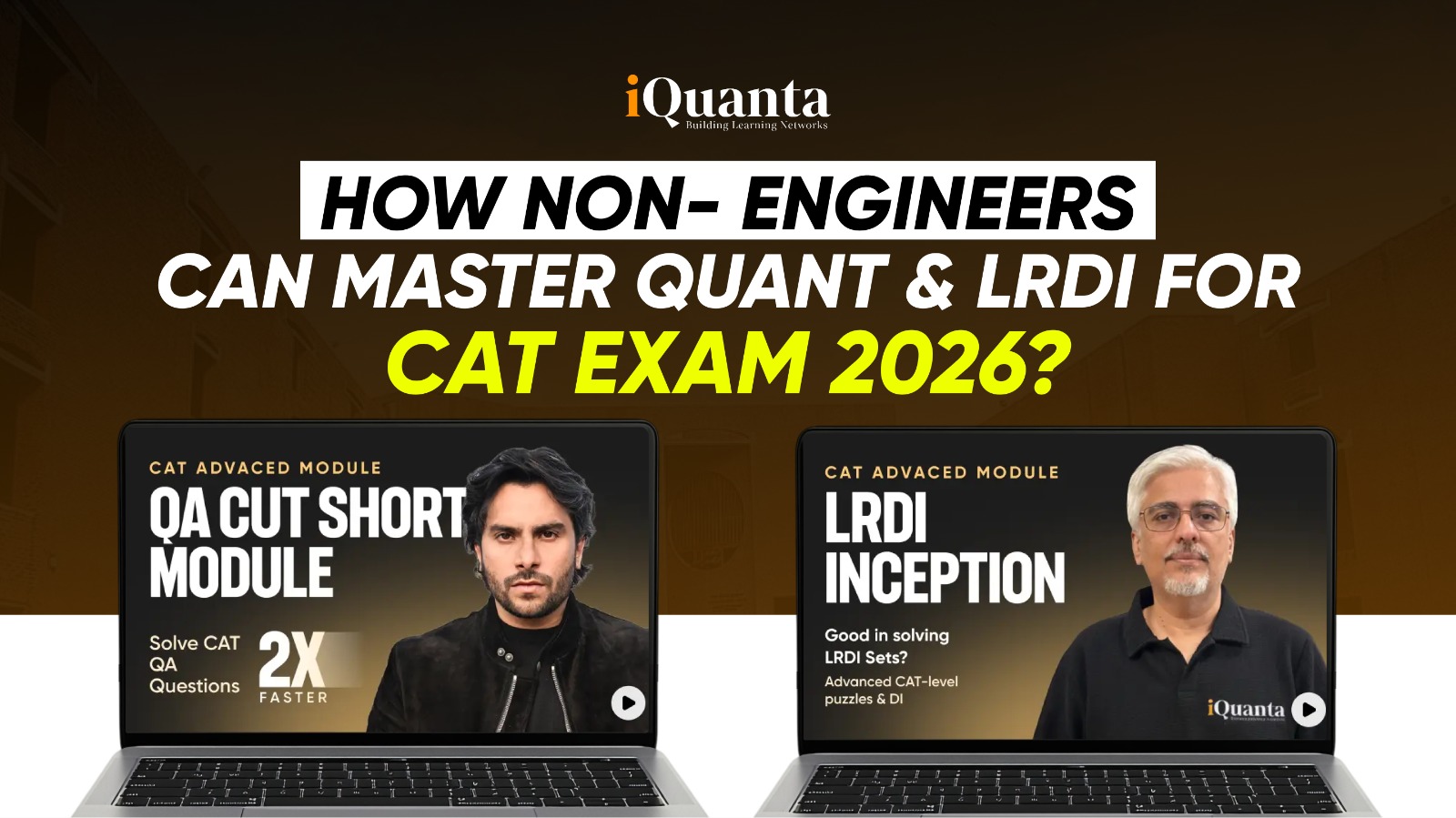
Wondering “How non-engineers can master Quant & LRDI for the CAT Exam 2026?” Well, you are not alone. Preparing for CAT as a non-engineer is not easy. Many students from commerce or arts backgrounds believe they are at a disadvantage. This belief usually comes from fear, not reality. The exam does not assess your educational background. It checks your conceptual clarity, logic, and consistency. Many aspirants initially struggle with Quant and LRDI. This is due to weak concepts and limited exposure. Most non-engineers have not practised maths for years. So the gap feels huge. But this gap can be filled with a smart plan.
All you need to understand is that CAT is a skill-based exam. Skills can be developed over time. You do not need to be brilliant at quant. You just need to practice regularly. You must adhere to a structured plan. And you need to show up every single day. If you start early and prepare smartly, you can compete with engineers. Many non-engineers score even 99+ percentile every year. The difference is not academics. The difference is in the quality of preparation. This is where iQuanta’s CAT 2026 course steps in. It provides customised basic modules that build concepts from scratch. Non-Engineer’s Quant and LRDI essentials are among them. It comprises topic-wise videos that cover the most essential topics and sets. Learn how non-engineers can master Quant & LRDI for CAT Exam 2026.
Join iQuanta’s diversified student community for free and prepare with other 4.1L+ peers. Get access to 24/7 doubt-solving, mentorship, free webinars, etc., all on one single platform.

Why Non-Engineers Struggle with Quant & LRDI in CAT Exam?
Many students ask whether non-engineers can score high marks in the CAT Quant & LRDI section. The answer is yes. The CAT exam does not check whether you have studied these two sections in your school or degree. It tests your conceptual knowledge, analytical thinking, and decision-making skills. You can start studying concepts during CAT preparation and still succeed in the exam. But you must understand the problem clearly. Most non-engineers experience similar challenges in Quant & LRDI. Check the reasons why non-engineers struggle with Quant & LRDI in the CAT exam:
- Weak Mathematical Foundation: This is the most common challenge. Many candidates stop studying maths after class 10. This makes their concepts unclear. Basic calculations feel heavy. They find topics like percentages or ratios challenging. They fail to solve advanced topics. This creates tension and panic. But the real problem is not the difficulty. It is actually a lack of concepts. Once you master the concepts, things become less difficult.
- Fear of Maths: Fear plays an important role. Many students believe they are weak at maths. This creates a mental block. They believe that they will fail even before trying. This fear stops them from practising questions. They delay preparation. They skip complex topics. This affects their confidence and leads to poor performance. Breaking this belief is essential. Quant is not about talent. It is about practice and clarity.
- Lack of Proper Guidance: Many students prepare without any plan. They use random study materials. They move from one topic to another. This creates stress and conceptual confusion. Quant and LRDI require a structured plan. You need to know which topics to cover daily. You need to track your progress level. Proper guidance can boost your preparation.
- Difficulty in the LRDI Approach: LRDI is not about rote learning. It is about the clarity of thoughts. Many candidates do not know how to approach a set. They worry when they see a new type of question. This led to random methods and wastage of time. The challenge is not the question, but the lack of approach.
Can Non-Engineers Really Score High in the CAT 2026 Exam?
Yes. This is absolutely possible. Many non-engineers score high percentiles in the CAT exam every year. They prioritise conceptual learning and practice. They skip shortcuts in the beginning. They build a strong foundation across all the topics. CAT Quant is based on conceptual maths. LRDI is based on logic and patterns. You can master both with the right approach and effort. All you need to do is spend 6-8 months of focused preparation. This helps you improve significantly. Your consistency matters a lot. Strong concepts help you solve advanced questions easily. This maximises your chances of success in the CAT exam 2026.
How to Build Quant from Scratch for the CAT Exam 2026?
You can start from the zero level even if your basics are weak. Do not feel embarrassed about it. Starting from the fundamentals is a smart move. Here are the tips to build Quant from scratch for CAT 2026:
Focus on NCERT-Level Concepts First
Start with simple topics. Master each concept properly. Popular topics are percentages, ratios, profit and loss, Time and work, Geometry, etc. These topics form the foundation of CAT Quant. Many advanced questions are based on them. This is where the iQuanta CAT 2026 course helps you. It offers a structured module, i.e., Non-Engineers Quant. It focuses on Class 6–10 concepts. It explains everything clearly. It also provides enough practice to build confidence. This structured learning helps you move step by step. It eliminates confusion. The module includes:
- 70+ videos
- 35+ hours of content
- 300+ important questions
Understand Concepts Clearly
Do not learn formulas without understanding them. That is why conceptual clarity is important. This helps you solve questions from easy to advanced levels. You do not panic when there is a slight change in the question. For instance, if you master ratios, you can solve mixture problems easily. Concepts link with each other.
Practice Regularly
Practice is really important in CAT 2026 preparation. You cannot retain concepts without regular practice. Solve questions daily. Start with simple ones. Then move to the moderate level. Slowly increase difficulty. Even 2-3 hours of daily practice can be a game-changer.
Move to CAT-Level Questions
Once you master the basics, start solving CAT-level questions. These questions check your exam readiness. Do not worry about errors. Focus on learning from mistakes. Each mistake strengthens your knowledge.
How to Master LRDI Effectively for the CAT Exam 2026?
LRDI is unpredictable in the CAT Exam 2026. All you need to learn is pattern recognition skills. It will become manageable with the smart approach and regular practice. Here are the tricks to master LRDI for the CAT Exam 2026:
Understand the Real Problem in LRDI
Most students face two common issues. The first one is that they don’t know how to approach a question. Secondly, they struggle to analyse the data. This results in wastage of time. They feel stuck and lose confidence. The solution is to learn the smart approach.
Build a Strong Approach to Solve Sets
LRDI is about a structured approach. You need to know how to break a question into small parts. Start by reading the question carefully. Recognise what is given and what is needed. Then arrange the data. Use tables. Use diagrams and visual representations. This can simplify things. This is where iQuanta’s CAT 2026 course steps in. It offers a structured module like LRDI Essentials. It focuses on explaining the approach. This helps you solve sets more efficiently. It covers:
- Basic understanding of sets and cases
- Problem-solving shortcuts
- Proper visual representation
Start with Easy and Basic Sets
Do not start with difficult sets. This will be the biggest mistake. Begin with simple ones. Practice tables, bar graphs, and basic arrangements. These sets help you understand basic concepts of LRDI.
Practice Variety of Sets
You should improve your familiarity with different types of questions. Practice puzzles, seating arrangements, caselets, games and tournaments, etc. The more sets you solve, the better your knowledge becomes.
Improve Set Selection Skills
You cannot attempt all the LRDI sets in the actual CAT exam 2026. You need to select the right ones. Some sets look simpler but are time-consuming. Some look challenging but are actually easy. Regular practice improves your question-selection strategies. It helps you learn how to recognise the right sets faster.
Conclusion
Non-engineers can master Quant and LRDI for the CAT Exam 2026. It is not about your degree or educational background. It is about a smart plan and consistency. Start from the fundamentals. Follow a structured plan. Practice daily. Analyse your performance and mistakes. Use the right resources, like the iQuanta CAT 2026 course. They offer modules like Non-Engineers’ Quant and LRDI Essentials to simplify your preparation. It provides clarity. It builds strong concepts from scratch. It trains your mind to approach questions strategically. So, why wait longer? Join the iQuanta CAT 2026 course today and get closer to success in the CAT exam.