

Preparing for the CAT exam is a long journey. You don’t just need strong concepts. You also need to get comfortable with time pressure and smart question selection techniques. The CAT exam is usually unpredictable and moderately difficult. Sometimes, you may find a question tricky and many times you don’t know where to begin. But the best part is that you can tackle CAT difficulty level with the right approach. Once you learn how to handle different levels of questions, your CAT preparation becomes simpler. This is where iQuanta’s CAT 2026 course steps in. It offers live classes, customised modules, and real-time doubt solving to simplify your preparation. Read on to know tips and tricks to tackle the CAT difficulty level across all the sections.
Join iQuanta’s diversified student community for free and prepare with other 4.1L+ peers. Get access to 24*7 doubt-solving, mentorship, free webinars, etc all at one single platform.

Why Does CAT Feel Difficult?
You should first understand why the CAT exam feels so difficult. This can help you build an effective strategy for all the sections. The key reasons are:
- It tests thinking ability more than rote memorisation.
- It checks how well you handle speed and accuracy together
- The difficulty level of questions is not the same in every section.
- You cannot switch sections.
- Negative marking means every incorrect answer reduces your overall score. That’s why a smart question selection strategy is crucial.
In short, you need to know how to pick the right questions. You should also learn to think clearly under pressure. And protect your scores from silly mistakes.
How to Tackle CAT Difficulty Level? Section-Wise Strategy
The CAT exam has three sections: Verbal Ability and Reading Comprehension (VARC), Data Interpretation and Logical Reasoning (DILR), and Quantitative Ability (QA). VARC carries 24 questions, and DILR & QA have 22 questions each. You must focus on learning the concepts and practising enough. The iQuanta CAT 2026 course can help you in this. It offers section-wise modules to help you master the basics from scratch. It provides live sessions, application classes, instant doubt-solving support, mocks wth analysis, and much more. It even offers daily practice doses in its course. You will be assigned a daily set of questions for all sections. It includes previously covered topics as well. This can strengthen your basics and track your progress. Let’s learn how to handle the CAT section-wise difficulty level:
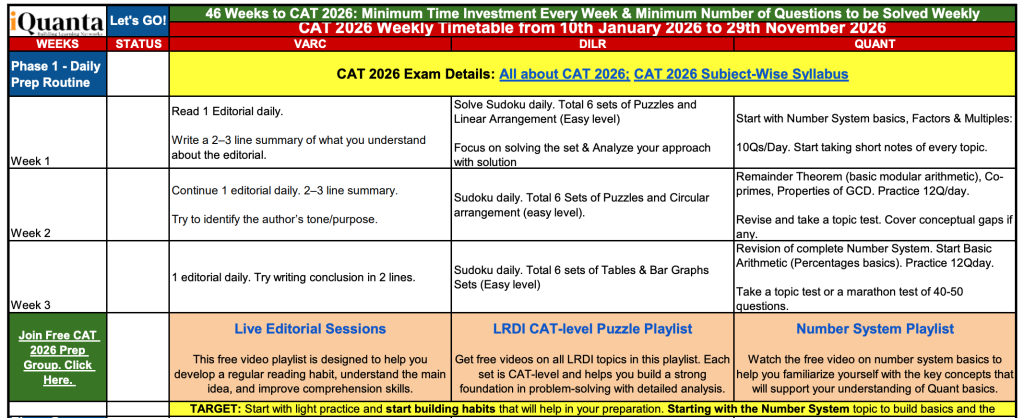
Click here and join the Whatsapp group to get the detailed timetable pdf for CAT 2026
Data Interpretation and Logical Reasoning (DILR)
DILR is one of the toughest sections of the CAT exam. DILR sets are often unpredictable. Some look easy but are time-consuming. While many DILR sets look tough, but are actually easy to solve. So, you must sharpen your pattern recognition skills. This can help you tackle tricky questions. Check tips to handle the CAT difficulty level of DILR:
- Start by developing a strong foundation across all topics. Make it a habit to practice 1-2 DILR sets daily. It must align with the latest exam format. This is where the Quanta CAT 2026 course can guide you. It offers the LRDI Essentials module to solidify your basics from scratch. It covers everything from concepts to complex topics and practice sets. It offers topic-wise videos and a beginner-friendly approach to enhance your preparation.
- Always spend 2-3 minutes scanning all the DILR sets in the beginning. Pick the ones that you are confident about. You can start with DILR sets whose conditions and structure are clear.
- Learn problem-solving skills and shortcuts to solve DILR questions faster. iQuanta CAT 2026 course offers problem-solving shortcuts, visual representation, and doubt-solving support. These elements can enhance your speed and accuracy.
- Practice DILR questions under real test conditions. It gives you exposure to the real exam. It helps you learn how to perform well under time pressure. iQuanta CAT 2026 course offers sectional mocks with in-depth analysis. Their mocks mimic the CAT difficulty level and format. This helps you know where your preparation stands.
Quantitative Ability (QA)
Quantitative Ability is one of the manageable sections if you practice well. You should first build strong concepts and learn how to apply them efficiently. Below are the tips to tackle the CAT difficulty level of QA:
- Start with Arithmetic, Algebra, and Geometry. Build fundamentals first and slowly move to advanced topics. To help, the iQuanta CAT 2026 course offer a Non-Engineer’s Quant module. This helps you grasp concepts from the ground up. It covers all the concepts from class 6 to 10th NCERT to CAT-level topics with practice sessions. It includes numerous practice questions that cover the most essential QA concepts.
- Solve topic-wise questions regularly to strengthen your concepts. The iQuanta CAT 2026 course is a one-stop solution for topic-wise assignments. It checks how well you understand the topics covered in their live and application-based classes.
- Focus on 3-step learning techniques. Learn the concept of a topic, solve basic questions, and then move to advanced-level problems. This can boost your speed and ensure retention.
- Maintain a notebook for formulas, shortcuts, and tricky facts. This can help you in quick revision.
- Solve topic-wise tests and assignments daily. This can improve your conceptual clarity. iQuanta CAT 2026 course offer topic-wise assignments that comprise mixed levels of questions.
Verbal Ability and Reading Comprehension (VARC)
VARC is among the unpredictable sections of the CAT. The right approach and strong concepts can improve your scores. Below are the tips to tackle the CAT difficulty level of VARC:
- Allocate 20-25 minutes daily to reading articles on different themes. Daily practice can help you solve the toughest passages easily. But which resources are right for your practice? The iQuanta CAT 2026 course is among the top choices. It offers the VARC essentials module to build your concepts from scratch. It provides 500 crucial terms for Reading Comprehension. It is accessible through interactive videos, articles, and focused RC practice.
- Focus more on developing accuracy in this section. Speed will eventually improve once you start solving questions correctly.
- Revise grammar rules and build a strong vocabulary. Practice VA questions from topics like Parajumble, Odd Sentence Out, etc. You can join the iQuanta CAT 2026 course to get access to unlimited CAT-level questions.
iQuanta CAT 2026 course lets you learn concepts in live classes and then use those concepts to solve questions in application classes. Their assignments and doubt-solving support can be a game-changer for your preparation. This can strengthen your foundation and help you handle the trickiest section.