
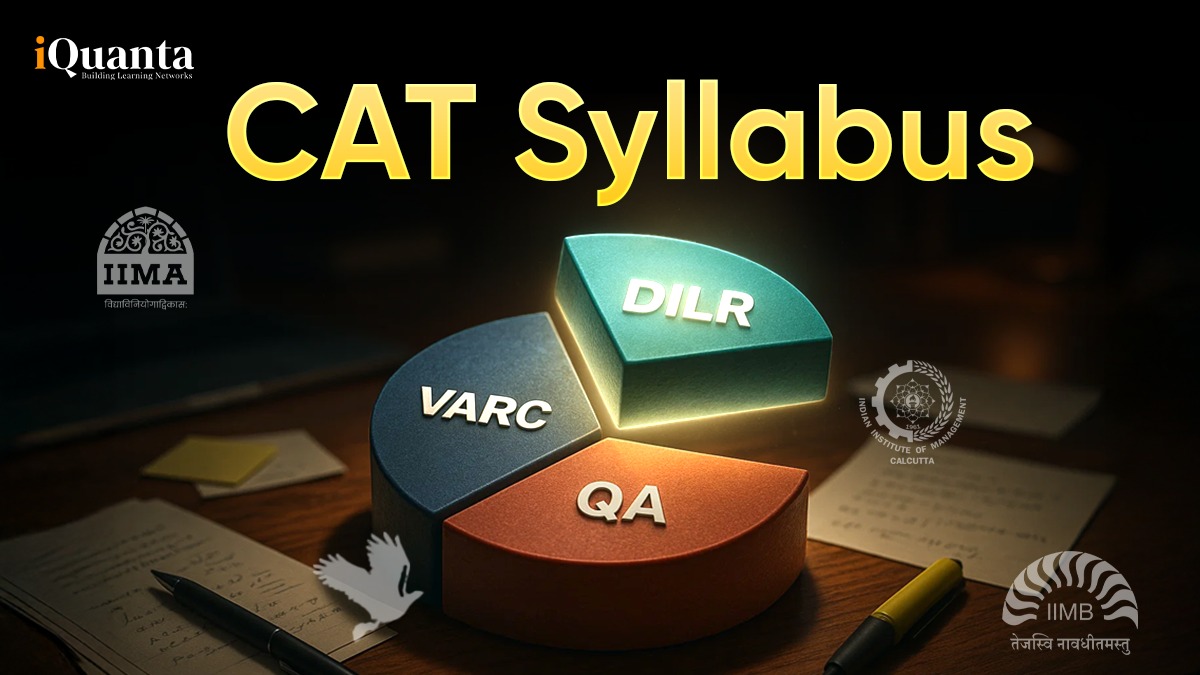
The CAT Syllabus for MBA is necessary to start your preparation for the CAT exam. It includes the complete breakdown of the subjects and overall weightage. Candidates appearing for the exam have 9 months to cover the crucial topics across all the 3 sections which are QA, VARC and DILR. Key topics in the Quants are Arithmetic (40%), Algebra (30%) and Geometry (15%) respectively. In the DILR section, important topics are Tables, Bar Graph, Pie Chart, Binary Logic, Routes etc. The CAT VARC Syllabus is a combination of RCs from different genres and Verbal Ability questions. Topics in the VA are Para Jumbles, Para Summary, Fill in the Blanks and Odd One Out.
CAT Syllabus High Weightage Topics
| Section | Importnat Topics | Weightage |
| VARC | Reading Comprehension, Para-jumbles, Para Summary, Odd-One-Out | 36% |
| DILR | Puzzles, Data Tables, Graphs, Games & Tournaments, Arrangements | 32% |
| Quants | Arithmetic, Algebra, Geometry, Modern Math, Numbers | 32% |
If we compare all the 3 sections, VARC has the highest weightage,i,e 36%. The CAT exam pattern comprises of 24 questions from the Verbal Ability and Reading Comprehension section. The other two sections, i.e, Quants and DILR, will be 22 questions each. Your accuracy rate should be near about 85-90% to clear sectional cut-off hassle free and obtain 99.99%ile in the CAT 2026. Check out this updated syllabus from each section and prepare smartly. This article is a detailed information about the CAT exam syllabus. Candidates can follow the full blog for further information.
Join iQuanta’s diversified student community for free and prepare with other 4.1L+ peers. Get access to 24*7 doubt-solving, mentorship, free webinars, etc all at one single platform.

CAT Syllabus for MBA – Section Wise Topics
MBA aspirants aiming to crack the Common Admission Test in 2026 must check the important subjects from the CAT syllabus. IIMs have set the syllabus of the CAT exam with 3 different sections. Three major subjects are VARC, DILR and QA. Every subject from the CAT syllabus for MBA has a set of high-weightage, moderate and low-weightage topics.
The overall weightage (%) also differs for each section. Candidates appearing for the CAT exam in 2026 are advised to start their preparation now. A candidate with a strong understanding of basic fundamentals will take 6-8 months to complete the entire syllabus. If you seek improvement in significant topics from VARC, QA and DILR then you’ll require a maximum of 8-12 months to pay equal attention on every topic.
Also Read: Right Time for CAT Preparation 2026
CAT Exam VARC Syllabus 2026
| Verbal Ability and Reading Comprehension | |
| Section | Topics Covered |
| Verbal Ability | Para Jumbles Odd One Out Para Summary Complete the Sentences |
| Reading Comprehension | Reading Comprehension Passages Tone of the Author Critical Thinking |
CAT VARC Syllabus Weightage
| CAT VARC Topics | ~ Approx Weightage (%) |
| Reading Comprehension Passages | 55-60% |
| Critical Reasoning Questions | 5-10% |
| Correct the Sentences | 10-15% |
| Vocabulary | 5-10% |
| Para Jumbles | 15-20% |
CAT Verbal Ability Syllabus 2026: All Important Topics
| VA Topics 2026 | Short Description |
| Para Summary | Selection of a correct summary for the relevant paragraph. |
| Sentence Placement/Insertion | To determine the correct position of a sentence in the given paragraph. |
| Odd One Out | Choose the sentence that is not compatible with the remaining sections |
| Para Jumbles | Arrangement of the jumbled sentences into a logical manner. |
| Critical Reasoning or Grammar-Based Questions (Very Rare) | To test English grammar and logical thinking. These questions rarely appear in the VARC section. |
CAT VARC Syllabus & Types of RCs
| Important RC Topics | Brief Description |
| Big Picture Questions | Inform, Analyse and Persuade the passage to identify the main purpose of the author behind writing the passage. |
| Fact-Based RCs | In such types of questions, you will have to provide a direct answer. The passages will mainly revolve around data-oriented information. |
| Inference-Based RCs | Answering these passages will require logical deduction and interpreting the author’s actual viewpoint. |
| Application-Based Questions | The passages will be in accordance with real-world or scenario-driven circumstances. You will have to select relevant new samples that fit perfectly with the situation. |
| Structure-Based Questions | Proceed with logical progress and analyse how one idea results in generating new ideas. The main purpose is to ask about the existence of a paragraph, sentence or example. |
| Evaluative Questions | Check the additional support for the author’s stance. |
Also Read – CAT Exam Pattern
CAT VARC Questions Analysis, Past Year Trends
| CAT Year | Number of RC Questions | Total Number of Verbal Ability Questions |
| CAT 2025 | 16 | 24 |
| CAT 2024 | 16 | 24 |
| CAT 2023 | 16 | 24 |
| CAT 2022 | 16 | 24 |
| CAT 2021 | 16 | 24 |
| CAT 2020 | 18 | 26 |
| CAT 2019 | 24 | 34 |
CAT Reading Comprehension Questions: Past Year’s
| CAT Exam | Reading Comprehension Passages |
| CAT 2025 | 4 |
| CAT 2024 | 4 |
| CAT 2023 | 4 |
| CAT 2022 | 4 |
| CAT 2021 | 4 |
| CAT 2020 | 4 |
| CAT 2019 | 5 |
Practice Para Jumbles Questions Free: CAT VARC Syllabus
| Option A | The paradox, however, lies in the fact that higher risks do not always yield proportionately higher returns. |
| Option B | In classical financial theory, investors are rewarded for bearing risk through the mechanism of risk premiums. |
| Option C | Behavioral economics complicates this assumption by demonstrating that human risk perception is inherently flawed. |
| Option D | This mismatch between assumed rationality and actual behavior has given rise to anomalies in market predictions. |
| Option E | Investors often overestimate gains in high-risk environments due to optimism bias and loss aversion. |
| Answer | B – A – C – E – D |
| Explaination | B gives the classical finance view. A presents the paradox in that assumption. C introduces behavioural economics as a counter. E gives examples of flawed perceptions. D ties it back to market anomalies. |
Correct the Sentences: Free Sample Question
| Question | Denouncing it as anti-democratic, the Lobbying Act was slammed by critics, imposing draconian limits on the activities of trade unions. |
| Option A | The Lobbying Act, which imposes draconian limits on the activities of trade unions, was slammed by critics. |
| Option B | Critics slammed the Lobbying Act, imposing draconian limits on the activities of trade unions |
| Option C | Critics slammed the Lobbying Act, which imposes draconian limits on the activities of trade unions. |
| Option D | No correction required |
| Answer | Option C |
| Explaination | The question is ” Choose the grammatically correct option”. The pronoun “which” after the “Lobbying Act” in option C clarifies that it is the Act that limits the activities of the trade unions. Hence, Choice C is the correct answer. |
Free Verbal Ability Question: Critical Reasoning
| Question | While society is chipping away at giving girls broader access to life’s possibilities, it isn’t presenting boys with a full continuum of how they can be in the world. To carve out a masculine identity requires whittling away everything that falls outside the norms of boyhood. At the earliest ages, it’s about external signifiers like favourite colours, TV shows, and clothes. But later, the paring knife cuts away intimate friendships, emotional range, and open communication Which of the following options puts forth the main idea of this paragraph best? |
| Option A | Boys are put in a straitjacket to conform to the popular, narrow view of masculine identity. |
| Option B | It is lopsided to approach gender equality by focusing only on girls’ empowerment. |
| Option C | It is a societal loss that boys are not allowed free self-expression. |
| Option D | Boys are forced to limit their emotional range to carve out a masculine identity. |
| Answer | Option A |
| Explaination | Option A addresses that boys are “put in a straitjacket”. It accurately portrays the main idea of the paragraph. |
Verbal Ability Questions For CAT 2026
By now, you are likely familiar with the CAT syllabus for MBA from the VARC section. In the upcoming section, we’ll explain the types of questions from each section. If you come across any issue, download the VARC Cheatsheet by iQuanta. It contains valuable information on how to approach an RC passage, option elimination techniques, figures of speech and other essential areas. For now, go through the type of questions from every VARC topic and segregate your preparation plan accordingly. Prior information about the questions and access to the cheatsheet will help you score 99+ Percentile in the VARC section of CAT 2026.
Practice Odd One Out Questions for CAT 2026
Question | A. Kafka’s works often depict protagonists trapped in absurd bureaucratic systems. |
| B. Orwell’s novels expose the perils of authoritarian surveillance states. | |
| C. Gabriel García Márquez’s magical realism blends fantastical elements with everyday reality. | |
| D. Huxley’s dystopian vision critiques consumerism and technological control. | |
| Answer | C. (A, B, D are dystopian/critical social fiction; C is magical realism — completely different style.) |
Para Summary Questions For CAT 2026
Totalitarianism is not always operated by diktat. It can be insinuated by suggestion and replication. Dissent does not have to be banned if it is countered by orchestrated mass promo rallies and hypnotizing oratory. Despotic establishments do not need to turn Hitlerian; all they need to do is to let the Reich’s chemistry work. Self-regulation and self-censorship will click in. Then any dissident who wants to retain his intellectual liberty will find himself thwarted by the general drift of society rather than by active persecution.
| Options | List of Options |
| Option A | Totalitarianism is generally operated by undermining freedom of expression through active persecution and censorship. |
| Option B | Hypnotising oratory and promo rallies can effectively counter dissent and lead to the persecution of the masses |
| Option C | Self-regulation and self-censorship in societies stifle freedom of expression. |
| Option D | Intellectual liberty does not have to be repressed by authority if there are self-appointed vigilantes to bully it into silence. |
| Answer | Option D |
CAT Reading Comprehension Genres
| Type of RC Genres | Genre Type |
| RC Genre 1 | Science and Technology |
| RC Genre 2 | Economy and Business |
| RC Genre 3 | Philosophy |
| RC Genre 4 | Culture and Politics |
| RC Genre 5 | History, Arts and Literature |
| RC Genre 6 | Abstract Topics |
RC Passages Reading Sources
| RC Genres from the CAT Syllabus For MBA | Reading Sources for RC Passages |
| Science and Technology | WIRED Psyche Big Think Nautilus Mag |
| Economy and Business | IMF Blogs Econofact VoxEU Fast Company Engage EPW The Economic Journal |
| Philosophy | Metapsychology Online Review Stanford Encyclopedia of Philosophy Argumenta |
| Culture and Politics | Discourse Mag The Guardian Reuters First Things Quillette The Washington Post Social Europe |
| History, Arts and Literature | Public Books History Today Art Forum History is Now Mag The Marginalian All Thats Interesting |
| Additional Sources | Aeon The Hedgehog Review The Public Domain Review Inquiries General The Conversation JSTOR Daily Noema Mag |
Samples Topics For RC Passages
| List of RC Passages | Sample Topics |
| Science and Technology | New developments in artificial intelligence and its ramifications on societies |
| History, Arts and Literature | The symbolism of naked Greek statues and their connection with the ongoing societal dynamics Economic and political development of countries and influence of it on world development |
| Economy and Business | Strategies available for the sustainable growth of business in emerging markets. |
| Philosophy | Justice in modern society. |
| Culture and Politics | Consciousness and freedom. |
| Abstract Topics | Inquiry in relation to the artificial intelligence. |
CAT DILR Syllabus 2026
| Data Interpretation and Logical Reasoning | |
| Section | Important Topics |
| DI | Venn Diagrams Different Tables with Missing Data Seating Arrangements Puzzles Quant-Based Logical Reasoning Binary Logic Games & Tournaments |
| LR | Data Sufficiency Bar Graphs Line Graph Pie Graph Tables Charts |
CAT QA Syllabus 2026: Topic-Wise Distribution
| CAT Quant Syllabus | Major Topics |
| Arithmetic | Percentages Profit and Loss Simple Interest and Compound Interest Ratio and Proportion Averages Mixture and Allegation Time and Work Pipes and Cisterns Time, Speed and Distance Races Trains and Boats |
| Algebra | Linear Equation Quadratic Equation Polynomials Indices & Surds Logarithms Inequalities Sequence & Series Functions Graphs Modulus |
| Number System | Properties of Integers Divisibility Remainder Theorem Factors LCM & HCF Factorial Trailing Zeroes Last Digits |
| Modern Maths | Set Theory Probability Permutation & Combination |
| Geometry | Triangles Quadrilaterals Polygons Circles Mensuration-3D Coordinate Geometry. |
CAT Quantitative Aptitude Syllabus For MBA
If you compare the CAT PYQs, the Quants section will consist of the most difficult questions. Every year, there will be 7-8 questions from the Arithmetic chapter. The total number of Algebra questions varies from 5-7 in the Common Admission Test. Only 2-3 questions will appear from the Geometry. There will be only 1-2 questions from the Number System and Modern Maths. Prioritizing the high-weightage topics will help you yield a high score. A complete breakdown of the high-yielding topics from each Quants chapter is mentioned below. Go through the table below to comprehend which type of questions will appear in the CAT 2026 exam.
CAT Arithmetic Syllabus 2026
| QA Topic | Type of Questions |
| Percentages | Calculations involving percentage increase or decrease. |
| Simple and Compound Interest | Calculations of interest over time. |
| Ratio and Proportion | Solving problems based on ratios and proportions. |
| Averages | Calculating averages of numbers. |
| Time, Speed, and Distance | Questions involving the relationship between time, speed, and distance. |
| Mixtures and Allegations | Problems involving mixing of different entities. |
| Profit and Loss | Problems on profit, loss, discount, and markup. |
| Time and Work | Problems on work done, efficiency, and time taken. |
CAT Algebra Syllabus 2026
| QA Topic | Type of Questions |
| Polynomials | Remainder Theorem, Factor Theorem |
| Inequalities | Linear and Quadratic Inequalities, Modulus Inequalities |
| Linear Equations | Single and Multi-variable equations |
| Logs, Surds and Indices | Logarithm identities, exponents |
| Quadratic Equations | Roots, Nature of Roots, Formation of Equation |
| Functions | Domain, Range, Graphs, Composition, Inverse |
CAT Geometry Syllabus 2026
| QA Topic | Type of Questions |
| Coordinate Geometry | Distance Formula, Section Formula, Area, Locus |
| Triangles | Types, Congruence, Similarity, Pythagoras, Inequality |
| Circles | Tangents, Chords, Arcs, Angles in Circle |
| Lines and Angles | Parallel Lines, Angles |
| Mensuration | Areas and Volumes of several 2D and 3D figures, such as triangles, rectangles, polygons, circles, and cones. |
| Quadrilaterals | Parallelogram, Rectangle, Rhombus, Trapezium |
| Polygons | Interior & Exterior Angles |
CAT Number System Syllabus 2026
| QA Topic | Type of Question |
| Divisibility Rules | Rules and tests for the divisibility of numbers. |
| LCM and HCF | Calculate the least common multiple and highest common factor. |
| Properties of Numbers | Even, odd, prime numbers, and additional properties. |
| Factors and Multiples | Finding factors and multiples of the numbers. |
CAT Modern Maths Syllabus 2026
| QA Topic | Type of Question |
| Permutation and Combination | Counting principles and arrangements. |
| Set Theory | Concepts of sets, Venn diagrams, and sets operation |
| Binomial Theorem | Expansion and properties. |
| Probability | Basic probability and its applications. |
Important Topics From CAT Exam Syllabus for MBA
| Section from the CAT Exam | Name of the topic | Total Questions (Approx) | Approximate Weightage (%) |
| Verbal Ability and Reading Comprehension | Reading Comprehension | 16 Question – 4 RCs: Each RC will have 4 different questions | 26% |
| Para Jumbles, Complete the Sentences, Odd One Out, Para Summary | 8 Questions | 10% | |
| Data Interpretation and Logical Reasoning | DI (Charts, Caselets, Charts, Tables) | 11 Questions | 16% |
| LR Puzzles (Arrangements, Syllogism, and more) | 11 Questions | 16% | |
| Quantitative Aptitude | Arithmetic & Algebra | 14 Questions | 32% |
| Geometry & Mensuration | 3 Questions | ||
| Number Systems & Modern Math | 3 Questions |
CAT Syllabus For MBA (VARC)
In the online CAT exam, Verbal Ability and Reading Comprehension is the first section. Candidates appearing in the CAT exam get a sectional time limit of 40 minutes to attempt the VARC questions. It holds nearly 34-36% weightage and is the most scoring section in the Common Admission Test. Constant reading from top English resources like The Hindu, The Economist, Aeon, The New York Times, The Guardian, etc, will benefit you in solving RC questions.
iQuanta offers exclusive modules like VARC Essentials Modules (500-word repository) and Engineer’s VARC Module, which has 60+ comprehensive videos with 30 hours of VARC content for extensive preparation. Your entire CAT syllabus for MBA from the VARC section will be covered through these resources. To know more about the main VARC topics, kindly check out the tabular content below.
CAT VARC Syllabus For MBA: Complete Breakdown
| Antonyms | Articles usage |
| Fill in the blanks | Idioms |
| Complete the sentences | Para jumbles |
| Errors in tenses | Verbal logic |
| One word substitution | Jumbled paragraphs |
| Verbal reasoning | Analogies |
| Types of clauses | Different usage of one word |
| Foreign language words used in English | Sentence correction |
| Subject-verb agreement | Para completion and inference |
| Syllogisms | Phrases modifiers |
| Parts of speech | Preposition |
CAT Syllabus for VARC (Topic-Wise Distribution)
| CAT VARC Topics | No. of Questions |
| Reading Comprehension | 16 |
| Para Summary | 1-3 |
| Odd One Out | 1-3 |
| Para Jumble | 1-3* (This topic didn’t appear in the CAT 2024 exam) |
| Para Completion | 1-3 |
| Total Question | 24 |
CAT Exam Syllabus for MBA: Previous Year RC Passages
| CAT Exam Year | Exam Slot 1 | Exam Slot 2 | Exam Slot 3 |
| CAT 2024 | Utility & Human Economics Entertainment/ Netflix Australian Species Craftsmanship | Spice Trade Unintended Consequences of Technology Peer Review of Research Carnivore-Human Conflict | Impact of AI Languages Chinese Moutai Saving outer space and other planets |
| CAT 2023 | Wolf → Environmentalists vs Farmer Philosophy → Change in Work Culture Indian Ocean-based Geographical Literature Human Behavior | Garments, Fashion Industry & Pollution Netflix Dubbing of titles for Europe→Good or Bad for Europe? Liberalism is Dying Facts & Interpretation in History | Romantic Aesthetics/ Philosophy Cultural Property Law → Exploration of Sites Nutmeg Curse→ Environment Degradation Rational Thinking |
| CAT 2022 | Ghosts & their mysteries how we can’t find their history Chinese Copy of articles Two levels of emotional thinking STOICS | Music Engineering technology Octopus Philosophy | Social reorganisation increasing crime rate Software if more easy humans are not capable to get solutions) Indian history American migration / urbanization increasing |
| CAT 2021 | Mayan Civilization Utopia and Dystopia Marshmallow Experiment Evolution of Tea as a Drink | Language/ Indigenous People Why Fiction Trumps Truth Colonialism/Nationalism Knowledge and Problems of Knowledge is a Scandal to Philosophy | Nanotechnology Language Instinct Time Accuracy Entropy Unconscious and Psychoanalysis |
| CAT 2020 | Anarchism Migration of Northern Seals Currency of the Tang Dynasty Grammar/Vocabulary | Investing in Renewable Energy Technologies Piracy in International Trade Freudian Models of Aggression A Study of Visualisation | Travel Writing and Feminism During Colonial Times The Need for Economic Literacy in the General Population Screen Time and Undercurrents of Social Class An Analysis of Human Nature |
CAT Syllabus For MBA: LRDI Important Topics
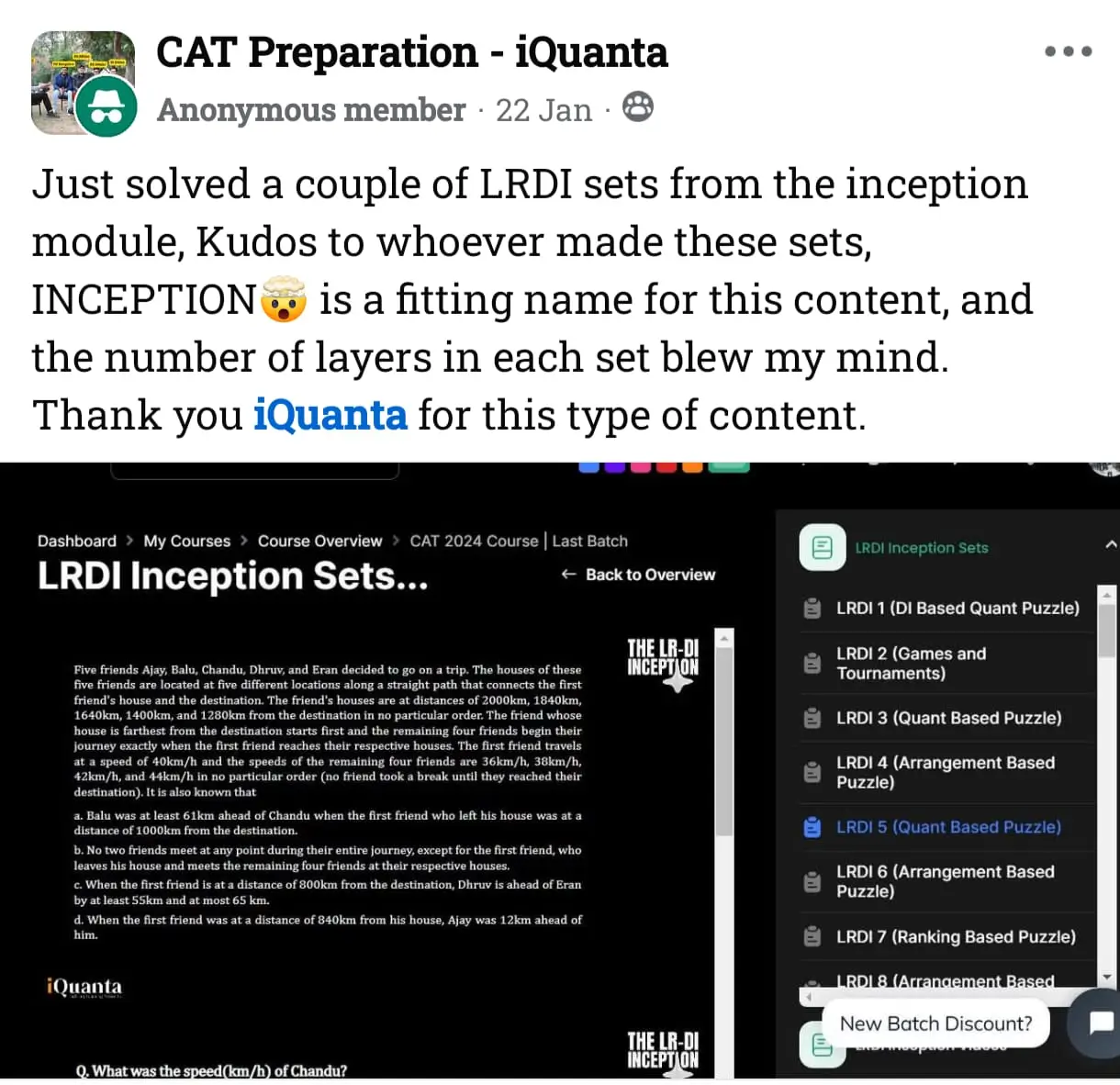
It’s very important to demonstrate logical reasoning, problem-solving, decision-making and critical thinking skills to qualify for the LRDI section. Basically, it’s the combination of charts, tables and puzzles which require an active presence of mind to solve them. Mainly, the DILR section has 4 different sets with 5 questions each. However, the pattern for the DILR section was different in the CAT 2024. The first 3 sets had 4 questions each. There were 5 questions each in the remaining 2 sets.
Also Read: All About CAT Exam 2026
CAT Exam Syllabus For MBA: Key Topics Quantitative Aptitude
Quants is the toughest section in the CAT exam only if you have not covered the 80% high-weightage topics from the CAT Syllabus for MBA. Maximum questions in the QA section will appear from Arithmetic, Algebra and Geometry. Pay attention to shortcuts and formulas essential to solve every QA question. Ensure that you indulge often in mental calculations to efficiently utilise the 40 minutes of sectional time limit. List of the fundamental topics from the QA section is below.
CAT Quantitative Aptitude Topic-Wise Weightage
| Topic | CAT 2022 (Approx Questions) | CAT 2023 (Approx Questions) | CAT 2024 (Approx Questions) |
| Average, Ratio, Mixture & Alligation | 3-5 | 4-6 | 3-5 |
| Profit & Loss, SI, CI, Percentages | 1-3 | 2-3 | 2-3 |
| TSD & Time and Work | 3-5 | 2-3 | 2-3 |
| Geometry | 3 | 3 | 2-3 |
| Quadratic, Polynomials & Simple Equations | 1-3 | 3-4 | 1-2 |
| Progression and Series | 1-3 | 2 | 1-2 |
| Inequalities, Modulus & Functions | 3-4 | 1-2 | 1-2 |
| Logarithm, Surds & Indices | 0-1 | 1-3 | 2 |
| Probability and P&C | 1 | 1 | 0-1 |
| Number System | 1 | 1-2 | 2-3 |
| Venn Diagrams | 0 | 0 | 0 |

CAT Syllabus Preparation Strategy: 100% Valuable Tips & Tricks
There are 2.95 lakh successful registrations for the CAT exam 2025. This number signifies that competition is going to be extremely tough this year. It also states that the number might increase in 2026, and so will the level of competition. Henceforth, your main target should be to cover the overall CAT syllabus for MBA from all aspects.
Consider following these 10 useful tips, which will help you to cover the 100% CAT exam syllabus for MBA 3-4 months before the actual exam. Next, you can utilise the remaining period for revising the syllabus, appearing for sectionals and full-length mocks. Allocate a proper time for mock analysis to review and improve the weak concepts.
- Check high-scoring topics from QA, DILR and VARC.
- Prioritize to cover the high-weightage topics.
- Spend more time on the weak topics from every section.
- Read for 1-2 hours daily to strengthen your RC skills.
- Write important QA formulas in a notebook.
- Refer to Barron’s List and Norman Lewis-Word Power Made Easy for VARC.
- Aim to develop speed and command an 85-90% accuracy rate.
- Practice sets from different levels.
- Learn to scan a set in the first 30 seconds only.
- Solve the CAT PYQs from the past 5 years, sectionals and full-length mocks.
Choose Online Coaching to Complete CAT Syllabus for MBA
Every competitive exam has two types of candidates. Some candidates opt for an online CAT coaching from ruptured institutes like iQuanta. Meanwhile, there are candidates who indulge in self-preparation to finish the CAT exam syllabus for MBA. The moment you enrol in an online coaching platform for CAT preparation, you’ll develop a structured approach. Your basics will be clear in every section of the CAT 2026. You also won’t lose track of the revision, practice, mocks and regular improvements. If you’re looking forward to appearing for the CAT exam in the future, then preparing with the help of an online CAT preparation platform under the guidance of top experts will certainly be the best decision for a bright career. Check out the prominent benefits of preparing for the Common Admission Test under the guidance of a top coaching institute.
- Timely Completion of Syllabus: The CAT exam syllabus for the MBA is vast and tricky. It means you will have to prepare with a structured roadmap. Online CAT coaching institutes have a well-planned timetable prepared in advance for the enrolled students. Each day will be valuable, and you’ll learn some important concepts from every section.
- Useful Techniques From Best Experts: Skilled academic professionals who demonstrate an in-depth understanding of the CAT exam syllabus teach the enrolled students. These individuals are experts and have been a CAT topper in the past. While teaching the students, they share valuable strategies, preparation tips and techniques to crack the CAT exam.
- Customised Study Modules: CAT allows candidates from diverse backgrounds to participate. As the CAT syllabus for MBA consists of mathematical questions, non-engineering candidates would find it difficult. Hereby, iQuanta – India’s No.1 online CAT coaching institute, offers a special module which completes the entire CAT QA syllabus from scratch.
- Non-Stop Doubt Solving: Taking an online coaching for the CAT exam from iQuanta has several advantages. If you come across any doubts while completing the CAT exam syllabus for MBA, you can address your doubts in the student community group. Top experts with an excellent teaching record will provide an instant solution to your queries.
- CAT Level Mocks and Questions: iQuanta also offers an exclusive bunch of questions after analysing the CAT PYQs. For every section, they have a certain number of questions that will help you prepare in accordance with the actual level of the exam. Further, every sectional test and full-length mock will also match the CAT exam level.
CAT Exam Syllabus for MBA: 30 Day Revision Plan
The CAT exam 2026 will probably happen in November 2026. If you’re aiming to appear for the CAT in 2026, your aim should be to complete the syllabus by July. Post this month, you must start to revise the overall syllabus and practice regularly. For every month, you must have a structured study plan. Amongst all, the November month will be extremely crucial for the 2026 aspirants. Thus, we’re sharing a detailed revision plan for you, which will help you to cover each and every topic in 30 days.
You can also make changes to this CAT study time-table depending on your assessment of the strong and weak topics. Each week, you will cover significant modules from every section and will not miss out on anything at all. Here’s the complete breakdown of the 30-day planner, which you can follow to finish the CAT exam syllabus for MBA in a strategic format.
Week 1: Vigorous Revision of High-Weightage Topics
| Quantitative Aptitude | Verbal Ability and Reading Comprehension | Data Interpretation and Logical Reasoning | Mocks Practice |
| Quick revision of the fundamental QA formulas. Note down crucial formulas from Arithmetic, Algebra and Geometry in a single notebook for regular revision sessions. | Practice 1 RC every day from a different genre. Solve 3 Verbal Ability sets from Odd One Out, Para Jumbles and Para Summary. | Enhance your familiarity with the most common and repetitive DI/LR patterns. Determine the weak and strong concepts closely for regular improvement. | Attempt at least 2 full-length mocks in Week 1. Spend 2+ hours on mock analysis. Pay deep attention to analyse your frequent mistakes. |
Week 2: Time to Boost Your Speed and Accuracy
| Quantitative Aptitude | Verbal Ability and Reading Comprehension | Data Interpretation and Logical Reasoning | Mocks and Additional Tips To Remember |
| Pick 30-40 different questions from the Arithmetic and Algebra section. | Choose 2 diverse topics every day from the RC. Allocate a specific time to read and solve 2 RCs each day. | Categorise DILR sets into three different sections. Solve one basic set, one moderate set and one advanced set each day from the DILR section | Your mock attempt should increase to 3-4 mocks. Aim to maximise your accuracy in those topics where you demonstrate strong conceptual understanding. Don’t touch any new topic as it might lead to additional stress and tension. |
Week 3: Start Working On Moderate Topics
| Quantitative Aptitude | Verbal Ability and Reading Comprehension | Data Interpretation and Logical Reasoning | Sectional and Mocks Practice |
| Set a dedicated timer to revise those topics from the CAT exam syllabus for MBA, where you exhibit mediocre knowledge. | Increase your consistency and accuracy to solve RC questions. Avoid random guessing to solve RC questions. | Incorporate CAT PYQs from the DILR section. | Carefully review the repetitive mistakes from all the full-length mocks you have appeared in the past. Attempt 2 advanced-level mocks with full dedication. Solve at least one sectional test from the VARC, DILR and QA sections |
Week 4: Final Revision Touch to the CAT Syllabus 2026
| Quantitative Aptitude | Verbal Ability and Reading Comprehension | Data Interpretation and Logical Reasoning | Total Number of Mocks |
| Arithmetic, Algebra, and Geometry should be your major focus areas. Use the Formula PDF to revisit the formulas that are essential to solve every question. | Dedicate your maximum time to understanding the skimming and skipping techniques. | Set a 40-minute timer to solve the DILR sets efficiently. | Attempting 3 mocks is necessary in the last phase of CAT exam revision. Take a quick look at the important shortcuts, techniques and formulas from every section. Prioritize rest in the last 3-4 days of the CAT exam |
CAT Exam Syllabus For MBA vs XAT Syllabus
Due to the availability of so many management exams, candidates have multiple options to establish a fruitful career. However, appearing for the various exams means that you need to complete the syllabus for each one of them. Apart from the CAT exam, candidates also appear for other top management exams like XAT, NMAT, SNAP, etc. After the Common Admission Test, the XAT (Xavier Aptitude Test) exam is also another popular MBA entrance exam amongst MBA aspirants. The XAT syllabus differs slightly from the CAT Syllabus for MBA. GK is the additional section in the XAT Syllabus. There is no negative marking for the incorrect GK responses. If you’re appearing for the XAT exam in the future along with the CAT, then here’s the list of key differences between the CAT syllabus and XAT syllabus, which will help you align your preparation accordingly.
Key Differences: CAT Syllabus and XAT Syllabus
| Entrance Exam | CAT | XAT |
| Full Form | Common Admission Test | Xavier Aptitude Test |
| Official Conducting Body | IIMs ( On Rotational Basis) | XLRI Jamshedpur |
| Core Syllabus | CAT Syllabus: Verbal Ability and Reading Comprehension, Data Interpretation and Logical Reasoning, Quantitative Aptitude | XAT Syllabus: Decision Making, Verbal and Logical Ability, Quantitative Ability & Data Interpretation, General Awareness |
| Total Duration of the Exam | 120 Minutes | 3 Hours 30 Minutes |
| Sectional Time Limit | 40 Minutes (Every Section) | Part 1: 170 Minutes Part 2: 10 Minutes |
| Total Number of Sections | 3 | 4 |
| Type of Questions | Multiple Choice Questions Type in the Answer | Multiple Choice Questions Essay |
| Number of Options in an MCQ Question | 4 | 5 |
| Online Registration Fee | Rs 2600 – General, EWS, OBC Rs 1300 – SC, ST and PwD | Common Registration Fee – Rs 2200 Additional Fee for Indian Candidates (XLRI Programmes) – Rs 200 per XLRI program XAT Exam Fee (Indian Candidates Applying Through GMAT/GRE) – Rs 2500 NRI and Foreign Candidates Applying Via GMAT/GRE for more than one programme: Rs 5000 |
| Number of Questions | Verbal Ability and Reading Comprehension – 24 Questions Data Interpretation and Logical Reasoning – 22 Questions Quantitative Aptitude – 22 Questions | Part 1 Decision Making: 21 Questions Verbal & Logical Ability: 26 Questions Quantitative Ability & Data Interpretation: 28 Questions Part 2 General Knowledge: 20 Minutes |
| Section-Wise Marks Distribution | Verbal Ability and Reading Comprehension – 72 Data Interpretation and Logical Reasoning – 66 Quantitative Aptitude – 66 | Part 1 Decision Making: 21 marks Verbal & Logical Ability: 26 marks Quantitative Ability & Data Interpretation: 28 marks Part 2 General Knowledge: 20 marks |
| Total Number of Questions | 68 | 95 |
| Total Marks | 204 | 95 |
| Positive Marking Scheme | +3 marks for every correct response | +1 mark for every right attempt |
| Negative Marking Scheme | -1 mark for every wrong attempt | -0.25 marks for every incorrect response. There will be no negative marking in the GK section of the XAT exam. |
| Negative Marking Scheme for Unanswered Questions | 0 marks | -0.10 marks for 8+ consecutively attempted questions |
| Most Difficult Section | The difficulty level varies for every section, every slot and every year. | It varies from year to year, but Decision Making is the toughest section. |
| B-Schools | IIMs and Other top B-schools | XLRI Jamshedpur and 250+ B-schools |

Final Words
Obtaining accurate information about the CAT syllabus for MBA should be your first step for structured CAT preparation. Once you have a detailed understanding of the syllabus of the CAT exam, your preparation will be on the right track. If you seek in-depth guidance in completing the entire CAT exam syllabus for MBA, then iQuanta is the most suitable online learning platform for you. Since its establishment, our experts have helped 1200+ students to score 99%ile in the CAT exam.
So far, we have built a team of 50+ teaching professionals, 4.1 lakh+ student community on Facebook, 24+M online students and much more. We strive to help every student achieve a good CAT score,i.e., 151+, which results in a high CAT percentile. There are 500+ online courses on our platform to prepare for different management courses. Connect now with our experts via a 1:1 free counselling session and enrol for an online CAT course that fits your CAT preparation plan.
Also Read: CAT vs Other MBA Exams
CAT Exam Syllabus for MBA – FAQs
We will not recommend to any CAT aspirant that one should avoid high-weightage topics from VARC, QA and DILR. All types of high-scoring topics from each section constitute the maximum section, and skipping them will lead to lower scores in the CAT exam.
Until today, there’s no confirmation about the change in the syllabus of the CAT exam for 2026. Reports suggest that the CAT exam syllabus will be the same for every section. You can join our free student community where our experts and mentors regularly share fresh updates about the CAT syllabus.
If you’re a beginner, 6 months won’t be enough to finish the entire syllabus of the CAT exam. Freshers should at least dedicate 9-12 months to cover each topic from the CAT syllabus 2026. However, 6 months are enough for CAT preparation if you exhibit strong fundamentals in QA, VARC and DILR.
The CAT exam syllabus for MBA includes the top 3 sections, which are Quantitative Aptitude, Data Interpretation and Logical Reasoning, Verbal Ability and Reading Comprehension.
It depends on the calibre of an individual candidate. Most students prefer dedicating at least 8-12 months to CAT preparation. You can also align your preparation as per your dream B-school.
Note down all the significant topics from the VARC, DILR and QA. Cover the foundational topics from the crucial topics, and then complete the remaining syllabus.
With a proven record of helping 580+ students in CAT 2025, iQuanta has set another example for providing the best resources and guidance to achieve 99.99%ile in the CAT exam
IIMs – the official conducting body of the CAT entrance exam, has not made any changes to the CAT syllabus of the CAT exam. However, slight changes took place in the total number of questions in the CAT 2024 question paper.