
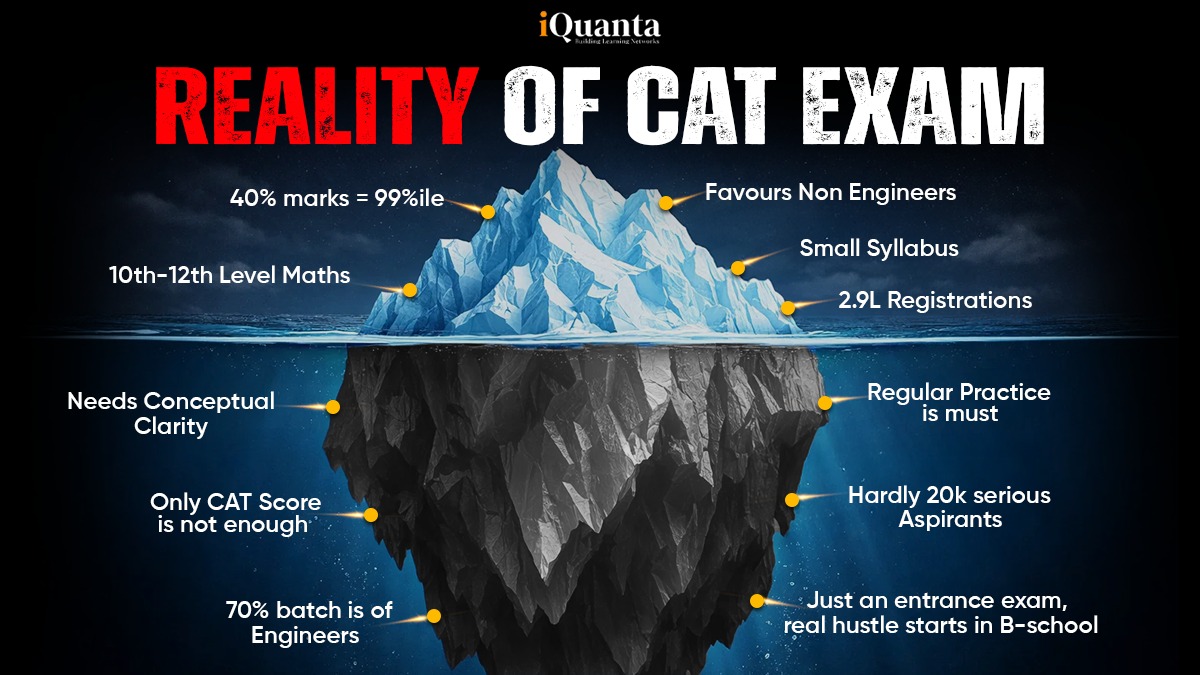
The CAT exam is one of the toughest entrance tests in the country. Lakhs of candidates prepare for this test to get into top B-schools and build a successful career. You may have heard that CAT is easy, has a short syllabus and only requires conceptual clarity. But when you start the CAT preparation, you may find the reality a bit different. CAT is not only about learning theories, formulas or solving questions. It checks your thinking, clarity, and consistency. Many students do not take the CAT exam seriously and later struggle. To help, we have discussed the harsh reality of the CAT exam. This will help you prepare with clarity and avoid common mistakes.
Join iQuanta’s diversified student community for free and prepare with other 4.1L+ peers. Get access to 24*7 doubt-solving, mentorship, free webinars, etc all at one single platform.

Reality of CAT Exam
There are many myths about the CAT exam which actually confuse the aspirants a lot. They must know the truth of the CAT exam in order to stay on track throughout the preparation. Let us understand the reality of CAT exam and what it means for you as an aspirant.
Around 40% marks can give you 99 percentile
This is one of the most surprising reality of the CAT exam. Yes, you don’t have to secure 90% marks to get 99 percentile in CAT. Sometimes, scoring nearly 40-45% marks can give you a 99 percentile. The reason? The paper is difficult, and many aspirants fail to solve enough questions. But this does not imply that CAT is easy. It just means that you must solve questions accurately instead of trying to solve the entire paper. Attempting a few questions correctly can give you a higher percentile.
CAT Maths is 10th-12th level
CAT Maths questions are mostly based on 10th-12th level topics like:
- Arithmetic
- Algebra
- Geometry
- Number system
But the CAT questions are not like school exams. Questions asked in school exams are mostly direct. But in CAT, you will find maths questions logical and require serious calculations. You must learn question selection strategies, think fast, and avoid wasting time. So, your priority should be conceptual clarity and practice during the preparation.
CAT syllabus looks Small
Many aspirants say that the CAT has a small syllabus. Technically, this is true. The CAT syllabus mainly includes:
- Verbal Ability and Reading Comprehension
- Data Interpretation and Logical Reasoning
- Quantitative Ability
Most topics are based on the 10th to 12th level standard. But the real obstacle is not the syllabus. The biggest challenge is the difficulty level of the questions. Questions are designed to check how well you can think and analyse the data. It is not about your memory. Even a simple topic like ratios can be challenging if asked in a tricky way.
CAT favours Non-Engineers
Engineers often have solid maths skills. This helps them in the Quant section. But this does not mean that non-engineers cannot excel. Many non-engineers perform very well because they are strong in Verbal Ability and prepare seriously. Many top colleges also give diversity points to non-engineers during shortlisting. So, your background does not determine your success. Your preparation does.
CAT needs strong conceptual clarity
You cannot excel in the CAT exam by memorising theories or formulas. You must know how to apply concepts when solving any question. You need to identify when to apply the formula and solve questions faster. CAT checks your thinking ability. You will struggle if your concepts are weak. So, you must build a strong foundation across all the topics.
Regular practice is a must
The CAT exam requires a focused strategy, not random preparation. You must practice basic to advanced-level questions regularly. This includes solving section-wise questions, mock practice, and analysing your mistakes. Regular practice will improve your speed, accuracy, and confidence. Every brilliant student fails without sufficient practice.
Only CAT score is not enough
Many students assume that securing 99 percentile guarantees admission. But this is not the reality. Many high percentilers still don’t get top college calls. Admission depends on factors such as:
- CAT score
- Academic profile
- Work experience
- PI scores, etc
The CAT score alone is not enough for MBA admission. You should prepare for the entire selection process.
Around 2.9 Lakhs Registration
Nearly 2.5 to 3 lakh students register for the CAT exam every year. This makes CAT look highly competitive. Aspirants from different backgrounds apply, such as:
- Engineers
- Commerce students
- Arts students
- Working professionals
Many students find the CAT exam challenging due to high registration numbers. But registration numbers do not reflect the complete truth. Many students register but lack serious preparation. So, you should not worry just by looking at the number of applicants.
Hardly 20,000 students prepare seriously for CAT
This is the most important reality of the CAT exam. Out of 2-3 lakh registered students, around 20,000 students prepare seriously. Many students lack consistency, skip mock tests, and lose motivation midway. In fact, many aspirants begin their preparation very late. Some aspirants participate in the exam for experience. This means you are competing with fewer serious candidates. If you learn and practice daily, you can easily move ahead of most aspirants.
Around 70% of Batch is of Engineers
One of the crucial reality of CAT exam is that around 70% batch is of Engineers. The reason? Many engineers prefer a top MBA college for better career growth. And the CAT is the popular entrance exam for leading B-schools. This makes the competition level more intense. But this does not mean that a non-engineer cannot compete with them. Non-engineers also get an academic diversity advantage in many top colleges. And if you are an engineer, you need to outperform others in your own category. In the end, your success depends on your preparation level, not your degree.
CAT is just an entrance exam, real hustle starts in B-school
Cracking the CAT exam is only the first step. The real competition begins after securing MBA admissions in a top college. You need to deal with academic pressure, case studies, and placements. So, CAT is just the gateway. Your real career growth is based on your journey in an MBA college.
Now, you know the reality of CAT exam. It is not impossible to succeed. But it is not very simple either. Conceptual clarity, mock practice and a smart plan can help you excel. But preparing alone can be challenging. You may not know what to cover and how to study. This is where expert guidance helps. The CAT 2026 course by iQuanta is designed to help you prepare in a structured way. They offer interactive classes, customised modules, 24X7 doubt support, exam-level mocks, analysis, and more. So, why wait longer? Join the iQuanta CAT 2026 course today and start your journey.