
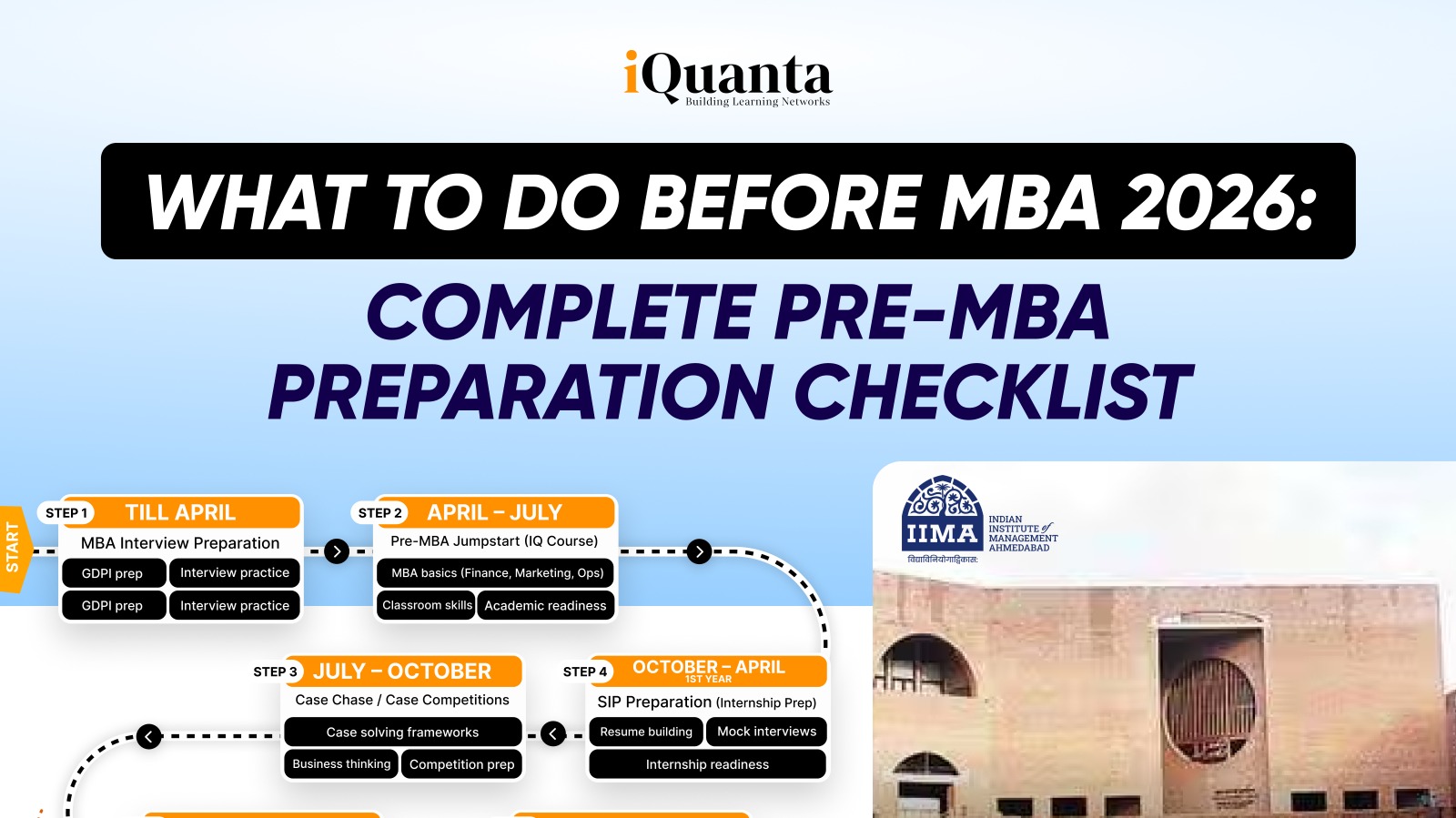
Before you start your MBA course, a 2-3 month preparation period is essential and is often referred to as the ‘Golden Period’. The pre-MBA period is a crucial phase which launches a student into early preparation for securing the right job roles through the Summer Internship Programmes (SIP). During the pre-MBA stage, students begin to cultivate the necessary skills needed in their desired job roles and prepare a resume aligned with their chosen domain.
Pre-MBA preparation covers all the pointers which candidates should follow to lead a successful MBA journey. An MBA is a program where people come from diverse backgrounds, whether they are technical, non-technical, or medical, and there are some skills that need to be learnt when going for the Master’s in Business Administration as a preparation checklist.
Now, many candidates are thinking about how to do the same and where I can get the sufficient resources to prepare for pre-MBA. There are many pointers which candidates should cover as a prerequisite, including important skills such as quantitative skills, business fundamentals, communication & presentation, technical skills and soft skills. Whether alongside learning skills in a defined manner, focusing on other pointers such as pre-arrival coursework, what to carry, financial preparation and more creates a beneficial impact to start with the MBA journey feasibly.
This blog covers the comprehensive guide about the pre-MBA checklist and how this will definitely impact in an advantageous manner for the candidates who are willing to go for the full-time MBA 2026 without any discrepancies.
Join iQuanta’s diversified student community for free and prepare with other 4.1L+ peers. Get access to 24/7 doubt-solving, mentorship, free webinars, etc., all on one single platform.

Pre-MBA Preparation: Different Skills to Cover As Basics
The first and foremost part that any candidate should cover in the pre-MBA preparation is learning fundamental skills so that, whether they came from a tech or non-tech background, they will be able to grasp the advanced concepts without any hurdles in between in the MBA programme. Let’s see what the skills are that we need to comprehensively cover, which will be an advantageous factor in the future.
- Quantitative Skills
- Business Fundamentals
- Communication & Presentation
- Technical/Soft Skills
The quantitative skills generally cover algebra and basic statistics, Excel, financial modelling basics in the form of an NPV, IRR, cash flow analysis, basic accounting principles and many more so that they will not be an untouched concept for you in MBA 2026.
Business fundamentals, including the business concepts and terminology, competitive analysis, market dynamics, supply management basics, financial ratios, consumer behaviour, etc. Now, in case you are coming from a technical background, then you might not be familiar with these concepts.
Communication & soft/technical skills are both impact factors and presentable skills in an MBA. 50% of the important projects can’t be projected if you are not aware of these skills. It includes Learn Tableau, Power BI, or similar BI tools. Get comfortable with SQL basics (if not already). Understand AI/ML fundamentals, business applications and many more.
Pre-MBA Preparation: Academic Preparation
There are many academic acquisitions that you should cover when you enter your MBA space. When you start with the MBA journey, then it is quite crucial that you should read about the coursework and be familiar with important tools such as Zoom, Canvas, Bloomberg Terminal, etc. These tools will be a part when you are going to present anything in a sufficient manner.
Case studies are an important part for the management aspirants, and you should prerequisitely read some good case studies along with books.
Pre-MBA Preparation: Academic Preparation
There are some physical items that candidates should carry as needed items when they are going for their MBA program. These respective gadgets and items will be a necessary thing that anyone should carry.
| Category | Items |
| Documents & Identification | Passport/visa (original + copies), Educational certificates & transcripts, Employment letters, Admission letter & program communication, Bank statements, Health insurance & prescriptions, Resume/CV, ID numbers (SSN equivalent), Birth certificate |
| Electronics & Technology | Laptop, Charger & cables, External hard drive, USB drives, Headphones/earbuds, Webcam & microphone, Phone & charger, Power bank, Universal adapter, Ethernet cable |
| Clothing & Personal Items | Business suits (2–3), Formal shoes, Business casual wear, Casual clothes, Activewear, Walking shoes, Outerwear (weather-based), a watch/jewellery, Toiletries, Medications, Glasses/contacts |
| School & Office Supplies | Backpack/laptop bag, Notebook, Pens, Highlighters, Calculator, Planner, Business cards, Portfolio/folder |
| Optional but Useful | Desk organizer, Desk lamp, Photos for motivation |
Pre-MBA Preparation: Financial Knowledge
This is one of the important parts that candidates should definitely research about what the actual tuition fees should be, the loan-taking procedure, what if there is any financial aid required, living expenses (accomodation charges), etc. Among all the factors, it is quite crucial for the candidates that they should have emergency funds equivalent to 3-6 months’ expenses.
GD & PI Preparation Strategy Before MBA 2026
While skill-building and resume refinement is important, it is also important to perform well in the GD and PI rounds to secure good placements. The GD and PI rounds are the main components of both internship and job selection procedures. Students are tested for their ability to think clearly, communicate coherently and their overall personality in the GD and PI rounds. If you prepare for GD and PI early on, you get more of an advantage compared to others.
What GD/PI Requires for MBA 2026
- Communication skills
- Logical thinking
- Confidence and personality
- Awareness about business and industry
GD & PI Preparation Focus Areas for MBA 2026
The main areas which recruiters assess in a GD and PI round are related to your academic background, strengths, weaknesses, motivation, and career goals. The table below summarises the main points which recruiters look for in candidates.
| Parameter | What Recruiters Look For |
| Communication | Clarity and articulation |
| Thinking | Logical and structured answers |
| Personality | Confidence and authenticity |
| Awareness | Industry and self-awareness |
Why Case Studies Are Important for MBA 2026
Case studies are common tools used to check a student’s ability to solve problems, make decisions and think critically. Students may participate in case study competitions pre-MBA or during their MBA journey to develop critical thinking abilities and learn how to solve different types of business problems. To excel in solving recruiter given case problems, it is important to learn key concepts as covered below.
- Profitability analysis
- Market sizing
- Business strategy
- Logical problem-solving
- Guesstimates
Final Placements Strategy Before MBA 2026
Starting your final placement early is the best strategy for securing good job offers. You do not have to wait until the second year to begin your final placement preparation. To secure your desired role, build a final placement strategy before MBA 2026 and follow it through. A few quick rules for the final placement season are as follows.
- The ideal resume length is one page.
- Use numbers to show impact
- Avoid lengthy paragraphs
- Focus on achievements, not responsibilities
- Identify domain you want to get a job in to build role clarity
- Practise case problems regularly
Pre-MBA Timeline: What You Should Be Doing at Each Stage
| Timeline | What You Should Do |
| 6 Months Before | This is your foundation phase where you focus on building strong quantitative skills and getting comfortable with business concepts through regular reading. At the same time, work on improving your English communication skills and begin learning Excel and financial modeling, which are essential during an MBA. You should also start researching accommodation options early to avoid last-minute hassle. |
| 4 Months Before | Now comes the execution phase. Complete any pre-MBA courses to prepare academically and finalize your accommodation. Start arranging your finances, including budgeting and loans if required. If you’re going abroad, complete your visa process. Additionally, update your LinkedIn profile and resume to get ready for networking and opportunities ahead. |
| 2 Months Before | This stage is all about logistics and health. Get your medical check-ups and vaccinations done, especially if required for travel. Book your flights and plan your transportation. Set up essential utilities like internet if possible and begin purchasing necessary items. Also, start connecting with your future classmates to build early relationships. |
| 1 Month Before | Focus on consolidating everything. Organise all your important documents with proper copies and begin structured packing. Arrange for insurance if needed and attend any virtual orientation sessions. Most importantly, take time to relax and mentally prepare yourself for the upcoming journey. |
| 1 Week Before | The final countdown requires you to complete packing and double-check all travel and accommodation details. Download important apps, ensure everything is in place, and prioritise rest. Keeping a positive mindset at this stage will help you transition smoothly. |
| First Week | Your MBA journey officially begins here. Attend all orientation sessions, set up your academic and tech requirements, and actively engage with your peers. Explore the campus and participate in welcome events to start building your network and ease into the new environment. |
Conclusion: Pre-MBA Preparation
Candidates should follow these strategies to make their entire MBA preparation journey feasible without any hurdle. The whole pre-MBA preparation covers several stages, and fulfilment of the same creates a significant impact, whatever your background may be.