
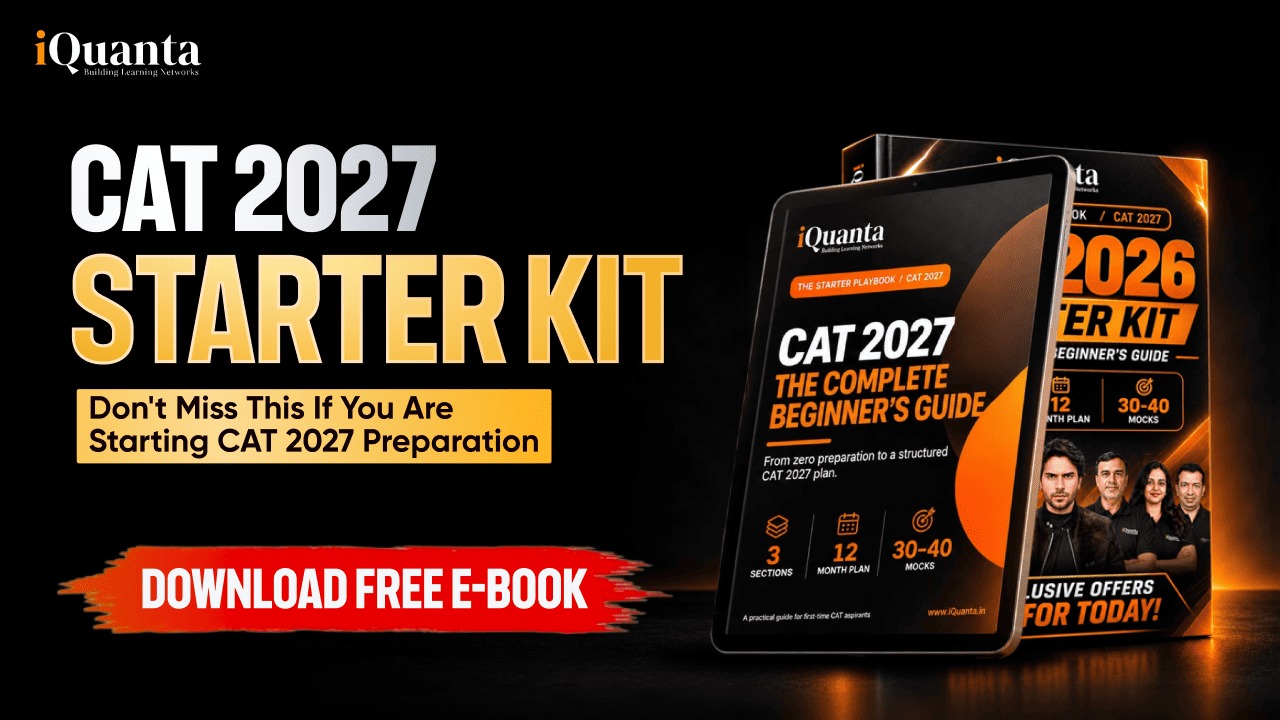
If you are someone who is starting his/her CAT 2027 preparation and is confused on how and where to start from, then iQuanta has brought the CAT 2027 starter kit. This is designed to help beginners build a structured and clear preparation. Candidates can know about the CAT exam pattern, eligibility criteria, section-wise syllabus, recommended study resources, preparation roadmap, mock test strategy, and common mistakes to avoid.
With approximately 12 to 13 months available before the CAT 2027 exam, CAT beginners can utilise this time period to maximise their acceptance rate to the IIMs and other top B schools. They can strengthen their basics, get good conceptual clarity and develop speed and accuracy.
Join iQuanta’s diversified student community for free and prepare with other 4.1L+ peers. Get access to 24/7 doubt-solving, mentorship, free webinars, etc., all at one single platform.

If you are a college student, working professional, or a first-time CAT aspirant, the CAT starter kit guide will guide you in your CAT preparation journey. Know about the CAT exam pattern, syllabus, section wise strategy, 12-13 preparation strategy, online courses available at iQuanta, and much more.
CAT 2027 Exam Overview
Before you begin your CAT 2027 exam preparation, it is important to understand the basics of the exam. The following table highlights the basics of the CAT 2027 exam based on the examination trend over the years.
| Particulars | Details |
| Exam Name | Common Admission Test (CAT) 2027 |
| Conducting Body | To be announced |
| Expected CAT 2027 Conducting IIM | To be announced |
| Expected CAT 2027 Exam Date | November 2027 |
| How Many IIMs are there? | 22 |
| Exam Mode | Computer-Based Test |
| Total Sections | 3 |
| Total Number of Questions | 68 |
| Total Exam Duration | 120 minutes |
| Sectional Duration | 40 minutes |
| Maximum Marks | 204 |
| Frequency | Once a year |
| Official Website | iimcat.ac.in |
For Whom is CAT 2027 Started Kit For?
The CAT 2027 starter kit is for someone who will be taking the CAT exam for the very first time and will begin his/her preparation from zero level. In case you know nothing about the CAT exam, then this CAT starter kit by iQuanta will share everything. This includes the exam pattern, syllabus, selection process, how to begin your probation and much more. It further removes the conduction that many CAT aspirants have that usually wastes the first 3-4 months.
CAT 2027 Eligibility Criteria
CAT aspirants should always go through the CAT eligibility criteria. They must ensure that they fulfill the basic eligibility requirements. Given below is the CAT eligibility criteria.
- A bachelor’s degree from a recognised university.
- General, EWS and NC-OBC candidates must have secured at least 50% marks or equivalent CGPA.
- SC, ST and PwD candidates must have secured at least 45% marks or equivalent CGPA.
- Final-year undergraduate students can also apply.
- There is no upper age limit for appearing in CAT.
- Prior work experience is NOT mandatory.
CAT 2027 Starter Kit: CAT Exam Pattern
CAT consists of three sections: Verbal Ability and Reading Comprehension (VARC), Data Interpretation and Logical Reasoning (DILR), and Quantitative Ability (QA). Each section has a sectional timing with total examination being 2 Hours. Given below is the CAT exam pattern.
| Section | Number of Questions | Duration | Maximum Marks |
| VARC | 24 | 40 minutes | 72 |
| DILR | 22 | 40 minutes | 66 |
| QA | 22 | 40 minutes | 66 |
| Total | 68 | 120 minutes | 204 |
CAT 2027 Marking Scheme
The marking scheme plays a key role for all the CAT aspirants. TITA (Type In The Answer) questions do not carry negative marking. Candidates should ensure that they focus on accuracy rather than solving maximum number of questions to avoid negative marking..
| Response Type | Marks |
| Correct Answer | +3 |
| Incorrect MCQ | -1 |
| Incorrect TITA | 0 |
| Unattempted Question | 0 |
CAT 2027 Starter Kit: CAT Exam Syllabus
IIMs do not have an officially prescribed CAT exam syllabus, However, based on the past year exam trend, we have shared the CAT syllabus as a part of the CAT starter kit.
CAT VARC Syllabus
The CAT VARC section consists of 24 questions. These questions are related to reading comprehension, verbal reasoning and the ability to understand complex passages. The topics covered under this section are as follows:
- Reading Comprehension (RC) – 4 RC sets of 4 Questions Each.
- Para Summary
- Odd One Out
- Para Jumble
- Para Completion
Below are the RC Genres:
- Science and Technology
- Philosophy
- Business & Economics
- History
- Art & Culture
- Culture & Society
- Environment
- Psychology
Tips to Prepare VARC for CAT 2027
For those who will be taking the CAT 2027 exam for the first time, they require consistent preparation over several months. They must read long articles and editorials on philosophy, economics, science and history. CAT passages are dense and abstract, not news.
Follow these steps:
- Read newspapers, editorials, and long-form articles for 45–60 minutes daily.
- Read on different subjects such as, philosophy, economics, science and history.
- After reading an article, summarise the author’s argument in two lines.
- Practice 2–3 RC passages every day using previous CAT papers.
- Gradually improve reading speed, comprehension and question-solving accuracy.
Target: They must attempt 15–17 questions with 80% or higher accuracy for targeting 95+ percentile in VARC.
CAT DILR Syllabus
Data Interpretation and Logical Reasoning or DILR consists of 22 questions. It tests a candidate’s ability to interpret information, identify patterns and solve complex problems through logical reasoning. The important topics include the following:
| Logical Reasoning | Data Interpretation |
| Puzzles | Pie Charts |
| Venn Diagrams | Line & Bar Graphs |
| Linear Arrangement | Cubes |
| Circular Arrangement | Scatter Chart |
| Caselets | Quant-based DI |
| Ranking and Order | Quant-based LR |
| Selection and Discussion | Table & Graphs |
| Games & Tournaments | DI Tables |
How to prepare for CAT DILR?
DILR is that section of the CAT exam that requires an extensive section. Beginners should try to develop the ability to understand different set structures rather than immediately trying to solve questions under time pressure.
Follow these steps:
- Solve 2 sets every day. Aim for 500–700 sets before the exam.
- Learn to represent information using tables, grids and diagrams.
- Practise previous CAT DILR sets and sectional tests.
- Learn to identify easy and difficult sets before attempting them.
Target: The aim should be to solve 2–3 sets with accuracy rather than attempting every set in the examination.
CAT Quantitative Ability Syllabus
Quantitative Ability consists of 22 questions. It covers questions based on Arithmetic, Algebra, Number System, Modern maths and Geometry. Out of all these, Arithmetic carries the maximum weightage. The important topics covered under this are as follows:
| Arithmetic | Algebra | Geometry | Number System | Modern Maths |
| Percentages | Linear Equations | Triangles | Properties of Integer | Set Theory |
| Profit & Loss | Quadratic Equations | Quadrilaterals | Divisibility | Probability |
| SI & CI | Polynomials | Polygons | Factors | Permutation & Combination |
| Ratio & Proportion | Indices & Surds | Circles | Remainder Theorem | |
| Averages | Logarithms | Mensuration – 3D | LCM & HCF | |
| Mixture and Alligation | Inequalities | Coordinate Geometry | Factorial | |
| Time & Work | Sequence Series | Trailing Zeroes | ||
| Pipes & Cisterns | Functions | Last Digits | ||
| Time, Speed & Distance | Graphs | |||
| Races | Modulus | |||
| Trains & Boats |
How to prepare for CAT Quantitative Ability?
Follow this preparation sequence:
- Begin from the Arithmetic section as it carries the maximum weightage and is the easiest to learn.
- For each topic: learn concepts, solve 30–40 basic questions, then 20–30 CAT-level questions, then past CAT questions on that topic.
- 3. Keep a formula and mistakes notebook.
- Build calculation speed: squares up to 30, cubes up to 15, and fractions to percentages.
Target: Aim for 12–14 correct answers out of 22. The typical percentile for QA is 95 to 99.
CAT 2027 Starter Kit: Strategy to Prepare for CAT in 12 Months?
The best way to prepare for the CAT 2027 exam is to begin early and 12 to 13 months is enough time. The iQuanta starter kit divides the preparation journey into four major phases: building fundamentals, completing concepts, starting mock tests and intensive revision. The month wise preparation plan for CAT 2027 aspirants is shared below.
| Timeline | Preparation Phase | Quantitative Ability | DILR | VARC | Mock Tests |
| Nov–Dec 2026 | Start | Basic maths, percentages, ratios, fractions and Arithmetic | One easy set daily, untimed | Daily reading for 45 minutes | Attempt CAT 2026 paper once it is released |
| Jan–Mar 2027 | Concept Building 1 | Complete Arithmetic and start Algebra | Two sets daily and understand different set types | Daily reading and two RCs | Topic-wise tests |
| Apr–Jun 2027 | Concept Building 2 | Complete Algebra, Geometry, Number System and Modern Maths | Two sets daily; gradually introduce timing | 2–3 RCs daily and VA practice | 1–2 full mocks monthly |
| Jul–Aug 2027 | Mock Start | Revise weak topics and solve previous CAT QA questions | Mixed sets and set selection | Previous CAT RCs | One mock weekly |
| Sep–Oct 2027 | Mock Intensive | Address errors identified through mocks | Sectional tests | Daily reading | Two mocks weekly |
| Nov 2027 | Final Revision | Revise formulas and mistakes | Light practice | Light practice | 1–2 mocks weekly; stop 4–5 days before CAT |
CAT 2027 Starter Kit: Best Resources for Beginners
Candidates who will be beginning their CAT 2027 preparation journey from scratch can have the best resources offered in the Quanta CAT 2027 starter kit.
1. CAT 2027 Online Course
The iQuanta CAT 2027 online course offers structured preparation resources for all three sections. Given below are the features offered under this.
| Feature | Details |
| Conceptual Videos | 210+ videos |
| Live and Application Classes | 1,200+ videos across sections |
| QA Practice Material | 1,500+ questions |
| DILR Practice Material | 300+ sets |
| VARC Practice Material | 700+ questions |
| Full-Length Mocks | 35 mocks |
| Sectional Mocks | 45 mocks |
| Non-CAT Mocks | 15 mocks |
| Doubt Support | 24/7 doubt-solving support |
2. CAT 2027 Books: 12 Books with 5,000+ Questions
iQuanta offers the best books for all the three sections of CAT exam. These books have over 5000 practice sets. The section wise number of books offered are as follows:
| Section | Number of Books |
| Quantitative Ability | 5 |
| Logical Reasoning and Data Interpretation | 4 |
| Verbal Ability and Reading Comprehension | 3 |
| Total | 12 |
3. IIM ABC Practice Batch 2027
The IIM ABC Practice Batch is designed to help aspirants strengthen their CAT-level problem-solving abilities through regular practice. Given below are the features offered in the IIM ABC Practice Batch.
Question Bank:
- 250 exact CAT-level RCs.
- 250 exact CAT-level LRDI sets.
- 1,250 topic-wise CAT-level Quant questions.
Daily Practice:
- 3 RC sets every day.
- 3 LRDI sets every day.
- 12 topic-wise Quant questions every day.
4. iCAT Mock Test Series
CAT Mock tests help aspirants evaluate their preparation and understand how they perform under examination pressure. The iQuanta iCAT mock test series includes:
- 35 CAT full-length mocks with video solutions.
- 45 CAT sectional mocks with video solutions.
- AI-based mock analysis.
- Error tracker.
- Score versus percentile analysis.
- Detailed video solutions.
The platform also provides tools to identify recurring mistakes and track performance improvements.
5. iQuanta App: Free CAT Preparation Resources
CAT Aspirants can also use the iQuanta app to access several free CAT preparation resources that come with the following features:
- 24/7 doubt support.
- CAT-level quizzes and mini mock tests.
- Previous year CAT question papers.
- Daily CAT practice questions.
- RC reading tool.
- Peer-to-peer learning community.
- AI-based analysis.
Why is iQuanta the Best CAT Preparation Platform?
iQuanta offers the best resources for all the CAT aspirants. Those who are beginners in CAT need a structured guidance to make their preparation journey easy. It serves as the best CAT starter kit for those are beginning their exam preparation journey. iQuanta offers conceptual clarity, application based classes, practice sessions, doubt solving support and much more.
1. Dual Pedagogy
iQuanta follows a dual-pedagogy approach where candidates can learn the fundamentals along with application-based practice. They learn through questions and practice sessions.
2. 24/7 Doubt-Solving Support
As per the iQuanta’s CAT starter kit, all the CAT aspirants get 24*7 doubt solving the support system. Resolving a doubt enables them to resolve their doubts via text or images. They receive the explanation either through video or via text.
3. Peer-to-Peer Learning
The CAT aspirants are a part of a peer group where they are free to interact with fellow aspirants. This allows them to exchange preparation strategies and stay motivated throughout their preparation journey.
iQuanta’s learning communities include WhatsApp, Instagram, YouTube and its dedicated learning app.
Common Mistakes CAT 2027 Beginners Should Avoid
Many CAT beginners tend to make common mistakes that must be avoided at all costs. The preparation approach matters a lot during the CAT preparation journey.
| Common Mistake | Why Should You Avoid It? / What Should You Do? |
| Starting Reading Late | VARC cannot be crammed in three months. Reading speed and comprehension take 6–9 months of daily practice to improve. Start in the first week of your preparation. |
| Collecting Study Material Instead of Solving It | Collecting five coaching PDFs, following three YouTube channels and buying two books without completing them can waste valuable preparation time. Pick one course and one mock series, and finish them. |
| Ignoring Your Weak Section | Sectional cutoffs mean that scoring 60 percentile in one section can affect your chances despite securing 99 percentile overall. Spend extra time improving your weakest section rather than focusing only on your favourite one. |
| Taking Mocks Without Analysing Them | Attempting a mock and forgetting about it wastes two hours. Proper mock analysis helps identify mistakes, understand weaknesses and improve your performance. |
| Attempting Too Many Questions | Accuracy matters more than the number of attempts. Attempting 34 questions with 30 correct answers can score significantly higher than attempting 45 questions with the same 30 correct answers because every incorrect MCQ carries a penalty of one mark. |
| Preparing Only for CAT | Not registering for other MBA exams such as XAT, NMAT or SNAP leaves you without backup options if your CAT performance does not go as expected. Prepare for other MBA entrance examinations alongside CAT. |
| Ignoring the Profile Side | Graduation marks, work experience quality and interview preparation play an important role in final selection. Even a 99.5 percentiler without a convincing answer to “Why MBA?” can lose the admission opportunity. |
| Stopping After One Bad Mock | Mock scores can fluctuate by 10–15 percentile between tests. Evaluate your performance across 8–10 mocks instead of judging your preparation based on a single test. |
Conclusion
CAT 2027 exam preparation requires consistent practice without losing target. CAT beginners should follow the CAT starter kit to begin their CAT exam preparation. Starting early gives advantage to understanding fundamentals, concepts, practice enough questions, improve their performance and having ample time for mock tests. Rather than being in a confused state of mind, one should focus on building the basics strong during the initial months and then proceed towards solving complex questions. With structured preparation resources and guidance, one can make the CAT 2027 preparation much more organized with a 100% success rate.