
CAT 2026: Are you a candidate who is thinking to enter in top IIMs but can’t find the clear way to get in? This might be a difficult task for many candidates to align themselves but let’s start a fresh where understanding about the basic eligibility criteria is all what matters the most initially. Common Admission Test is the entrance examination which termed as a common eligibility criteria to get eligible for further rounds in IIMs or other B-schools in India. If anyone wants to pursue masters program from Indian Institutes of Management, then candidates have to mandatory give the CAT exam. The CAT exam pattern is flexible for candidates to grasp where three sections are aligned in the same order – Verbal Ability & Reading Comprehension, Data Interpretation & Logical Reasoning and Quantitative Ability. The CAT exam journey comes with understanding the importance of MBA in today’s landscape and further career opportunities available for the students. This blog is the detailed guide for all the CAT aspirants who are seriously planning to pursue this exam with structured way to get into. Let’s begin discussing the complete CAT preparation journey which turned out to be as a numerous advantage for both beginners and experienced professionals.
Join iQuanta’s diversified student community for free and prepare with other 4.1L+ peers. Get access to 24*7 doubt-solving, mentorship, free webinars, etc all at one single platform.

What is Common Admission Test?
Let’s first cover “What is CAT exam?“. At a glance, it first looks basic but understanding of the basic eligibility criteria will be very helpful for candidates in the structured CAT preparation. Common Admission Test is the Computer-Based Test which possess overall 3 slots with the total time duration of 120 minutes. The sections in CAT exam aligned in such a manner where Verbal Ability & Reading Comprehension comes first, followed by Data Interpretation & Logical Reasoning and Quantitative Ability. Top IIMs like IIM Ahmedabad, IIM Bangalore, IIM Calcutta, IIM Kozhikode, IIM Lucknow and IIM Indore provide some weightage to the CAT exam scores which further calculated in the composite scores for selection of the candidates in MBA/PGP program. Grasping about the CAT exam pattern give you a clear look in the starting itself about the Common Admission Test so that later you will not get confused about the fundamentals. The detailed idea about the CAT 2026 expected pattern specified below.
| Particulars | Details Related to the Common Admission Test |
| Mode of the CAT Exam | Computer-Based Test (CBT) |
| Number of Slots | 3 |
| Exam Duration | 120 minutes |
| Number of Sections | 3 (40 minutes each) |
| Sections & Order of Attempt | 1. VARC (Verbal Ability & Reading Comprehension) 2. DILR (Data Interpretation & Logical Reasoning) 3. QA (Quantitative Ability) |
| Total Number of Questions | 68 |
| Sections & Number of Questions | VARC -24 DILR -22 QA -22 |
| Total Marks | 204 |
| Questions Type | MCQ (Multiple Choice Questions) TITA (Type In The Answer) |
| Marking Scheme for MCQ Questions | +3 Marks for Correct Answers -1 Marks for Incorrect Answers |
| Marking Scheme for TITA Questions | +3 Marks for Correct Answers 0 Marks for Each Unattempted or Incorrect Answers |
Along with understanding the CAT exam, candidates should have a practical knowledge about why they are giving Common Admission Test 2026? while covering it’s importance in today’s MBA landscape.
Eligibility Criteria to Sit in a Common Admission Test
There is some pre-requisite required to get eligible to sit for the CAT (Common Admission Test). Candidates can check the details mentioned below.
| Particulars | Details |
| Conducting Body | IIMs (Indian Institutes of Management) |
| Academic Qualification | Minimum 3 years of bachelor’s degree from recognized institution as a basic eligibility. |
| Minimum Marks (For General/EWS/OBC) | 50% or equivalent CGPA |
| Minimum Marks (For SC/ST/PwD) | 45% or equivalent CGPA |
| Final Year Students | Eligible for provisional admission under conditions where they required the proof signed by Principal/Registrar. |
| Work Experience | Not mandatory to sit for CAT |
| Age Limit | No age limit |
| No. of CAT Attempts Allowed | No limits on CAT attempts |
What is the Marking Scheme in Common Admission Test?
The CAT marking scheme covers +3 marks for every correct response, -1 marks for incorrect response and 0 marks assigned in case of unanswered questions. The detailed information is mentioned in the table below.
| Section | Number of Questions | Time Limit | Every Correct Response | CAT Marking Scheme For Incorrect Response | Unanswered Questions |
| Quantitative Aptitude | 22 | 40 Minutes | +3 | -1 | 0 |
| Verbal Ability and Reading Comprehension | 24 | 40 Minutes | +3 | -1 | 0 |
| Data Interpretation and Logical Reasoning | 22 | 40 Minutes | +3 | -1 | 0 |
| Total | 68 | 120 Minutes | – | – | – |
Top MBA Colleges in India to Target Common Admission Test 2026
| Top MBA Colleges in India | Fees (in Lakhs) | Highest Package | Average Package |
| IIM Ahmedabad | 27.5 | 1.10 Cr | 35.50 LPA |
| IIM Bangalore | 26.3 | — | 34.88 LPA |
| IIM Calcutta | 27 | 1.45 Cr | 34.23 LPA |
| ISB Hyderabad | 38.67 | — | 34.21 LPA |
| FMS Delhi | 2.32 | 1.23 Cr | 34.10 LPA |
| XLRI Jamshedpur & Delhi | 30.6 | 1.10 Cr | 31.08 LPA |
| IIM Lucknow | 20.75 | 75 LPA | 32.30 LPA |
| SPJIMR Mumbai | 22.66 | 89 LPA | 32.10 LPA |
| IIM Kozhikode | 23.5 | 72.02 LPA | 28.05 LPA |
| IIM Indore | 21.15 | 70 LPA | 29.57 LPA |
| IIM Mumbai | 21 | 54 LPA | 33.84 LPA |
| JBIMS | 8.13 | 87.12 LPA | 26.12 LPA |
| MDI Gurgaon | 25.9 | 53.6 LPA | 26.20 LPA |
| SJMSOM (IIT Bombay) | 15.21 | 53.8 LPA | 25.82 LPA |
| IIFT Delhi | 21.82 | 85.40 LPA | 27.30 LPA |
| IIM Shillong | 26.18 | 71.50 LPA | 26.44 LPA |
| TISS Mumbai | 1.85 | 36.25 LPA | 28.20 LPA |
| IISc Bangalore | 5.04 | 37.5 LPA | 29.62 LPA |
| SIBM Pune | 27.77 | 53.58 LPA | 28.83 LPA |
| NMIMS Mumbai | 27 | 67.70 LPA | 25.13 LPA |
| DMS (IIT Delhi) | 12 | 40.5 LPA | 23.4 LPA |
| VGSOM (IIT Kharagpur) | 12.94 | 37.63 LPA | 22.75 LPA |
| IIM Raipur | 18 | 42.29 LPA | 18.15 LPA |
| IIM Trichy | 21 | 43.69 LPA | 19.43 LPA |
| IIM Udaipur | 21.33 | 47.66 LPA | 18.77 LPA |
| SCMHRD Pune | 27.06 | 35.90 LPA | 22.16 LPA |
| IIM Ranchi | 19.2 | 50.39 LPA | 19.29 LPA |
| IIM Rohtak | 17.9 | 36 LPA | 18.73 LPA |
| XIM Bhubaneswar | 25.4 | 30 LPA | 19.53 LPA |
| MICA Ahmedabad | 28 | 40.91 LPA | 19.22 LPA |
| IIT Madras | 12.26 | 35.5 LPA | 17.9 LPA |
| IIM Kashipur | 17.3 | 29.86 LPA | 15.04 LPA |
| IIM Nagpur | 21.5 | 69.57 LPA | 18.07 LPA |
| IIT Roorkee | 9.74 | 24 LPA | 17.91 LPA |
| IIT Kanpur | 7.05 | 36 LPA | 17.2 LPA |
| BITSOM | 28.55 | 50 LPA | 23.41 LPA |
| DFS Delhi | 0.97 | 32 LPA | 19.12 LPA |
| DSE Delhi | 0.98 | 30 LPA | 13.92 LPA |
| IIM Visakhapatnam | 20.51 | 32.50 LPA | 16.40 LPA |
| IIM Amritsar | 21.5 | 58.52 LPA | 19.73 LPA |
| IIM Jammu | 20.73 | 31.75 LPA | 15.48 LPA |
| IIM Sambalpur | 21 | 48.60 LPA | 15.65 LPA |
| IMT Ghaziabad | 23 | 41.55 LPA | 16.25 LPA |
| GLIM Chennai | 21.63 | 37 LPA | 15.1 LPA |
| IMI Delhi | 23.54 | 40.31 LPA | 17.91 LPA |
| GIM Goa | 21.45 | 32.20 LPA | 15.13 LPA |
| NIBM Pune | 16.8 | 26.60 LPA | 14.10 LPA |
| IRMA Anand | 19.78 | 31.84 LPA | 15.72 LPA |
| FORE Delhi | 20.77 | 29 LPA | 16.8 LPA |
| IIM Sirmaur | 20 | — | 13.30 LPA |
| IIM Bodhgaya | 17.96 | 22 LPA | 13 LPA |
| SIMSREE | 1.38 | 22.50 LPA | 15.10 LPA |
| TAPMI Manipal | 19.5 | 32.77 LPA | 13.99 LPA |
| SDA Bocconi Asia | 20.75 | — | 14.10 LPA |
| KJSOM Mumbai | 22 | 27.25 LPA | 12 LPA (Median) |
| UBS Chandigarh | 0.48 | 24 LPA | 12.43 LPA |
| DBE Delhi | 1 | 30.25 LPA | 15.12 LPA |
| SIOM Nashik | 18.1 | 21.6 LPA | 13.09 LPA |
| LBSIM | 16.5 | 20 LPA | 12.25 LPA |
| BIMTECH Greater Noida | 14 | 24.43 LPA | 11.10 LPA |
Why Common Admission Test is a Flexible Exam to Target Top B-Schools?
Common Admission Test is the flexible option for candidates if they are targeting to enter in the management domain. This exam is conducted in the month of November within three slots. The general exam pattern for CAT exam covers the Verbal Ability & Reading Comprehension, Data Interpretation & Logical Reasoning, and Quantitative Ability. Although, the alignment of sections are ordered in the same manner while attempting the actual CAT examination. In India top B-schools or other private schools majorly consider CAT exam as a basic eligibility criteria for candidates to call them for further process. So, if you are preparing for the Common Admission Test alone then its quite advantageous for the candidates to apply in case of most of the best MBA institutes in India like IIMs, FMS Delhi, and more.
Why is the CAT Exam Important in Today’s MBA Landscape?
Importance of choosing the Common Admission Test comes with the extensive advantages for candidates which includes the admission in top IIMs or B-schools in the country who are widely popular for their placement statistics, industrial exposure, international exchange programs, expert faculty members across the globe, and alumni network. Post getting the brand name of IIMs, it becomes very easy for the candidates to pursue their management careers in top MNCs, startups and more. But starting CAT preparation is a challenge that requires a streamlined approach and there are numerous questions that needs to understand.
- How to start the aligned CAT exam preparation?
- What should be the detailed CAT study plan?
- How CAT Syllabus be easily classified?
- Which section should be covered first for CAT preparation?
- Will CAT 2026 really worth it with respect to today’s MBA landscape?
- What should cover apart from CAT syllabus to crack the CAT exam?
These are the basic questions that needs to be covered to complete the Common Admission Test journey for effective preparation. Let’s discuss all these points in a detailed manner.
Next Step is to Understand the CAT Syllabus for Effective Prep
CAT syllabus is an integral part of the CAT exam and entire CAT preparation depends on the extensive understanding of syllabus. The Common Admission Test is majorly classified into Verbal Ability & Reading Comprehension, Data Interpretation & Logical Reasoning and Quantitative Ability. It is quite indispensable for the candidates to know about the CAT exam syllabus for MBA. Please find the detailed CAT LRDI syllabus, CAT syllabus for VARC and Quantitative Aptitude syllabus below.
CAT Exam Preparation – Important Topics & Weightage of VARC
Verbal Ability & Reading Comprehension will be one of the important sections to prepare for CAT 2026 because it is not asked in the exam but also covers important weightage during interview process of IIMs. If candidates possess low scores in the particular section, then chances of getting calls from the top business schools would be less. Talking about the CAT preparation strategy of VARC, then building reading habits is the key to secure good scores in it. Candidates should try for Aeon essays, the Guardian, editorials and novels of their interest which leads to a success in CAT 2026. The detailed syllabus for the CAT VARC covers RC passages across various genres like Science and Technology, History, Arts and Literature, Economy and Business, Philosophy, Culture and Politics and Abstract Topics. There is an another important section which will be a part of VARC is Verbal Ability which include components such as Para Jumbles, Para Summary, Vocabulary and Odd One Out. The important topics asked in the CAT 2026 exam along with its important weightage is mentioned in the table given below.
| VARC Topics | Key Topics Covered |
| RC Passages | Science and Technology History, Arts and Literature Economy and Business Philosophy Culture and Politics Abstract Topics |
| Para Jumble | Arrange the sentences in a logical manner |
| Para Summary | Choose the correct summary that matches the exact idea of the paragraph |
| Vocabulary | This topic will involve questions related to assumptions, contextual meaning, conclusions and spot the error |
| Odd One Out | Determine irrelevant sentences that logically look different from the available options |
CAT VARC Syllabus 2026: Topic-Wise Weightage
This section covers the respective weightage of important topics which are widely asked in the CAT exam.
| VARC Topics | Number of Questions | Approximate Weightage (%) |
| RC Passages | 16 Questions – 4RCs – Each RC will have 4 different types of questions. | 55-60% |
| Correct the Sentences | 2 | 10-15% |
| Critical Reasoning | 2 | 5-10% |
| Vocabulary | 2 | 5-10% |
| Para Jumbles | 2 | 15-20% |
CAT 2026 Exam – Topics to Be Covered in LRDI
LRDI stands for Logical Reasoning and Data Interpretation. The important topics under the LRDI CAT syllabus covers Tables and Charts, Games and Tournaments, Scheduling and Blood Relations, Venn Diagram & Hybrid Sets, Puzzles and Seating Arrangements. Many students think that LRDI is one of the complex sections in CAT exam due to sets of different patterns covered across. The CAT preparation for the particular section requires good problem-solving skills to articulate caselets in CAT 2026 with accuracy. Candidates should found the detailed syllabus for LRDI along with the weightage of important topics below.
| DI & LR Topics | Key Topics Covered |
| Tables and Charts | Tabular Data Mixed Sets Bar Charts Line Charts Pie Charts |
| Games and Tournaments | Scoring-System Round-Robin Knockout |
| Scheduling and Blood Relations | Direct Reasoning Task Allocation Family Trees |
| Venn Diagrams & Hybrid Sets | Logical Deduction Set Theory |
| Puzzle and Seating Arrangements | Linear Arrangements Circular Arrangements Grid-Based Arrangements Complex Arrangements |
Topic-Wise Weightage For DILR Syllabus
Good knowledge about the weightage for DILR topics is really indispensable during CAT preparation for the students who are highly indulge in understanding CAT syllabus in their early preparation. Candidates should have a look on the topic-wise weightage for DILR syllabus below.
| DI & LR Topics | No. of Questions | Approximate Weightage (%) |
| Tables and Charts | 4-6 | 40–50% |
| Games and Tournaments | 4-5 | 10-20% |
| Scheduling and Blood Relations | 3-4 | 5-10% |
| Venn Diagrams & Hybrid Sets | 2-3 | 5-10% |
| Puzzle and Seating Arrangements | 3-4 | 50-60% |
CAT Preparation – Important Topics in QA To Target CAT 2026
Quantitative Ability overall asks the problem-solving ability with accuracy from candidates and also include important topics such as Arithmetic, Algebra, Geometry and Mensuration, Number System, and Modern Maths. Among all these major topics, candidates should cover both Arithmetic and Algebra which is widely covering major portion of Quants in the CAT exam. Please find the attached CAT QA syllabus along with detailed weightage.
| Most Important QA Topics | Quantitative Aptitude Sub-Topics |
| Arithmetic | Percentages Profit and Loss Simple Interest and Compound Interest Ratio and Proportion Averages Mixture and Alligations Time and Work Pipes and Cisterns Time, Speed and Distance Races Trains and Boats |
| Algebra | Linear Equations Quadratic Equations Polynomials Indices and Surds Logarithms Inequalities Modulus Sequence & Series Functions Graphs |
| Geometry and Mensuration | Triangles Quadrilaterals Polygons Circles Mensuration – 3D Co-ordinate Geometry |
| Number System | Properties of Integers Divisibility Remainder Theorem Factors LCM & HCF Factorial Trailing Zeroes Last Digits |
| Modern Maths | Set Theory Probability Permutation and Combination |
Section-Wise Weightage for QA Topics
| Most Important QA Topics | Approx Number of Questions | Approximate Weightage (%) |
| Arithmetic | 7-9 | 35–50%. |
| Algebra | 5-8 | 25-35% |
| Geometry and Mensuration | 2-3 | 10-15% |
| Number System | 1-2 | 5-10% |
| Modern Maths | 1-2 | 5-10% |
Various Career Opportunities After Common Admission Test
This section covers different career opportunities after CAT exam.
| MBA Specializations | Core Subjects | Career Opportunities |
| Finance | Financial Accounting, Investment Banking, Corporate Finance, Risk Management | Investment Banker, Financial Analyst, Portfolio Manager, Risk Manager |
| Marketing | Consumer Behavior, Advertising, Digital Marketing, Sales & Distribution, Product Management | Brand Manager, Marketing Manager, Digital Marketing Specialist, Market Research Analyst |
| Human Resource Management (HRM) | Organizational Behavior, Recruitment, Compensation Management, HR Analytics, Labor Laws | HR Manager, Talent Acquisition Specialist, Training & Development Manager |
| Operations Management | Supply Chain Management, Logistics, Quality Management, Project Management | Operations Manager, Supply Chain Analyst, Logistics Head, Quality Assurance Manager |
| Business Analytics & Data Science | Data Mining, Predictive Analytics, Machine Learning, Big Data, Business Intelligence | Data Analyst, Business Analyst, Data Scientist, Analytics Manager |
Which is the Best CAT Coaching in India for CAT 2026 Prep?
Common Admission Test is the indispensable examination for candidates who are preparing to enter in the management domain and effective preparation for the same will create an impact to increase an overall CAT percentile. Now, Common Admission Test 2026 is the next best milestone for the candidates and best CAT preparation comes with the utilization of outstanding resources. Many candidate have already applaud iQuanta as the best CAT online coaching in India for preparation of competitive examination. Let’s see what are the major resources that candidates should explore for effective preparation of Common Admission Test.
This platform is trusted for 9+ years with record-breaking results of 1800+ CAT 99%ilers, iQuanta’s CAT online coaching gives you live classes, mocks, doubt solving and mentorship in one structured program.
- Live Conceptual Classes + Application Classes (Dual-Pedagogy Approach)
- 24*7 Doubt Solving Support
- CAT Advanced Modules (Engineer’s VARC, Non-Engineer’s QA and LRDI Essentials)
- iCAT Mock Test Series
- Cut Short Modules that 2x your Problem-Solving Skills
- Rigorous Practice through Assignments and Notes
- Free Formula-Based PDFs in Quants for Revision
- Get one-on-one mentorship from top faculty along with guidance.
To get access to the CAT 2026 courses for effective preparation, candidates can click on the button specified below.

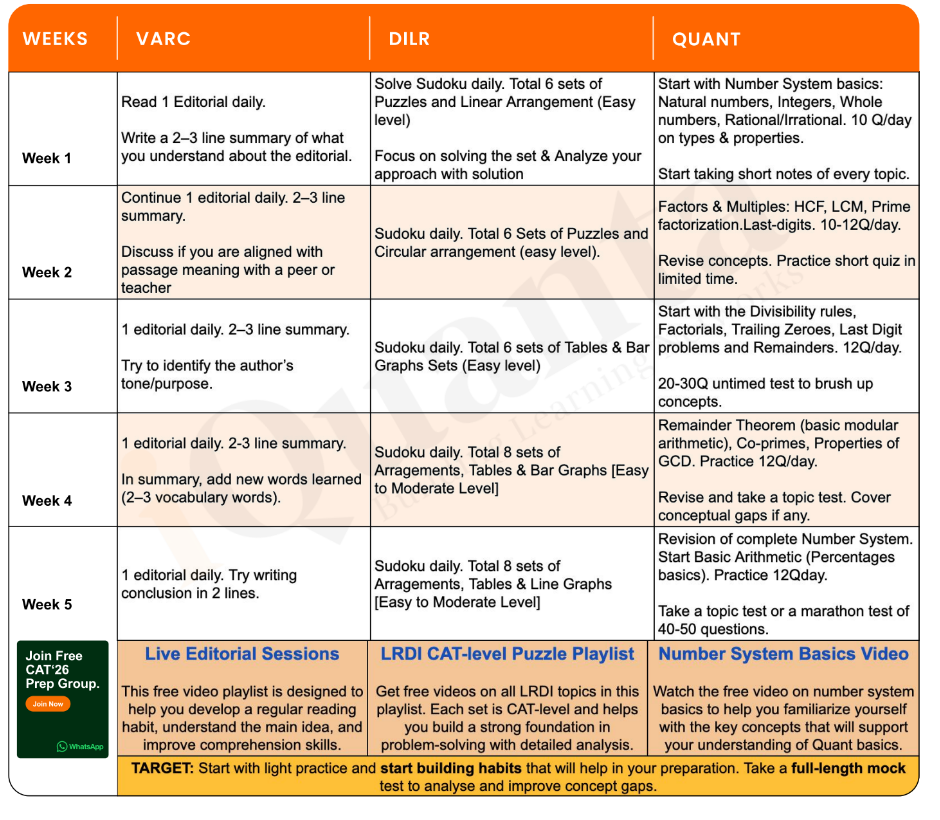
CAT Preparation: Detailed Week-Wise Strategy
Now we have covered the detailed CAT syllabus across VARC, DILR and QA but just aligning with the CAT exam syllabus will not be really helpful for candidates to cover CAT preparation instead they should be focused on the detailed week-wise strategy as CAT study plan. To get the detailed CAT exam study plan, candidates should check the button specified below.
Is Completing the CAT Syllabus Enough to Crack the Exam?
Common Admission Test assess candidates based on the aptitude skills which cannot covered by just completing the CAT exam syllabus for all the three sections instead you should maintain consistency for practicing problems, solving full-length CAT mock test series, PYQs and advanced modules to target CAT 2026 effectively.
CAT Mocks & Previous Year Questions
With the help of solving CAT mock test series and past year CAT papers, candidates can easily understand the pattern of questions came in Common Admission Test as it will be really helpful for the candidates to get the reflection of actual CAT exam. Candidates can check the iCAT mock test series by iQuanta.
Advanced Modules to Target Common Admission Test
It is very common among aspirants that they should not 100% confident to each and every section in the CAT exam and to understand the same concern, iQuanta has designed advance modules which are advantageous for both engineering and non-engineering aspirants to target CAT 2026 exam.
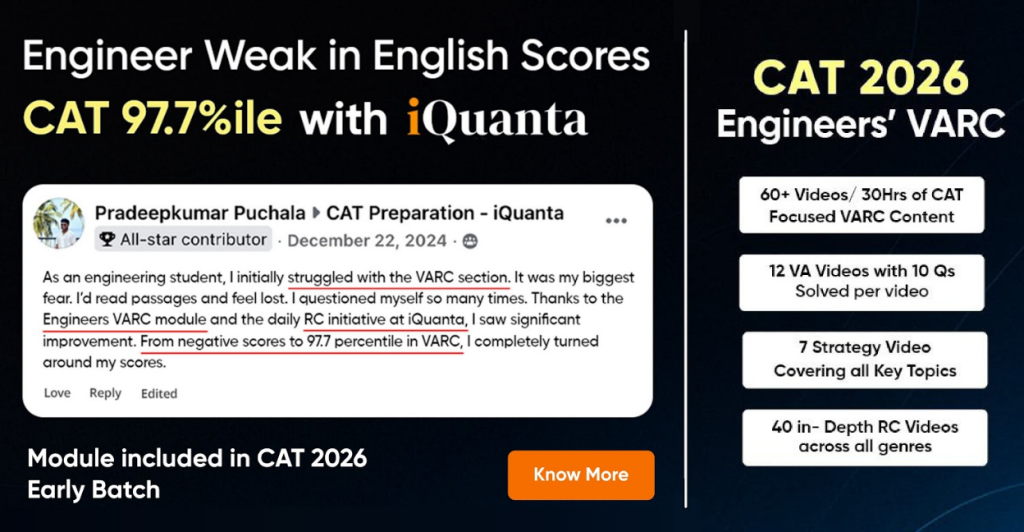
CAT 2026 Engineer’s VARC Module
CAT 2026 Non-Engineer’s QA Module

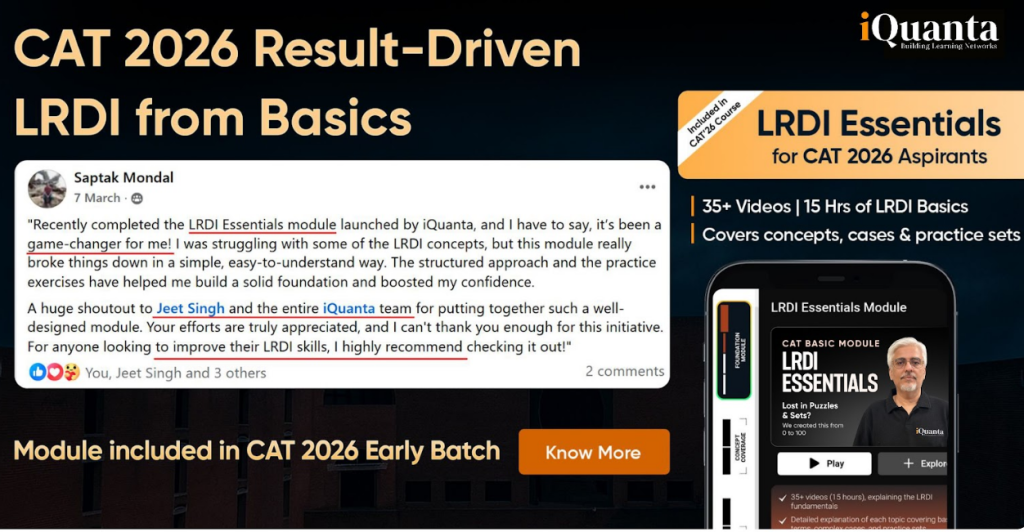
LRDI Essentials for Effective CAT 2026 Preparation
Meet Common Admission Test Toppers from iQuanta
Meet toppers from iQuanta who have shared their defined journey and proves that cracking competitive examination like Common Admission Test can be achievable with consistency, dedication and utilizing the best resources. Their hardwork have showcased in the result where overall CAT percentile crosses 99+.
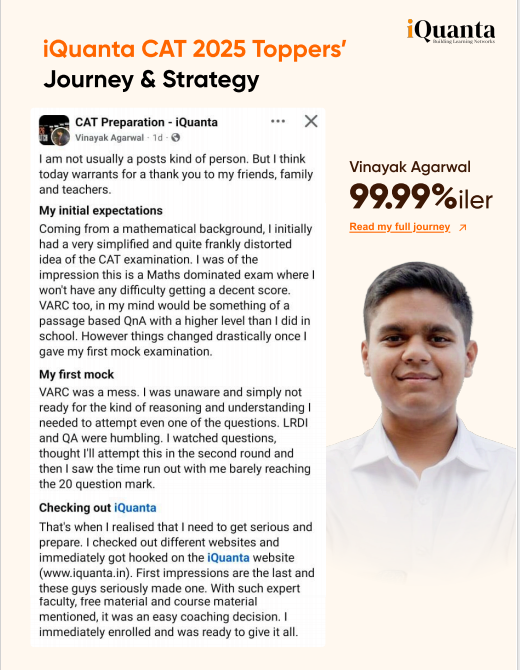
CAT Topper 2025 – Vinayak Agarwal (99.99%iler); iQuanta Student
| CAT 2025 Topper’s Name | VARC | DILR | QA | Overall Percentile |
| Vinayak Agarwal | 99.47 | 99.97 | 99.97 | 99.99 |
CAT 2025 Topper – Parav Goyal (99.98%iler); iQuanta Student
| CAT 2025 Topper’s Name | VARC | DILR | QA | Overall Percentile |
| Parav Goyal | 98.45 | 100 | 98.86 | 99.98 |

CAT Topper 2025 – Soumyadip Mukherjee (99.97%iler); iQuanta Student
| CAT 2025 Topper’s Name | VARC | DILR | QA | Overall Percentile |
| Soumyadip Mukherjee | 98.6 | 99.9 | 99.91 | 99.97 |

CAT Topper 2025 – Anmol Gupta (99.96%iler); iQuanta Student
| CAT 2025 Topper’s Name | VARC | DILR | QA | Overall Percentile |
| Anmol Gupta | 91.64 | 100 | 99.9 | 99.96 |

CAT Topper 2025 – Chirag Surana (99.96%iler); iQuanta Student
| CAT 2025 Topper’s Name | VARC | DILR | QA | Overall Percentile |
| Chirag Surana | 99.79 | 99.94 | 99.35 | 99.96 |

CAT Topper 2025 – Swastik Mukherjee (99.96%iler); iQuanta Student
| CAT 2025 Topper’s Name | VARC | DILR | QA | Overall Percentile |
| Swastik Mukherjee | 99.96 | 99.57 | 99.61 | 99.96 |

CAT Topper 2025 – Harsh Khudania (99.93%iler); iQuanta Student
| CAT 2025 Topper’s Name | VARC | DILR | QA | Overall Percentile |
| Harsh Khudania | 95.82 | 99.86 | 99.93 | 99.93 |

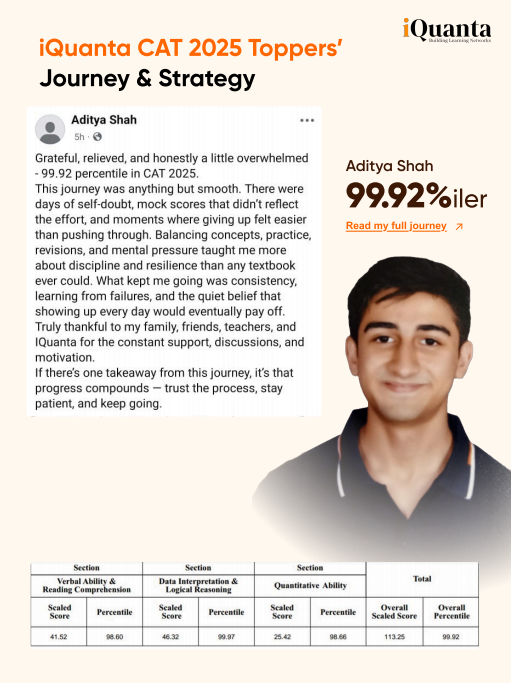
CAT Topper 2025: Aditya Shah (99.92%iler); iQuanta Student
| CAT 2025 Topper’s Name | VARC | DILR | QA | Overall Percentile |
| Aditya Shah | 98.60 | 98.97 | 99.66 | 99.92 |
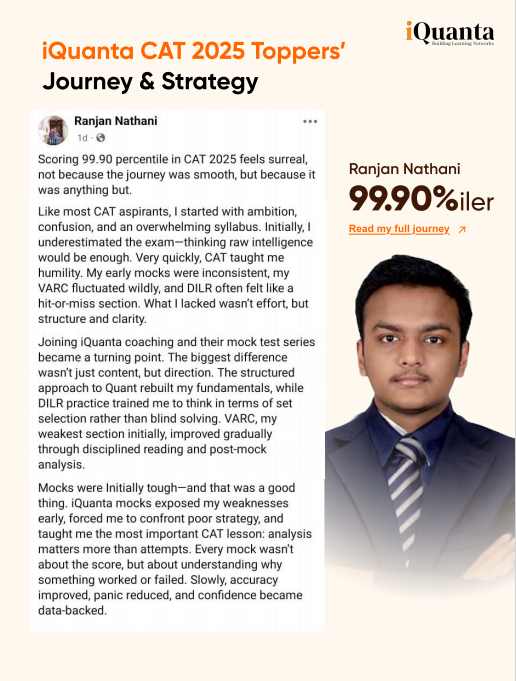
CAT Topper 2025: Ranjan Nathani (99.90%iler); iQuanta Student
| CAT 2025 Topper’s Name | VARC | DILR | QA | Overall Percentile |
| Ranjan Nathani | 99.95 | 87.72 | 99.94 | 99.90 |
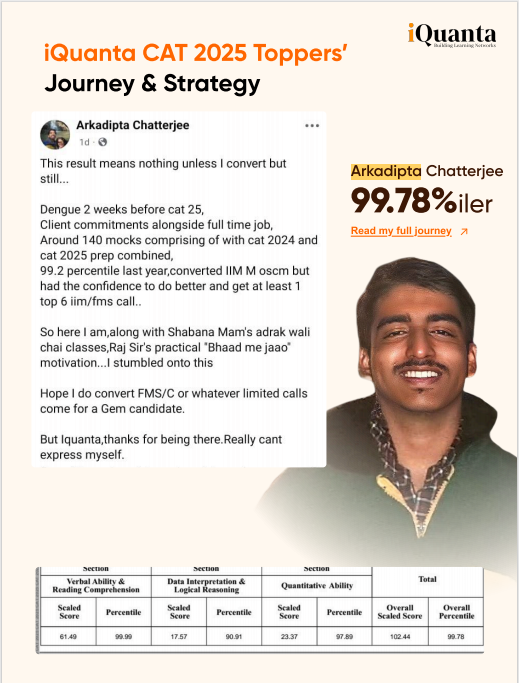
CAT Topper 2025 – Arkadipta Chatterjee (99.78%iler); iQuanta Student
| CAT 2025 Topper’s Name | VARC | DILR | QA | Overall Percentile |
| Arkadipta Chatterjee | 99.99 | 90.91 | 97.89 | 99.78 |
CAT Topper 2025 – Vivek Upadhyay (99.76%iler); iQuanta Student
| CAT 2025 Topper’s Name | VARC | DILR | QA | Overall Percentile |
| Vivek Upadhyay | 99.91 | 96.68 | 98.21 | 99.76 |

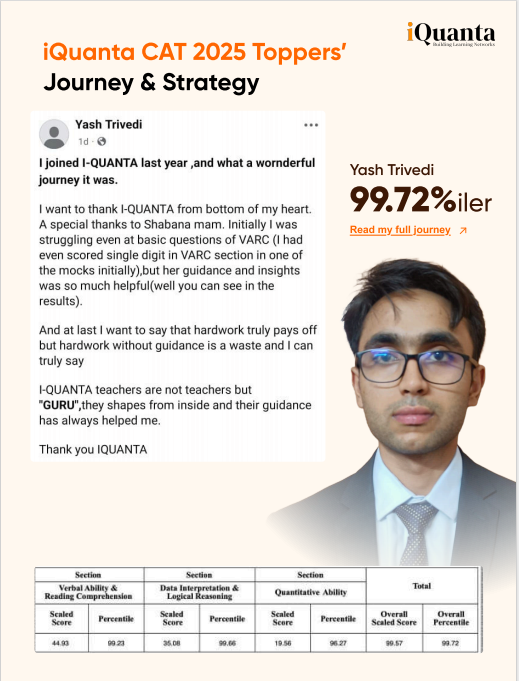
CAT Topper 2025 – Yash Trivedi (99.72%iler); iQuanta Student
| CAT 2025 Topper’s Name | VARC | DILR | QA | Overall Percentile |
| Yash Trivedi | 99.23 | 99.66 | 99.57 | 99.72 |
CAT Topper 2025 – Sankalp Raj (99.68%iler); iQuanta Student
| CAT 2025 Topper’s Name | VARC | DILR | QA | Overall Percentile |
| Sankalp Raj | 99.02 | 96.13 | 99.64 | 99.68 |

CAT Topper 2025 – Anuj Kumar Upadhyay (99.68%iler); iQuanta Student
| CAT 2025 Topper’s Name | VARC | DILR | QA | Overall Percentile |
| Anuj Kumar Upadhyay | 93.13 | 96.68 | 99.98 | 99.68 |

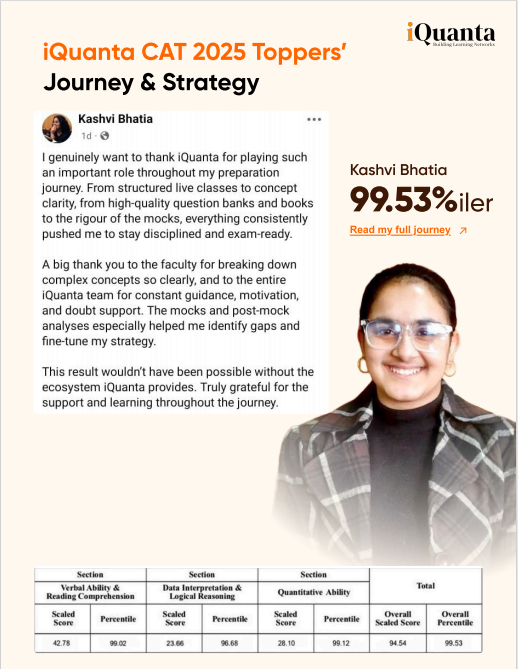
CAT Topper 2025 – Kashvi Bhatia (99.53%iler); iQuanta Student
| CAT 2025 Topper’s Name | VARC | DILR | QA | Overall Percentile |
| Kashvi Bhatia | 99.02 | 96.68 | 99.12 | 99.53 |
CAT Topper 2025 – Raman Khudia (99.49%iler); iQuanta Student
| CAT 2025 Topper’s Name | VARC | DILR | QA | Overall Percentile |
| Raman Khudia | 99.17 | 96.83 | 98.34 | 99.49 |

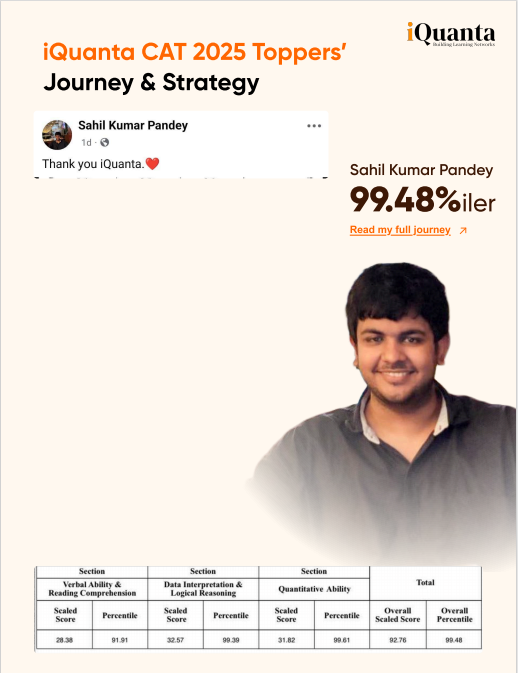
CAT Topper 2025 – Sahil Kumar Pandey (99.48%iler); iQuanta Student
| CAT 2025 Topper’s Name | VARC | DILR | QA | Overall Percentile |
| Sahil Kumar Pandey | 91.91 | 99.39 | 99.61 | 99.48 |
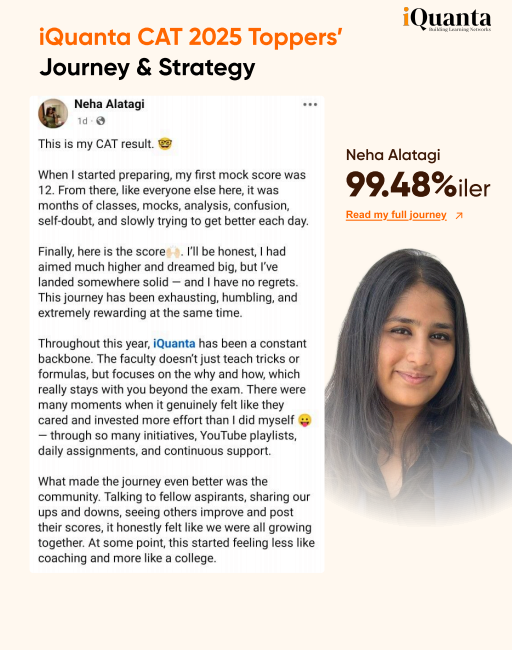
CAT Topper 2025 – Neha Alatagi (99.48%iler); iQuanta Student
| CAT 2025 Topper’s Name | VARC | DILR | QA | Overall Percentile |
| Neha Alatagi | 98.08 | 99.21 | 97.55 | 99.48 |
CAT Topper 2025 – Sri Tej Aduru (99.43%iler); iQuanta Student
| CAT 2025 Topper’s Name | VARC | DILR | QA | Overall Percentile |
| Sri Tej Aduru | 92.59 | 96.13 | 99.92 | 99.43 |

CAT Topper 2025 – Ehsaas Agarwal (99.41%iler); iQuanta Student
| CAT 2025 Topper’s Name | VARC | DILR | QA | Overall Percentile |
| Ehsaas Agarwal | 92.59 | 99.34 | 99.46 | 99.41 |
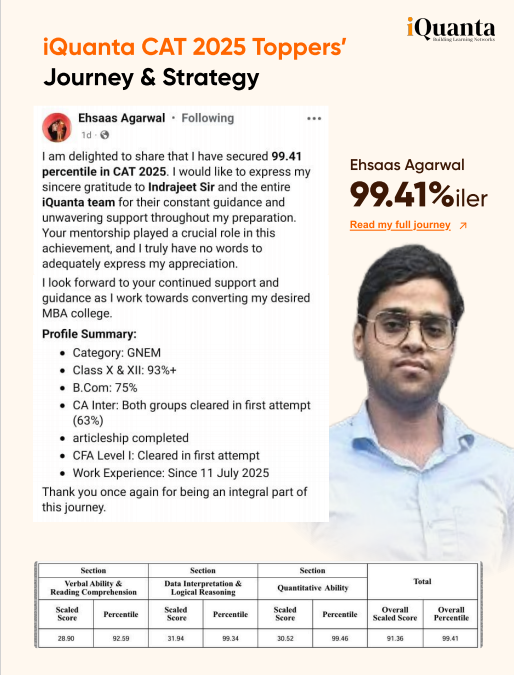
CAT Topper 2025 – Abhiraj Singh (99.39%iler); iQuanta Student
| CAT 2025 Topper’s Name | VARC | DILR | QA | Overall Percentile |
| Abhiraj Singh | 96.96 | 99.13 | 98.34 | 99.39 |
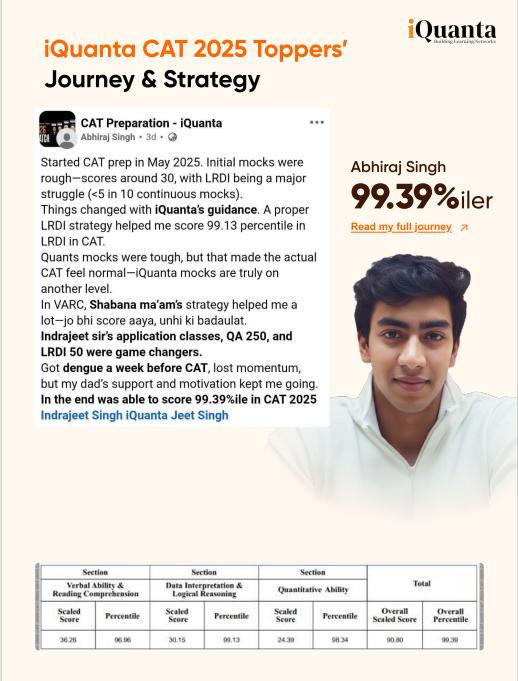
CAT Topper 2025 – Kushagra Barai (99.33%iler); iQuanta Student
| CAT 2025 Topper’s Name | VARC | DILR | QA | Overall Percentile |
| Kushagra Barai | 97.37 | 96.83 | 99.24 | 99.33 |
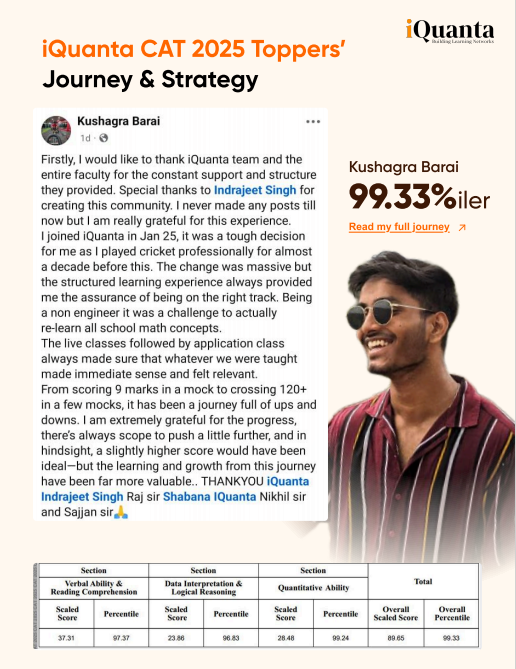
CAT Topper 2025 – Rohith Attilli (99.18%iler); iQuanta Student
| CAT 2025 Topper’s Name | VARC | DILR | QA | Overall Percentile |
| Rohith Attilli | 93.69 | 95.87 | 99.79 | 99.18 |
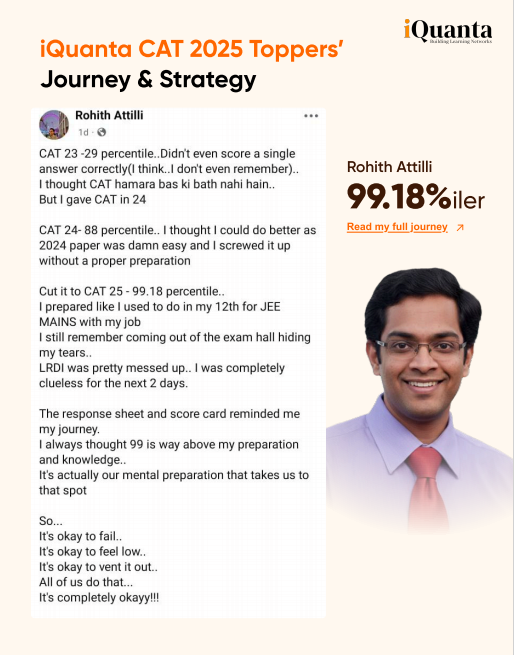
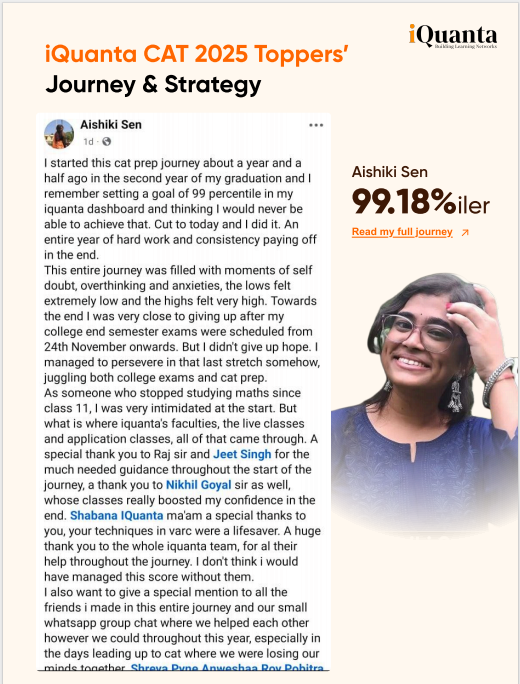
CAT Topper 2025 – Aishiki Sen (99.18%iler); iQuanta Student
| CAT 2025 Topper’s Name | VARC | DILR | QA | Overall Percentile |
| Aishiki Sen | 98.91 | 99.3 | 87.04 | 99.18 |
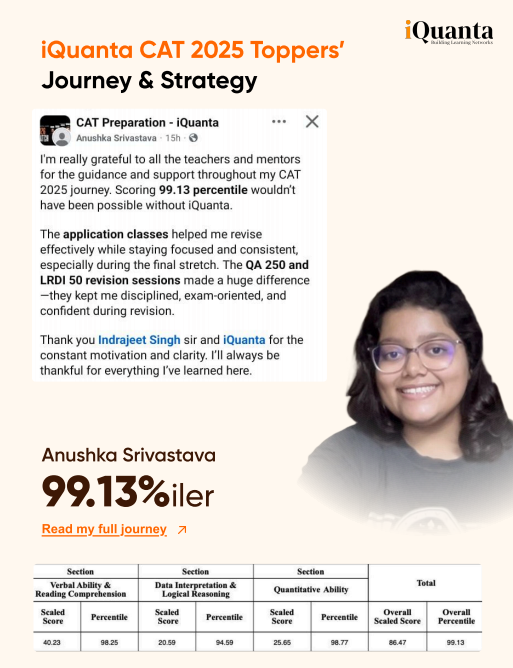
CAT Topper 2025 – Anushka Srivastava (99.13%iler); iQuanta Student
| CAT 2025 Topper’s Name | VARC | DILR | QA | Overall Percentile |
| Anushka Srivastava | 98.25 | 94.59 | 98.77 | 99.13 |
Struggling with Self-Preparation? Choosing the Best CAT Coaching in India
Just solving good amount of questions across sections is not enough to crack CAT exam. The detailed CAT preparation strategy comes with the expert guidance. Common Admission Test is a competitive examination where accuracy and time both matters to compete among pool of aspirants and the best way to make it possible is by following smart tricks that will mentor by expert CAT faculty who are having great accomplishment in the same industry. The complete information about top mentors is tabulated below.
| CAT Expert Faculty | Achievements |
| Indrajeet Singh | Founder & CEO, Wizard of Quant |
| Amit Panchmatia | CAT QA 100%iler, LRDI 99.8%iler |
| Shabana Shahab | CAT VARC 99.56%iler |
| Raj Kumar Jha | 6 Times CAT QA 100%iler |
| Kamal Lohia | CAT 99.99%iler, QA & LRDI Expert |
| Nikhil Goyal | CAT & XAT 99.9%iler |
| Sajjan Baranwal | CAT 99.8%iler, QA & LRDI Expert |
The CAT 2026 preparation will become easy for the candidates with expert mentorship and live classes where they will cover concepts in-depth along with 24*7 doubt solving support. Candidates can check iQuanta’s CAT 2026 full course with varied benefits specified below:
- 24*7 Doubt Solving Support
- 8000+ Quant, VARC & LRDI Practice Questions
- 3 Basics and Advanced Modules
- 35 Full & 45 Sectional Mock Tests

Conclusion: Common Admission Test
CAT examination opens different advantages for candidates whether it is about quality education, placement statistics, international exchange programs at top IIMs or B-schools. Common Admission Test is highly acceptable by maximum business schools in the country so preparing for it will give a clear advantage to fight for a successful careers across various domains.