

CAT 2026: Preparing for the Common Admission Test (CAT Preparation) comes with a detailed understanding of syllabus including important topics to be asked in exam along with their weightage. The whole examination is classified in 3 sections i.e, VARC, DILR & QA. These sections are aligned in the order where VARC comes first, followed by DILR & QA. The time duration for the CAT exam is 120 minutes or 2 hours. Every year, approximate 2-3 lakh candidates appeared in the exam while carrying their dream to pursuing management from top business schools like IIMs (Indian Institutes of Management). This blog covers the detailed strategy of the CAT exam with overview of CAT 2026 syllabus with weightage.
Join iQuanta’s diversified student community for free and prepare with other 4.1L+ peers. Get access to 24*7 doubt-solving, mentorship, free webinars, etc all at one single platform.

Does CAT Syllabus An Initial Step?
Many aspirant start their CAT preparation journey without a proper strategy but the initial step should be there to understand the complete roadmap in the form of CAT exam syllabus. The exam is the complete combination of VARC, DILR and QA. Every section has their defined topics which cover high-weightage to score maximum in the Common Admission Test. You will be redirected towards the important topics of CAT syllabus in the further section.
With the help of a CAT exam syllabus, candidates will be able to prepare the in-depth strategy across VARC, DILR and QA. This leads to an integral part of the consistency and determination which focusing on building a proper roadmap.
Below section is a comprehensive steps about the CAT preparation that will be realy helpful in your entire MBA journey.
Step-by-Step Process for CAT Preparation
This section covers the comprehensive steps about the complete CAT exam preparation. Candidates will get a clear pictures by understanding these steps in a detailed manner.
- Students should begin their CAT preparation journey by understanding detailed CAT syllabus across Verbal Ability & Reading Comprehension, Data Interpretation & Logical Reasoning and Quantitative Ability.
- Next, solve questions across CAT exam sections and analyze where you are making wrong and correct later during CAT preparation.
- Solving PYQs and Mock Test Papers will help you in reflecting the CAT exam pattern.
Why CAT Syllabus Covers 50% Strategy to Compete?
CAT Syllabus is an integral part of the exam preparation journey which is considered as one of the important parts to cover early. Just configuring entire CAT exam syllabus will not create a major impact because this exam is the combination of candidate’s problem solving and aptitude skills. There are three major sections who covers entire curriculum that later leads to a strategy to start mock test series and PYQs. Let’s discuss more about the CAT syllabus in below sections.
CAT Preparation – Detailed Syllabus To Start with CAT 2026
The first step to start the CAT preparation is the understanding of CAT syllabus which is revolving around three major parts – Verbal Ability & Reading Comprehension, Data Interpretation & Logical Reasoning and Quantitative Ability. Covering important topics across these sections with weightage is the major goal for the students in building accuracy and speed towards targeting 99+ percentile in the CAT exam. Let’s discuss the CAT syllabus across VARC, DILR & QA in a detailed manner.
Completing CAT syllabus early will be an advantageous for the candidates to understand concepts in-depth and will get extra space or time for solving maximum question without any hassle at last moment. Solving maximum question will give you a clear picture about your weakened concepts and later you will manage to complete it.
CAT Exam Preparation – Important Topics & Weightage of VARC
Verbal Ability & Reading Comprehension will be one of the important sections to prepare for CAT 2026 because it is not asked in the exam but also covers important weightage during interview process of IIMs. If candidates possess low scores in the particular section, then chances of getting calls from the top business schools would be less. Talking about the CAT preparation strategy of VARC, then building reading habits is the key to secure good scores in it. Candidates should try for Aeon essays, the Guardian, editorials and novels of their interest which leads to a success in CAT 2026. The detailed syllabus for the CAT VARC covers RC passages across various genres like Science and Technology, History, Arts and Literature, Economy and Business, Philosophy, Culture and Politics and Abstract Topics. There is an another important section which will be a part of VARC is Verbal Ability which include components such as Para Jumbles, Para Summary, Vocabulary and Odd One Out. The important topics asked in the CAT 2026 exam along with its important weightage is mentioned in the table given below.
| VARC Topics | Key Topics Covered |
| RC Passages | Science and Technology History, Arts and Literature Economy and Business Philosophy Culture and Politics Abstract Topics |
| Para Jumble | Arrange the sentences in a logical manner |
| Para Summary | Choose the correct summary that matches the exact idea of the paragraph |
| Vocabulary | This topic will involve questions related to assumptions, contextual meaning, conclusions and spot the error |
| Odd One Out | Determine irrelevant sentences that logically look different from the available options |
CAT VARC Syllabus 2026: Topic-Wise Weightage
This section covers the respective weightage of important topics which are widely asked in the CAT exam.
| VARC Topics | Number of Questions | Approximate Weightage (%) |
| RC Passages | 16 Questions – 4RCs – Each RC will have 4 different types of questions. | 55-60% |
| Correct the Sentences | 2 | 10-15% |
| Critical Reasoning | 2 | 5-10% |
| Vocabulary | 2 | 5-10% |
| Para Jumbles | 2 | 15-20% |
Also Read: 8 Months to CAT 2026: Why Is This Period Crucial for Your CAT Preparation?
CAT 2026 Exam – Topics to Be Covered in LRDI
LRDI stands for Logical Reasoning and Data Interpretation. The important topics under the LRDI CAT syllabus covers Tables and Charts, Games and Tournaments, Scheduling and Blood Relations, Venn Diagram & Hybrid Sets, Puzzles and Seating Arrangements. Many students think that LRDI is one of the complex sections in CAT exam due to sets of different patterns covered across. The CAT preparation for the particular section requires good problem-solving skills to articulate caselets in CAT 2026 with accuracy. Candidates should found the detailed syllabus for LRDI along with the weightage of important topics below.
| DI & LR Topics | Key Topics Covered |
| Tables and Charts | Tabular Data Mixed Sets Bar Charts Line Charts Pie Charts |
| Games and Tournaments | Scoring-System Round-Robin Knockout |
| Scheduling and Blood Relations | Direct Reasoning Task Allocation Family Trees |
| Venn Diagrams & Hybrid Sets | Logical Deduction Set Theory |
| Puzzle and Seating Arrangements | Linear Arrangements Circular Arrangements Grid-Based Arrangements Complex Arrangements |
Topic-Wise Weightage For DILR Syllabus
Good knowledge about the weightage for DILR topics is really indispensable during CAT preparation for the students who are highly indulge in understanding CAT syllabus in their early preparation. Candidates should have a look on the topic-wise weightage for DILR syllabus below.
| DI & LR Topics | No. of Questions | Approximate Weightage (%) |
| Tables and Charts | 4-6 | 40–50% |
| Games and Tournaments | 4-5 | 10-20% |
| Scheduling and Blood Relations | 3-4 | 5-10% |
| Venn Diagrams & Hybrid Sets | 2-3 | 5-10% |
| Puzzle and Seating Arrangements | 3-4 | 50-60% |
CAT Preparation – Important Topics in QA To Target CAT 2026
Quantitative Ability overall asks the problem-solving ability with accuracy from candidates and also include important topics such as Arithmetic, Algebra, Geometry and Mensuration, Number System, and Modern Maths. Among all these major topics, candidates should cover both Arithmetic and Algebra which is widely covering major portion of Quants in the CAT exam. Please find the attached CAT QA syllabus along with detailed weightage.
| Most Important QA Topics | Quantitative Aptitude Sub-Topics |
| Arithmetic | Percentages Profit and Loss Simple Interest and Compound Interest Ratio and Proportion Averages Mixture and Alligations Time and Work Pipes and Cisterns Time, Speed and Distance Races Trains and Boats |
| Algebra | Linear Equations Quadratic Equations Polynomials Indices and Surds Logarithms Inequalities Modulus Sequence & Series Functions Graphs |
| Geometry and Mensuration | Triangles Quadrilaterals Polygons Circles Mensuration – 3D Co-ordinate Geometry |
| Number System | Properties of Integers Divisibility Remainder Theorem Factors LCM & HCF Factorial Trailing Zeroes Last Digits |
| Modern Maths | Set Theory Probability Permutation and Combination |
Section-Wise Weightage for QA Topics
The CAT Quantitative Aptitude syllabus covers the important areas such as Arithmetic, Algebra, Geometry, Mensuration, Number System and Modern Maths. The approximate number of questions and weightage across these important concepts are specified in the table mentioned below.
| Most Important QA Topics | Approx Number of Questions | Approximate Weightage (%) |
| Arithmetic | 7-9 | 35–50%. |
| Algebra | 5-8 | 25-35% |
| Geometry and Mensuration | 2-3 | 10-15% |
| Number System | 1-2 | 5-10% |
| Modern Maths | 1-2 | 5-10% |
CAT 2026 Exam Pattern
The complete details about the CAT exam pattern along with time duration is specified in the table mentioned below.
| Sections in CAT 2026 | Number of Questions Asked in the CAT Exam | Time Allotted Across Sections in CAT Exam |
| Verbal Ability & Reading Comprehension | 24 | 40 |
| Data Interpretation & Logical Reasoning | 22 | 40 |
| Quantitative Ability | 22 | 40 |
Important Points to Keep in Mind During CAT Preparation
Candidates should cover these important points to align the focused CAT preparation.
- It is important for aspirants to understand the CAT syllabus in a detailed manner across VARC (Verbal Ability & Reading Comprehension), DILR (Data Interpretation & Logical Reasoning) and QA (Quantitative Ability).
- Solving sufficient amount of questions along with covering live lectures across sections is really crucial for candidates during CAT preparation.
- Concentration and consistency both are an important factors if candidates are planning to appear for CAT 2026 exam because it is a sectional test and each section covers specified time limit to solve questions and this is the biggest reason for practicing maximum patterns before appearing for the actual exam.
- Mock Test Series, Sectional Mock Tests and Previous Year Questions (PYQs) all are an integral components of CAT preparation that helps you to actually understand the CAT exam pattern.
- While solving CAT full length mock test series (iCAT), candidates should analyze their performance and cover the weak concepts before appearing for CAT 2026.
CAT 2026 Preparation with Unique Modules of iQuanta
There are several months left for the CAT 2026 and preparing early for the CAT exam is a key factor for students to compete. People with diverse background sit for the Common Admission Test and preparing effectively for the sections whether it is VARC, DILR & QA, candidates should look at the unique modules prepared by iQuanta to streamlined the focused approach. The unique modules cover Non-Engineer’s Quant, Engineer’s VARC and LRDI Essentials.
CAT Preparation: Non-Engineers’ Quant
Candidates who are coming from the non-engineering background may not get in-touch with mathematics in their graduation and might forgotten fundamental concepts. To help them gain confidence and accuracy while solving Quant questions, iQuanta has designed a unique module that directly impacts their sectional scores in the Quantitative Ability. Non-Engineers’ Quant module for CAT 2026 aspirants covers –
- 70+ videos of basic Math
- 300+ important questions covering the most essential concepts
- 6th-10th NCERT concepts for CAT

CAT Preparation: CAT 2026 Engineer’s VARC
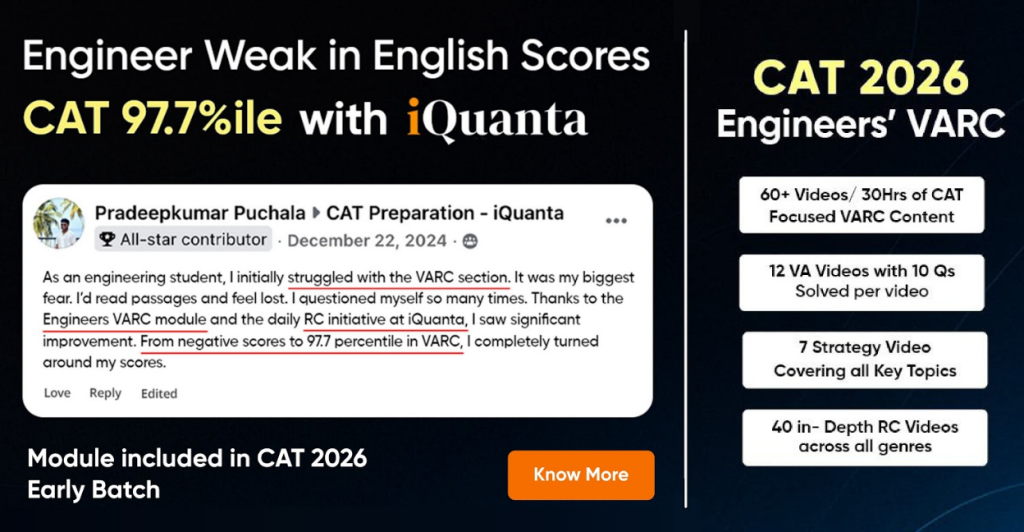
Candidates who are coming from engineering background are initially struggled with the VARC section and this factor is widely considered as the biggest fear for them. To improve accuracy while solving RCs of various genres, candidates should cover the CAT 2026 Engineers’ VARC module. The features for the respective module are mentioned below.
- 60+ videos / 30 hours of CAT focused VARC content
- 12 VA videos with 10 questions solved per video.
- 7 strategy video covering all key topics
- 40 in-depth RC videos across all genres.
CAT Preparation: LRDI Essentials for CAT 2026 Aspirants
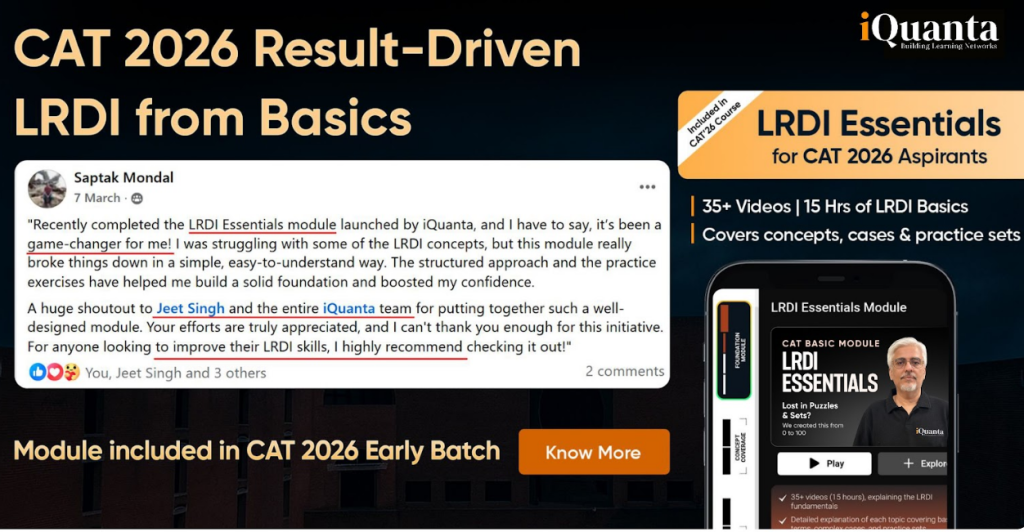
LRDI (Logical Reasoning & Data Interpretation) is one of the important sections for CAT preparation and targeting CAT 2026 exam. This section include complex sets or caselets to solve. To get the accuracy and speed both for covering questions in Logical Reasoning & Data Interpretation, candidates should follow LRDI Essentials module. The features of LRDI essentials for CAT 2026 aspirants is mentioned below.
- 35+ videos / 15 hours of LRDI basics
- Cover concepts, cases and practice sets.
CAT 2026 Exam Preparation with iQuanta’s Full Course
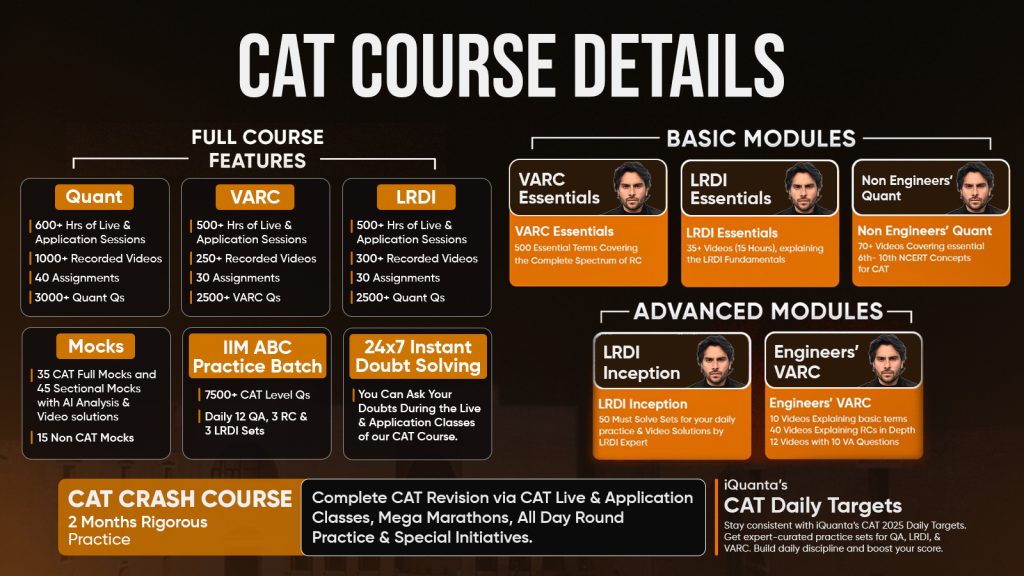
The CAT 2026 preparation will become easy for the candidates with expert mentorship and live classes where they will cover concepts in-depth along with 24*7 doubt solving support. The complete flow diagram of a CAT 2026 course is mentioned in the graphic given below.
CAT 2026 – Meet Top CAT Faculty for Expert Mentorship
Just solving good amount of questions across sections is not enough to crack CAT exam. The detailed CAT preparation strategy comes with the expert guidance. Common Admission Test is a competitive examination where accuracy and time both matters to compete among pool of aspirants and the best way to make it possible is by following smart tricks that will mentor by expert CAT faculty who are having great accomplishment in the same industry. The complete information about top mentors is tabulated below.
| CAT Expert Faculty | Achievements |
| Indrajeet Singh | Founder & CEO, Wizard of Quant |
| Amit Panchmatia | CAT QA 100%iler, LRDI 99.8%iler |
| Shabana Shahab | CAT VARC 99.56%iler |
| Raj Kumar Jha | 6 Times CAT QA 100%iler |
| Kamal Lohia | CAT 99.99%iler, QA & LRDI Expert |
| Nikhil Goyal | CAT & XAT 99.9%iler |
| Sajjan Baranwal | CAT 99.8%iler, QA & LRDI Expert |
CAT Result – Maximum 99+ Percentilers from iQuanta
This year again iQuanta served an amazing result and have maximum 99+ percentilers. What iQuanta team has delivered is nothing short of commendable. 20-25 students scored 99.90+ percentiles from iQuanta, including 99.99, 99.98, 99.97, and 99.96 with three achievers in each bracket. Out of the mentioned numbers 2500 across India, 600+ 99%ilers belongs to iQuanta itself. The perfect combination of leadership, guidance and expert mentorship from Indrajeet sir and other expert CAT faculty resulted an impressive result of students in CAT 2025. There are some students who have shared their success stories and still continuing……………………….
- Vinayak Agarwal (99.99%ile)
- Parav Goyal (99.98%ile)
- Soumyadip Mukherjee (99.97%ile)
- Swastik Mukherjee (99.96%ile)
- Anmol Gupta (99.96%ile)
- Chirag Surana (99.96%ile)
- Harsh Khudania (99.93%ile)
- Aditya Shah (99.92%ile)
- Rajan Nathani (99.90%ile)
- Arkadipta Chatterjee (99.78%ile)
- Yash Trivedi (99.72%ile)
- Sankalp Raj (99.68%ile)
- Vivek Upadhyay (99.76%ile)
- Anuj Kumar Upadhyay (99.68%ile)
- Kashvi Bhatia (99.53%ile)
- Raman Khudia (99.49%ile)
- Sahil Kumar Pandey (99.48%ile)
- Neha Alatagi (99.48%ile)
- Sri Tej Aduru (99.43%ile)
- Ehsaas Agarwal (99.41%ile)
- Kushagra Barai (99.33%ile)
- Rohith Attilli (99.18%ile)
- Aishiki Sen (99.18%ile)
- Anushka Srivastava (99.13%ile)
Conclusion: Focused Strategy for CAT 2026 Exam
Common Admission Test 2026 is the next milestone for the candidates who wish to pursue management program from the top IIMs or B-schools in the country. The whole examination covers the detailed strategy across Verbal Ability & Reading Comprehension, Data Interpretation & Logical Reasoning and Quantitative Ability. Candidates should start CAT preparation by understanding the detailed syllabus across sections, covering live classes to refer the applications supporting particular topic or concept. The best way to follow the synopsis behind the word “focused CAT preparation” comes with expert mentorship which is really helpful while solving questions with smart tricks or strategies.

FAQs: CAT 2026 Preparation
Early preparation for CAT 2026 exam help candidates in covering CAT syllabus in-depth where each topic will be covered properly and this will be an advantage for the candidates who started their early CAT preparation.
There are three major sections involved in the Common Admission Test –
1. Verbal Ability & Reading Comprehension (VARC)
2. Data Interpretation & Logical Reasoning
3. Quantitative Ability
The CAT exam pattern include three sections – VARC, DILR & QA where VARC covers 24 questions, DILR covers 22 questions and last, Quantitative Ability which possess 22 questions again. The overall number of questions covered is 68 according to the previous year analysis and the total time duration of CAT exam is 120 minutes or 2 hours.
The main topics covered in Quantitative Ability to target CAT 2026 are Arithmetic, Algebra, Geometry and Mensuration, Number System and Modern Maths.
Verbal Ability & Reading Comprehension is classified as RCs, and the other part is Verbal Ability. The major portion in Verbal Ability & Reading Comprehension is covered by RCs of various genres where Verbal Ability introduce concepts like Para Jumbles, Para Summary, Odd-One-Out.
Candidates should follow consistency during CAT preparation where initial steps for them should have the in-depth understanding of CAT syllabus along with the consistent revision of concepts and important formulae. Post completing syllabus, candidates should focused towards the CAT full length mock test series and PYQs to cover the different patterns of CAT-level questions before appearing for the actual exam.