

CAT Preparation Strategy: CAT is one of the most popular management entrance tests in the country. Over 2 lakhs candidates appear in this exam every year. This exam requires focused preparation and consistency. That’s the reason why many aspirants ask, “I am a weak student. Can I crack the CAT 2026 Exam?” Many students consider themselves weak due to poor academic performance or because they come from Tier 3 colleges. But now they want to ace the CAT exam with flying colours.
So, it’s natural to ask: Can a weak student crack CAT, or what is the best CAT preparation strategy for weak students? And CAT is the only entrance test that gives equal opportunity to every aspirant. CAT has three sections: Quant, DILR, and VARC. You can gain an edge in Quant if you have studied it well in your 10th, 12th, or graduation. Still, Quant is more about aptitude than advanced maths. If you are weak in Maths, you can still build a strong foundation with a focused approach. DILR and VARC questions do not require heavy calculations or formula tricks. So, you can excel in all three sections with the right mindset. We have shared below the focused CAT strategy for weak students who want to secure 99+%ile in CAT.
Join iQuanta’s diversified student community for free and prepare with other 4.1L+ peers. Get access to 24*7 doubt-solving, mentorship, free webinars, etc all at one single platform.

CAT Preparation Strategy for Weak Students
The CAT exam covers three sections: Verbal Ability and Reading Comprehension (VARC), Data Interpretation and Logical Reasoning (DILR), and Quantitative Ability (QA). If you are weak in any of these subjects, you should have a clear CAT exam preparation strategy. This will help you build a strong base and understand advanced topics without confusion. Let’s see the section-wise CAT preparation strategy for weak students:
CAT Strategy for VARC
You can excel in the CAT VARC section by mastering reading skills. Here are the tips and tricks to perform well in VARC for CAT:
- This section is 70% about reading comprehension. It is the main component of VARC. You need to build a daily habit of reading the newspaper and high-quality articles based on different themes. This can improve your ability to read passages faster without losing meaning.
- Vocabulary and Context usually hold 30% of the weightage in this section. Do not focus on guesswork or randomly memorising word lists. You need to understand the context of every term. Example: In a politics RC, you should be familiar with terms like “right-wing” or “left-wing.” In a Philosophy RC, you need to know the meaning of “nihilism” or “existentialism.”
Recommended Tools/Resources: Generally, you can read the editorial section of newspapers (The Hindu) and magazines (The Guardian). This can help you learn new words and improve your comprehension skills. Still, many of you struggle with consistency and don’t know where to start. This is where iQuanta CAT 2026 course steps in. It helps you build a solid foundation from zero level. Its VARC Essentials Module offers a repository of these key terms and 500+ articles. You can learn these terms through their interactive videos, articles, and focused RC practice. This will not only improve your reading ability but also help you practice exam-level questions.

CAT Exam Preparation Strategy for Quant
Quantitative Ability (QA) for CAT is the only section that has a defined syllabus. This makes the questions a bit predictable in the CAT exam. If you analyse past papers, you will get a rough idea of the type of questions usually asked in Quant. Check out the CAT strategy for the Quant section below:
- You can start with the Number System. It serves as a base for several topics like Divisibility, LCM/HCF, factors, etc. Even if there are no direct questions from the number system, you can still use its rules to solve questions from different Quant topics. It can even help you in solving DI sets.
- Master concepts of every Quant Topic. Understand the basics first and practice 25-30 questions related to it. This can help you handle tough questions well. This is the only way to solidify your Quant section.
- Keep practising until you recognise question types instantly. This will help you achieve mastery and strengthen your question-selection strategies.
There are times when you may not solve all the questions accurately. All you need is conceptual clarity. You can either learn it from your mentors or join the iQuanta CAT 2026 course. This program offers the Non-Engineer’s Quant Module. It covers fundamentals from class 6 to 10th NCERT to CAT-level concepts. Once you learn the basics, solve 30-40 questions related to that particular topic. This can boost your confidence and build your foundation from the ground up.

CAT Preparation Strategy for LRDI
LRDI is basically an unwritten syllabus. This section covers questions related to arrangements, Venn Diagrams, reasoning-based DI, Quant-based DI/reasoning, etc. Many times when you try to solve them, you may not recognise the question type instantly. You may first treat it as a puzzle only and later categorise it. In short, there are greater chances that DILR sets will be unpredictable. You need to build a flexible approach to problem-solving. You must establish a realistic target for solving different sets. Initially, you may find these sets a bit time-consuming. The more you practice, the better your pattern-recognition skills will become. Check the CAT exam preparation strategy for LRDI below:
- Clear basic concepts across all the topics. Start by solving LRDI sets from the CAT past papers before 2016. This paper usually comprises easy questions. This can solidify your foundation and boost your confidence. It will also help you learn expert techniques to identify patterns instantly.
- Once you understand concepts, start solving complex and abstract sets from CAT papers post 2017. You can also solve mocks to track your progress.
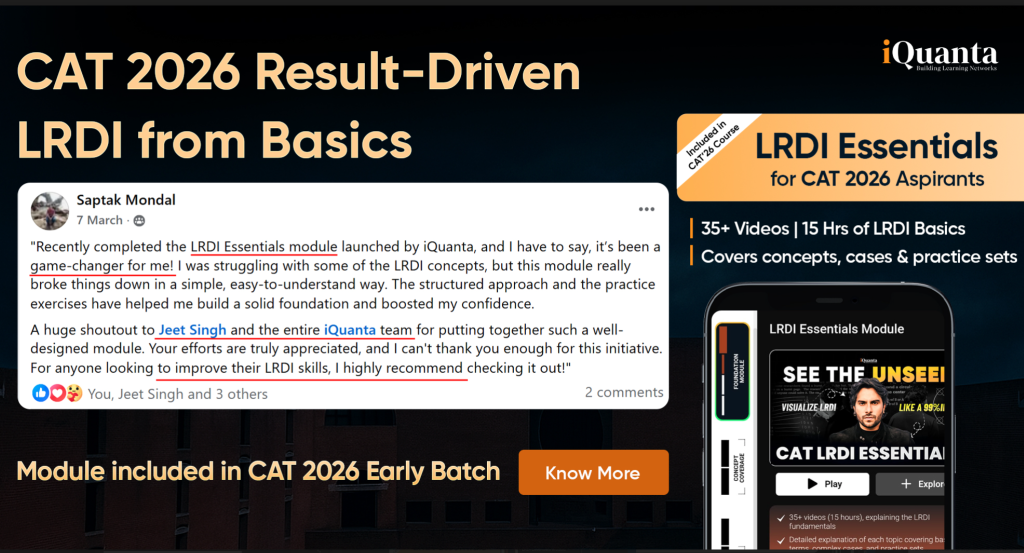
Many students may not be able to solve past papers before 2016 due to poor concepts. If you are struggling with fundamentals, check the LRDI Essentials Module in the iQuanta CAT 2026 course. It helps you learn the basics from scratch across every topic. This simplifies your question-solving approach and advances your preparation.
Being a weak student does not reduce your chances of clearing the CAT exam. All you need is the right CAT preparation strategy and dedication. CAT mainly rewards conceptual clarity and accuracy. So, you need a sectional approach for VARC, Quant, and DILR. Regular practice of all topics can turn your weakness into power. To help you, iQuanta has launched the CAT 2026 course. It offers interactive classes, customised modules, 24X7 doubt-solving support, mocks with analysis, and more.