1. Khet Bachao Abhiyan – Rabi 2026
Launched by: Ministry of Agriculture and Farmers Welfare
Launch location: Karnal, Haryana
Duration: 22 October to 30 November 2026
Objective: To promote sustainable agriculture, preserve soil health, ensure optimal use of water, and encourage farmers to adopt and judiciously use agricultural inputs for the Rabi season.
Focus of the initiative:
- To promote soil testing among farmers for the judicious use of fertilizers.
- Encouraging water conservation and supporting groundwater recharge.
- Crop diversification through the promotion of millets, oilseeds, and pulses, along with climate-resilient farming.
- Promotion of farm mechanisation, crop management, and crop residue handling.
Implementation: Through mass outreach via Kisan Chaupals and farmers’ conferences targeting Gram Panchayats, in coordination with state governments and ICAR.
2. Commission for Air Quality Management (CAQM)
Current Affairs: The Commission for Air Quality Management (CAQM) reviewed dust pollution in Delhi and directed agencies to strengthen mitigation strategies.
About the Commission for Air Quality Management (CAQM):
- Nature: A statutory body formed under the National Capital Region and Adjoining Areas Act, 2021.
- Jurisdiction: National Capital Region and the bordering states of Punjab, Haryana, Uttar Pradesh, and Rajasthan.
- Replaced: The Supreme Court-formed Environment Pollution (Prevention and Control) Authority (EPCA).
Composition:
- Chairperson: Must have a minimum of 15 years of experience in the field of environment or 25 years of experience in public administration.
- Tenure: 3 years or until the age of 70 years, whichever is earlier.
- Members: Must include representation from the Union Government, concerned states, technical experts, and NGOs.
Powers and Functions:
- It has overriding powers over state governments in case of conflict.
- It can restrict activities causing pollution, inspect industries, and shut down non-compliant units.
- In case of non-compliance, the document states a penalty of imprisonment of up to 5 years or a fine of up to Rs. 1 crore.
- It enforces the Graded Response Action Plan (GRAP) to control pollution and addresses the stubble mitigation framework and biomass co-firing norms.
Note: Appeals against CAQM orders are filed with the National Green Tribunal (NGT).
3. 7th Agrivoltaics World Conference
Venue: Bharat Mandapam, New Delhi
Hosted by: Ministry of New and Renewable Energy, in collaboration with Germany’s Federal Ministry for the Environment (BMUV) and Conexio-PSE.
Theme: Powering the Global South
What are Agrivoltaics?
Agrivoltaics combines agricultural land use with solar panels, where land is used for agriculture beneath elevated solar photovoltaic structures.
Its aim is to build a farmer-centric, economical model that enhances productivity through the dual use of land for food and energy security.
Advantages:
- Optimal land use and regulation of the microclimate.
- Helps in water retention in soil.
- Helps farmers increase supplementary and sustainable income.
Note: Agrivoltaics can help India in its Net-Zero transition and in achieving the 500 GW non-fossil energy target.
4. 9th IBSAMAR 2026
Image 1 from the original document
What is IBSAMAR?
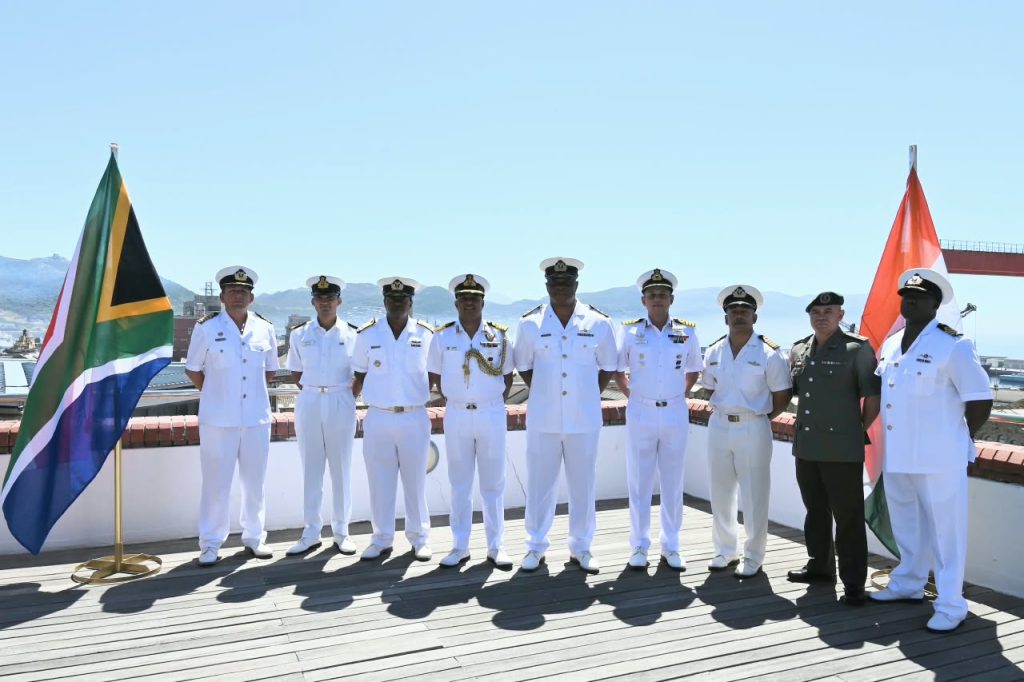
It is a trilateral naval exercise between India, Brazil, and South Africa.
- Framework: IBSA (India–Brazil–South Africa) Dialogue Forum.
- Established: Under the 2003 Brasilia Declaration.
- Location: Simon’s Town, South Africa.
- Edition: 9th IBSAMAR, concluded in October 2026.
Phases of the exercise:
- Harbour phase
- Sea phase
Major areas of focus:
- Surface warfare
- Anti-air operations
- Anti-submarine warfare
India’s representation: Guided-missile stealth frigate INS Tarkash.
5. Emissions Gap Report 2026
Released by: United Nations Environment Programme (UNEP)
Major finding: The 1.5°C global warming target under the Paris Agreement is unattainable without a temporary overshoot.
Current Situation:
- Global greenhouse gas emissions reduced in 2025, but CO₂ emissions from fossil fuels continued to rise.
- In 2024, for the first time, the global temperature rise exceeding 1.5°C above pre-industrial levels was recorded.
- Temperatures could return below 1.5°C by 2100 if deep mitigation is coupled with massive Carbon Dioxide Removal (CDR).
Note: Nationally Determined Contributions (NDCs) are insufficient, reducing emissions by merely 11%–15% by 2035.
6. Army Commanders’ Conference
Image 2 from the original document
About the Conference:
It is a biannual policy forum chaired by the Chief of Army Staff to discuss operational readiness, emerging security dynamics, and the modernisation of the military.
Land Warfare Doctrine:
During the conference, the Defence Minister released the Land Warfare Doctrine to provide a strategic framework for adapting to evolving battlefield dynamics.
Major focus of the Doctrine:
- Integrating conventional military domains with multi-domain warfare, including cyberspace, space, and electronic warfare.
- Adopting emerging technologies such as Artificial Intelligence (AI), unmanned platforms, and surveillance through autonomous systems.
- Addressing dual security challenges involving China and Pakistan.
7. Defence Cooperation Pact Between Qatar, Pakistan, Turkey, and Indonesia
Image 3 from the original document
About the Pact:
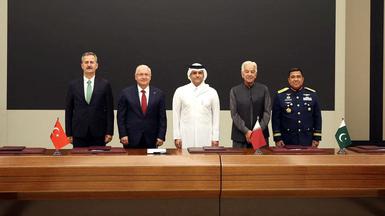
It is a quadrilateral defence agreement, also called the Badr Memorandum of Understanding, signed by Pakistan, Turkey, Qatar, and Indonesia.
Key Features:
- It is a defence industrial cooperation agreement, not a collective security arrangement like NATO.
- The MoU focuses on:
- Defence industrial manufacturing.
- Joint research and development.
- Transfer of technology.
- Joint military training.
- It aims to pool the signatory nations’ manufacturing capabilities to enhance defence capabilities and supplies to allied nations.