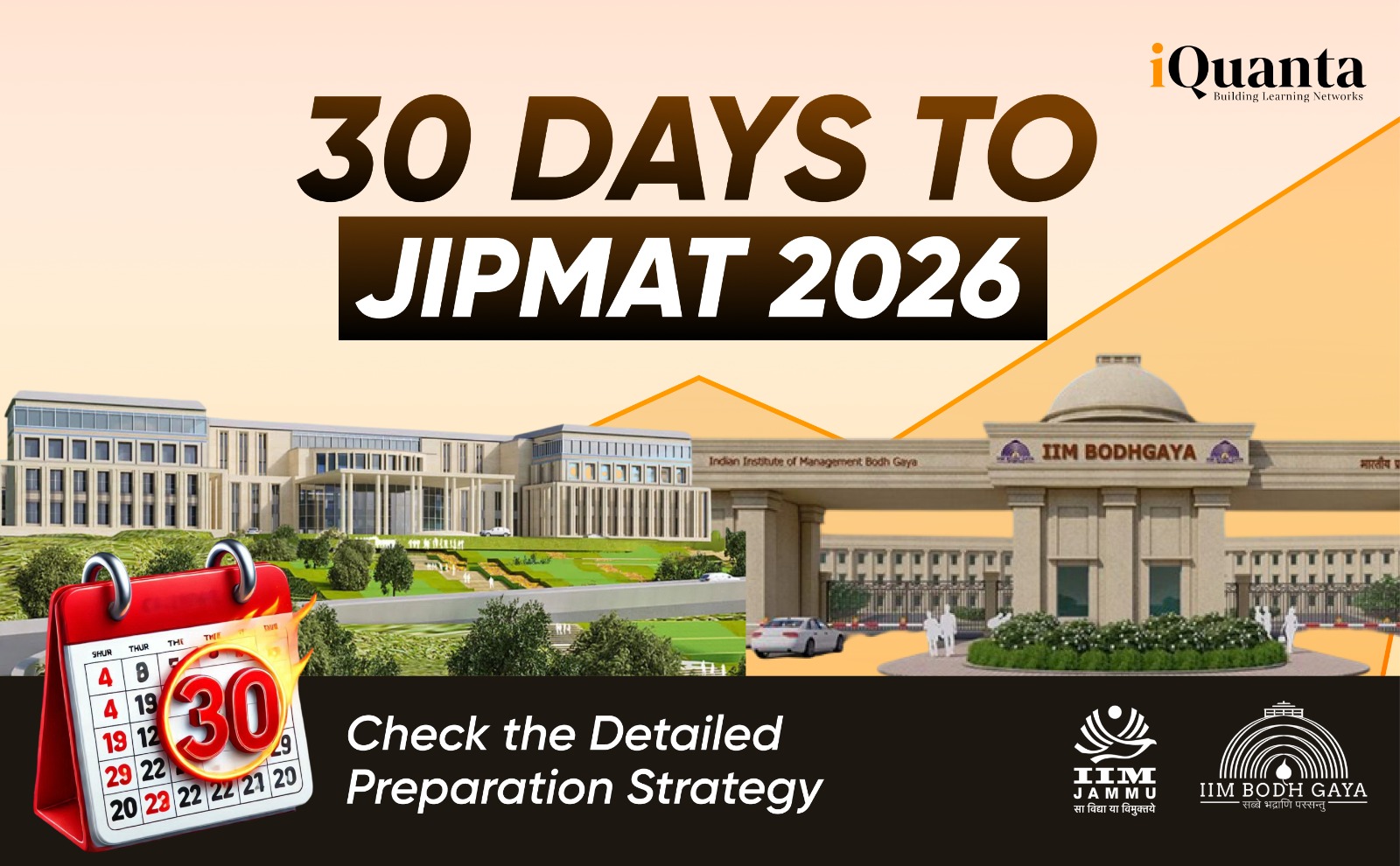
JIPMAT stands for the Joint Integrated Programme in Management Aptitude Test. This exam is conducted by the National Testing Agency (NTA), but candidates have to understand that the JIPMAT exam is just an exam by NTA. The exam body has no role after your JIPMAT scores. The colleges you can target with the help of this exam are IIM BodhGaya and IIM Jammu.
Now, the clock is ticking, and there are only 30 days left to the JIPMAT exam which is quite an indispensable period for the candidates to be completely focused towards cracking such a competitive exam. This detailed preparation strategy and solving PYQs helps you to better understand the examination that leads to the top scores.
Join this free IPMAT preparation WhatsApp group to get free study material, strategies by toppers and experts, latest updates and more
Starting with Understanding the JIPMAT Exam Pattern
This section covers the detailed exam pattern of the JIPMAT exam. This exam covers three major sections, including the Quantitative Aptitude (QA), Data Interpretation & Logical Reasoning (DILR) and Verbal Ability & Reading Comprehension (VARC).
| Sections | Number of Questions |
| Quantitative Aptitude (QA) | 33 |
| Data Interpretation & Logical Reasoning (DILR) | 33 |
| Verbal Ability & Reading Comprehension (VARC) | 34 |
| Total | 100 |
The total number of questions asked in the exam is 100, with a total time duration of 150 minutes.
Detailed 30-Day Preparation Strategy for the JIPMAT 2026
Your 30-day JIPMAT 2026 prep window is tighter than it sounds but entirely workable if you stop treating every day as a fresh start and instead treat it as one deliberate unit inside a larger system, as here’s exactly how to use those 30 days.
- Days 1 – 3: Quant foundation first: Arithmetic, Algebra, Number Systems, Geometry. These four areas cover the bulk of the QA section. Work from first principles, not shortcut tricks you’ll forget under pressure.
- Days 4 -5: Verbal basics: Focus only on reading comprehension structure and para-jumbles. Skip vocabulary drilling for now, as it produces anxiety more than marks at this stage.
- Days 6 – 7: Logical reasoning patterns: Syllogisms, seating arrangements, blood relations, coding-decoding. Every one of these follows predictable patterns. Master the pattern, not the individual question.
- Days 8 – 10: First revision loop: Redo every question you got wrong in week one. Don’t just check the answer to trace exactly where your reasoning broke down. This is the most important habit in the entire 30 days.
- Days 11 – 18: Speed and application phase: Begin each day with a timed 30-question sectional test. No checking answers mid-test. Cover advanced QA (DI, P&C, and probability), sentence correction, critical reasoning, and reasoning speed drills in rotation across this stretch. This can either conclude your PYQs and mock test series both work as important components for the candidates.
- Days 19 – 20: First two full mocks: Sit both under real exam conditions. Spend as much time analysing each mock as you spent taking it. Most aspirants skip analysis and wonder why scores don’t move.
- Days 21 – 27: Test-taking craft: Alternate full mocks with targeted weak-section practice, including PYQs.
- Days 28 – 29: Wind down, don’t cram: Light revision only and review your error log (a running document of every mistake since day one).
- Day 30: Complete rest: Sleep eight hours. Eat well. Trust the work. Cramming the night before is statistically associated with worse performance, not better.
- Daily schedule that actually works: One hour of Quant in the morning before school/coaching, one RC passage, then a proper break. In the evening, 90 minutes of deep work on your weakest section, followed by a mock or sectional, followed by 30 minutes updating your error log and planning tomorrow.
- The one tool that matters most: Keep a dedicated error log from day one. Every wrong answer gets an entry to the question type, why you went wrong, and the corrected approach in your own words. This log becomes your personal revision guide in the final week and is worth more than any textbook.
One of the important things for cracking any competitive examination is solving a lot of problems in the form of PYQs and mock test series to conclude where you stand.