
Pursuing management from a top institute costs your consistency, hard work, and dedication. Here “CAT exam” came into the picture, which combines three major parts, including the VARC, DILR, and QA. Each section divides equal importance to their own, where quantitative aptitude shares 1/3rd of the major contribution in the form of arithmetic, algebra, geometry, modern math, and number systems.
Among all the important topics of the CAT Quantitative Aptitude section, arithmetic covers 40% of the portion, 35% goes with algebra, 15% is covered by geometry, and the rest is covered by both modern math and the number system, which cover 5% of the portion of the entire Quant section. If you are preparing for the CAT exam, then grabbing good marks in the Quantitative Ability section completely depends on the problem-solving ability and focusing on high-weightage topics like arithmetic and algebra.
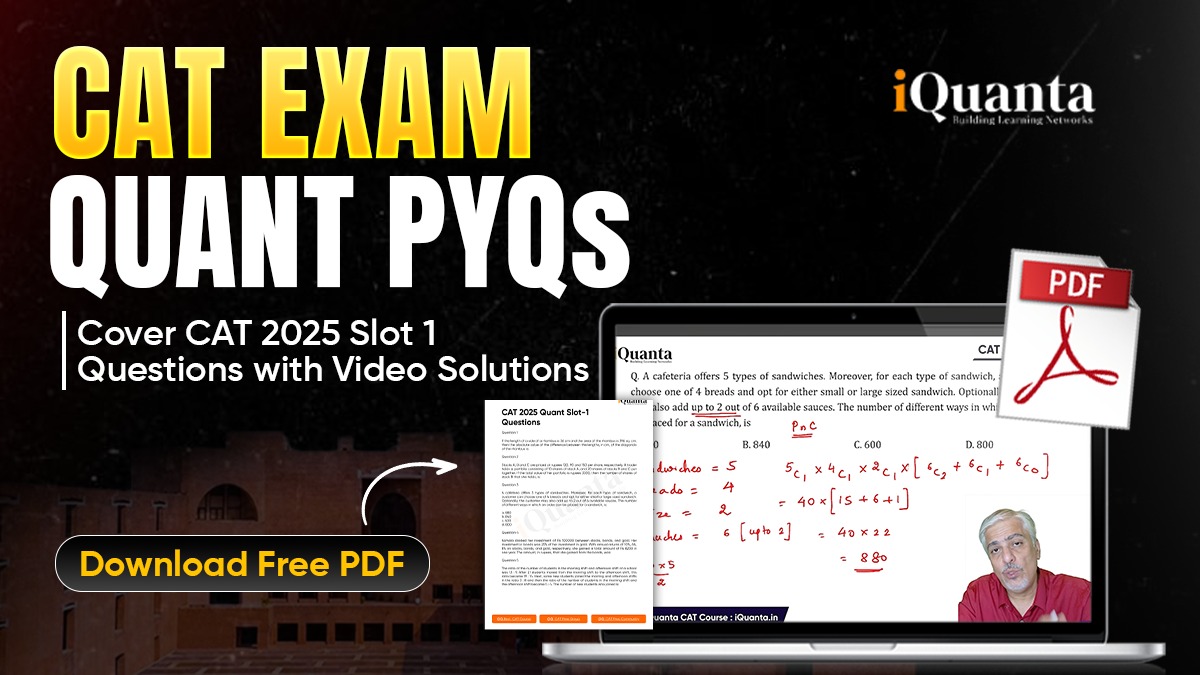
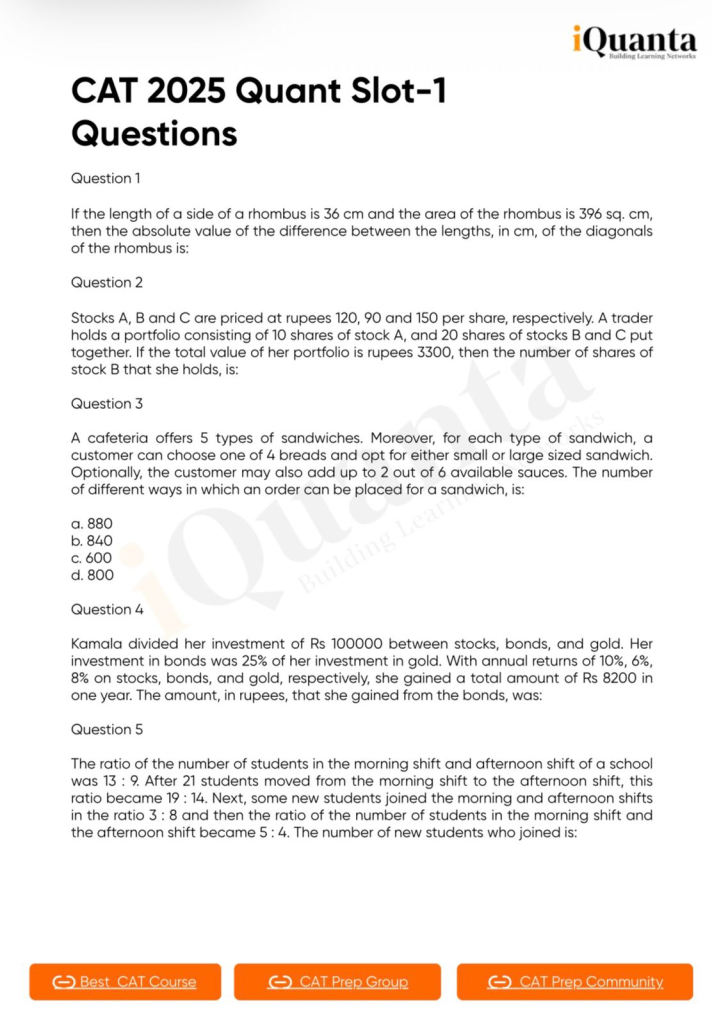
You might find good questions of Quants from past year papers, but getting the detailed solutions with them is all that matters the most for clearing concepts. To help candidates with the same, iQuanta has designed the CAT exam quant questions PDF from past year slot 1 with detailed video solutions. Candidates can easily download the PDF for free towards focusing on the efficient CAT exam preparation. Let’s see what’s there in the PDF and how it will help in my preparation journey for the CAT 2026 exam.
Join iQuanta’s diversified student community for free and prepare with 4.1L+ other peers. Get access to 24/7 doubt-solving, mentorship, free webinars, etc., all on one single platform.

Important Topics in the CAT Quantitative Aptitude with Weightage
Preparing the Quantitative Ability section in the Common Admission Test is all about being highly focused on these major topics, such as arithmetic, algebra, geometry, modern math, and number systems.
| Most Important QA Topics | Quantitative Aptitude Sub-Topics |
| Arithmetic (40%) | Percentages Profit and Loss Simple Interest and Compound Interest Ratio and Proportion Averages Mixture and Alligation Time and Work Pipes and Cisterns Time, Speed and Distance Races Trains and Boats |
| Algebra (35%) | Linear Equations Quadratic Equations Polynomials Indices and Surds Logarithms Inequalities Modulus Sequence & Series Functions Graphs |
| Geometry and Mensuration (15%) | Triangles Quadrilaterals Polygons Circles Mensuration – 3D Coordinate Geometry |
| Number System (5%) | Properties of Integers Divisibility Remainder Theorem Factors LCM & HCF Factorial Trailing Zeroes Last Digits |
| Modern Math (5%) | Set Theory Probability Permutation and Combination |
If you are preparing with such important topics in the quant section, then the probability of getting good scores will be higher for the candidates.
How is the CAT Exam Quant Questions PDF helpful?
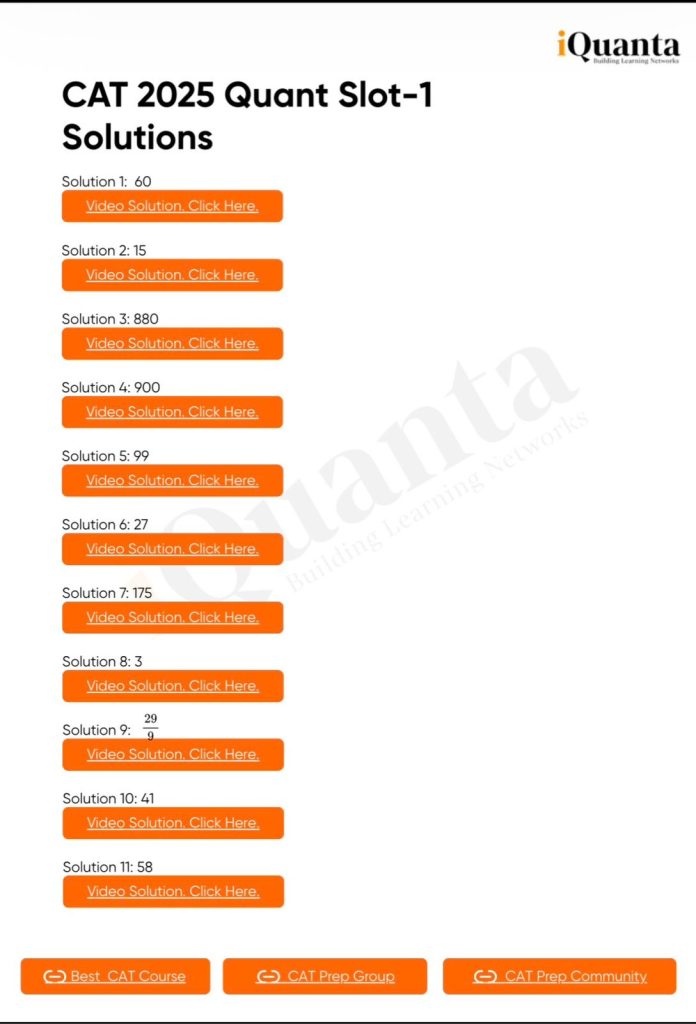
The PDF consists of questions from past year’s slot 1 paper with their video solutions. Covering questions is beneficial, but video solutions will get you a clear edge about the topic. If you are a serious aspirant, then practicing these questions will be an enormous advantage to qualify for the CAT 2026 exam with excellent scores. You can download or access the respective PDF by clicking on the button specified below.
Final Words
The probability of scoring 99+%ile will be higher if you score a good percentile in the Quantitative Ability section. This section consistently wants a problem-solving aptitude of a candidate. Instead of focusing completely on each topic, candidates should work on high-weightage concepts that have been asked in the exam. You should start your practice session with the questions that were asked in slot 1 of the previous year’s CAT exam paper with a detailed solution.