
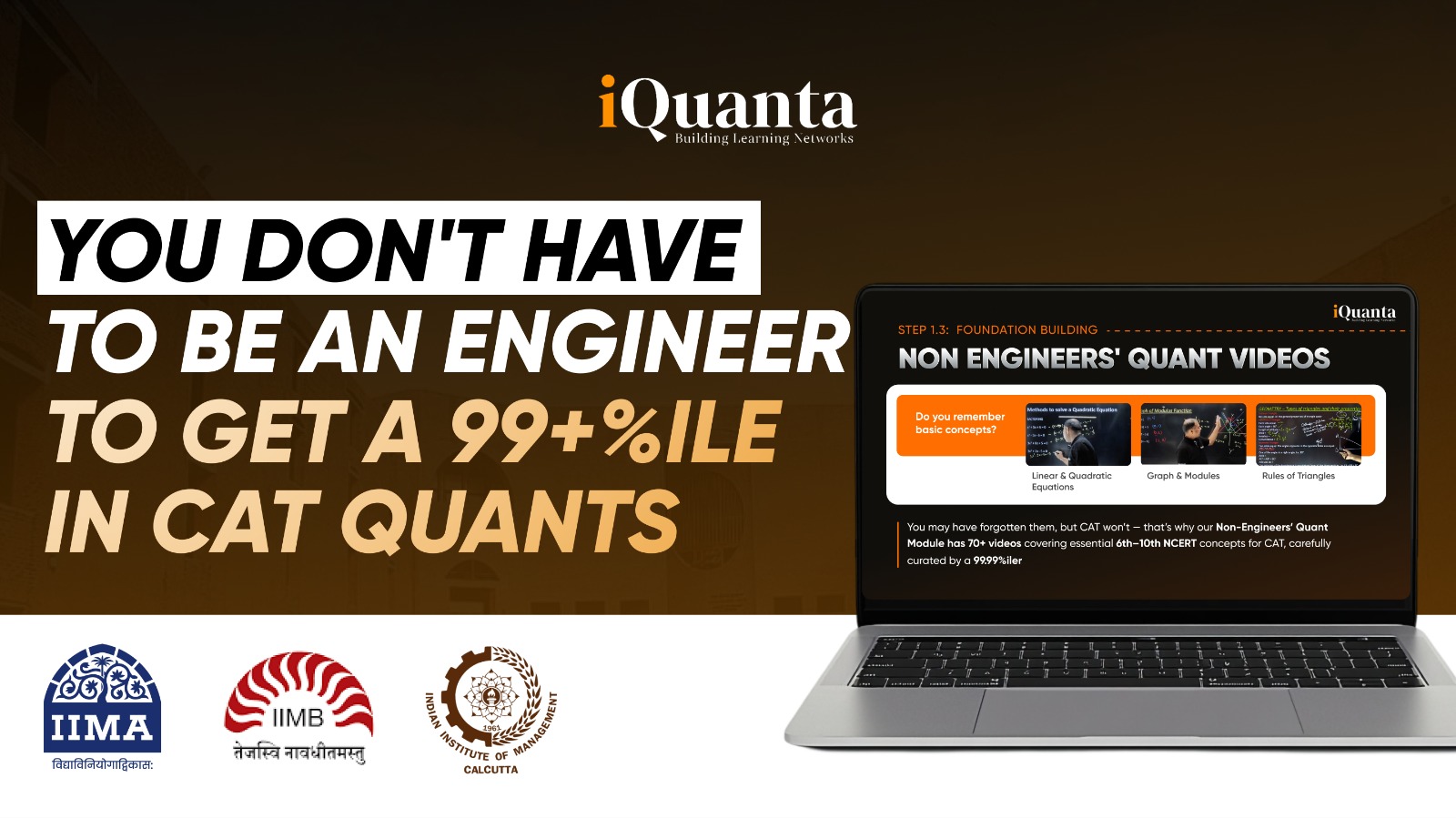
CAT Quant is easy for Engineers and difficult for non-engineers. This is only a myth that CAT Quant is only for Engineers. If you feel like Quant is difficult only because you are a non-engineer then you ought to know that non-engineers can actually do well in Quant. Do not fall prey to the common beliefs and myths which have predominated the CAT aspirants world for a long time.
The truth of the matter is simple. CAT Quant is neither about Engineers nor about non-engineers. It is about clarity, smart preparation and strategy. With the right method of studying, proper use of resources like the iQuanta non-engineers quant module and practical guidance, you can easily conquer the CAT Quant section and score more marks than those candidates who have sound technical and mathematical knowledge, for example, students from engineering backgrounds.
Join iQuanta’s diversified student community for free and prepare with other 4.1L+ peers. Get access to 24/7 doubt-solving, mentorship, free webinars, etc., all on one single platform.

Engineers Have an Advantage in CAT Quant – A Myth or a Reality
Given that Engineers are those candidates who hail from a predominantly mathematical background but that is not the reason to feel like Quant is only for the Engineers. It is a complete myth because CAT Quant does not have questions based on advanced engineering math nor does the Quant section examine calculus-heavy concepts or complex derivations.
Instead, the main chapters or topics which are repeated almost every year in the CAT Quant section are purely based on 10th and 12th level mathematics. The list of key topics which comprise CAT Quant syllabus are given below.
- Arithmetic (Percentages, Profit & Loss, Time & Work)
- Algebra (Equations, Inequalities)
- Geometry and Mensuration
- Number Systems
- Modern Math (P&C, Probability)
The above topics are not engineering level, these are school-level and can be easily understood or solved by students in 10th or 12th standard. There is no reason to assume non-engineers will not be able to solve basic mathematics questions. It may be the case that as a non-engineer you may need to revise or refresh the concepts, practice basics for some time to get back your mathematical skills and then prepare seriously for the CAT exam. But before you begin preparing, it is crucial to know what the CAT exam actually tests.
- Conceptual clarity
- Problem-solving ability
- Speed and accuracy under pressure
Why Non-Engineers Can Actually Do Well in Quant
The table below outlines unique strengths of Non-engineers which can actually help them succeed in the CAT Quant section.
| Strengths of Non-Engineers for CAT Quant | |
| Strengths | Details |
| Strong Concept Grasp | Non-engineers do not rely on formulas or shortcuts instead they deeply understand the concepts. |
| Fresh Mindset Approach | Since CAT Quant exam level topics are not completely familiar, non-engineers may approach the section with a fresh mindset that is open to learning new techniques. |
| Serious Preparation | Due to myths and personal reasons, non-engineers tend to prepare seriously right from the beginning unlike Engineers who may have the common tendency to underestimate CAT Quant. |
| Balanced Preparation | VARC and LRDI are sections where non-engineers perform well, this helps balance their overall percentile even if Quant seems challenging. |
Requirements for 99+ Percentile in CAT Quant
To score 99+ percentile in CAT 2026, you do not have to attempt all the questions. Such an assumption is wrong and leads to stress, anxiety and poor performance. As a non-engineer who is a beginner, you’ll have to understand that CAT Quant has around 20-22 questions in total out of which you only have to answer about 10-15 questions or so correctly.
| Master the Right Strategy for 99+ Percentile in CAT Quant | |
| Particulars | Details |
| Total Questions | Around 22 |
| Ideal Questions to Attempt | Attempt 10-14 questions correctly |
| Goal | Score 99+percentile |
Smart Preparation Strategy for Non-Engineers
You may prepare on your own through self-study but it may lead to confusion about what to study, time wastage on low-priority topics and lack of a structured practice plan. To help yourself with a proper plan, right material and all time guidance, you may choose to join iQuanta’s Non-Engineers Quant Module and make the best usage of your time.
| How to Study Efficiently to Crack CAT Quant | |
| Technique | Details |
| Build Strong Basics | PercentagesRatiosAveragesSimple & Compound Interest |
| Focus on High-Weightage Topics | You have to select important topics and study them first. For instance, Arithmetic, Algebra and Geometry are important, practice first Modern Math and Number Systems can be studied selectively. |
| Learn Shortcuts and Techniques | CAT has sectional and overall time limits. Learn exam level techniques like Approximation, Option elimination and Pattern recognition. Join structured coaching platforms like iQuanta to help prepare. |
| Practice Smart Not Hard | Do not attempt random questions. After solving questions, analyse your results, check for mistakes and keep a record of areas where you make mistakes. |
| Master Question Selection | You may learn to identify which questions are easy and doable and do them first |
How to Master Quant Question Selection as a Non-Engineer
You’ll need an accuracy level of at least 85 to 95% to master the CAT Quant section. It is important to know that you do not have to attempt all questions, but only the right ones accurately. One of the greatest differences between an Engineer and a Non-Engineer is not knowledge, but the skill to select the right question.
| Do’s and Dont’s for Non-Engineers CAT Quant Success | |
| Do’s | Dont’s |
| Chooses easy/moderate questions | Attempt all questions |
| Know when to skip a question | Get stuck on tough questions |
| Focus on scoring more marks | Focus on just solving the question |
Where Most Non-Engineers Struggle
The table below summarizes the common challenges which most non-engineers face when solving CAT Quant questions. Solutions to the problems or challenges of non-engineers when solving CAT Quant section for marks are also mentioned in the table below.
| Challenge | Solution |
| Weak basics | Start from zero-level concepts |
| Fear of math | Practice gradually |
| Lack of structure | Follow a guided plan |
| Time pressure | Learn shortcuts & mocks |
iQuanta’s Non-Engineers Quant Module
Students who do not have a strong background in mathematics like Engineers may utilize the iQuanta’s Non-Engineering Quant Module which will help you overcome your doubts and insecurities and score 99+ through confidence, strategic approach and right guidance.
| Feature | Benefit |
| Zero-to-Advanced Teaching | Perfect for beginners |
| Simplified Concepts | No complicated theory |
| Shortcut Techniques | Faster problem-solving |
| Topic-wise Practice | Strong mastery |
| Live Doubt Solving | No learning gaps |
| CAT-Level Questions | Real exam preparation |
How iQuanta’s Non-Engineers Quant Module Bridges the Gap
Whether you are a beginner or an intermediate level CAT aspirant, the iQuanta’s Non-Engineering Quant Module is designed to help you understand the basics, build confidence, learn to solve CAT-level questions, develop skills, and build strategies for success.
| Stage | What You Learn | Outcome |
| Beginner | Basic concepts | Confidence building |
| Intermediate | CAT-level problems | Skill development |
| Advanced | Mock strategy | 99+ readiness |

Final Takeaway
The final message of this informational and motivational blog is that you do not have to be an Engineer to score 99+ in CAT Quant. With right conceptual knowledge, smart strategies, consistency in practice, and thoughtful guidance you will be able to score maximum marks and face no regrets.
Also if you decide to join a structured program like iQuanta’s Non-Engineers Quant Module, your doubts, fears and insecurities will wash away as mentors and faculty teach you how to solve basic questions to advanced questions. This module will help transform CAT Quant from your weakest section to your strongest or at least the most confident section.