The IPMAT exam or the Integrated Programme in Management Aptitude Test, is the entrance test for candidates aspiring to join the Integrated Programme in Management of five years’ duration, post Class 12. There are different aptitude tests conducted by IIM Indore and IIM Rohtak for admissions into their respective IPM programme. Some other management institutes also accept the IPMAT score. IIM Indore conducts the IPMAT Indore exam whereas IIM Rohtak conducts IPMAT Rohtak.
In this age of cut-throat competition for management programs, preparation for IPMAT 2027 needs conceptual understanding, practice, and proper time management skills. With six months left in hand for preparation, your study plan can be designed with targets in Quantitative Ability, Verbal Ability, and Logical Reasoning, based on which exam you want to give.
Here is a detailed six-month preparation plan for IPMAT 2027.
Join this free IPMAT preparation WhatsApp group to get free study material, strategies by toppers and experts, the latest updates and more
IPMAT 2027 Exam Pattern: Understand the Sections
Before starting IPMAT 2027 preparation, understand the difference between the IPMAT Indore and IPMAT Rohtak examination patterns.
IPMAT Indore Exam Pattern
- Quantitative Ability (MCQ)
- Quantitative Ability (Short Answer)
- Verbal Ability (MCQ)
- Total duration: 120 minutes
- Sectional duration: 40 minutes each
- Marking: +4 for correct answers and -1 for incorrect MCQs. No negative marking for Short Answer questions.
IPMAT Rohtak Exam Pattern
- Quantitative Ability: 40 questions
- Logical Reasoning: 40 questions
- Verbal Ability: 40 questions
- Total questions: 120
- Total duration: 120 minutes
- Marking: +4 for correct answers and -1 for incorrect answers.
Detailed Breakdown of IPMAT Indore 2027 Syllabus
Checking the IPMAT Indore syllabus can help you in your preparation. It helps you get familiar with the topics important for each section. There are a total of 3 sections in the exam, namely Quantitative Ability (MCQ), Quantitative Ability (SA) and Verbal Ability (MCQ). Mastering concepts of all these sections can help you perform well. Check the expected IPMAT Indore syllabus 2027 explained below.
IPMAT Indore Quantitative Aptitude Syllabus
| IPMAT Indore Quantitative Aptitude Syllabus | |
| Category | Topics |
| Number System | Finding Unit Digit, Cyclicity |
| Simplification, BODMAS | |
| Remainder Theorems | |
| HCF & LCM, HCF LCM of fractions | |
| Surds & Indices | |
| Concept of Factors | |
| Divisibility Rules in detail | |
| Factorials | |
| Mixed Questions with other topics | |
| Arithmetic | Percentages |
| Profit Loss & Discount | |
| Ratio & Proportion | |
| Partnerships | |
| Average | |
| Mixture & Alligation | |
| Simple & Compound Interest | |
| Time & Work | |
| Pipes & Cisterns | |
| Time, Speed & Distance | |
| Boats & Streams | |
| Relative Speed, Linear Races | |
| Trains | |
| Circular Tracks TSD | |
| Mixed Questions with other topics | |
| Algebra | Algebraic Identities |
| Linear Equations | |
| Quadratic and Cubic Equations | |
| Nature of Roots, Discriminant | |
| Inequalities | |
| Logarithms | |
| Functions | |
| Modulus Functions | |
| Arithmetic Progressions | |
| Geometric Progressions | |
| Maximum/Minimum Values of Functions | |
| Range & Domain of Functions | |
| Binomial Theorem | |
| Geometry & Mensuration | Lines & Angles |
| Triangles & Circles, Theorems | |
| Quadrilaterals & Areas | |
| Polygons and Internal, External Angles | |
| Regular Polygons | |
| Coordinate Geometry | |
| Mensuration (Surface Area and Volumes of 3D Figures) | |
| Higher Mathematics | Matrices & Determinants |
| Set theory & Venn Diagrams (3 set) | |
| Relations & Functions | |
| Sequence & Series (Arithmetic & Geometric Progressions) | |
| Permutation & Combination | |
| Inequalities, Domain & Range | |
| Probability | |
| Modulus Functions | |
| Binomial Theorem | |
| Equations of Lines & Circles | |
| Trigonometry, Height & distance-based questions | |
| Mean, Median & Mode | |
IPMAT Indore Verbal Ability & Reading Comprehension Syllabus
| IPMAT Indore Verbal Ability & Reading Comprehension Syllabus | |
| Category | Topics |
| Grammar | Noun & Pronoun |
| Adverb & Verb | |
| Prepositions | |
| Conjunctions | |
| Direct & Indirect Speech | |
| Figures of Speech | |
| Articles | |
| Sentence Correction | |
| Active – Passive Voice | |
| Poetic Devices | |
| Subject-Verb Agreement | |
| Reading Comprehension | The meaning of a particular word used in the passage |
| Tone of the author | |
| Tone of the passage | |
| Main Idea of the passage | |
| Reasoning based upon passage | |
| Idioms/Phrases from passage | |
| Other questions based on the Passage | |
| Verbal Ability | Error Spotting |
| Fill in the blanks | |
| Sentence Completion | |
| Para jumbles | |
| Sentence Improvement | |
| Vocabulary | Synonym & Antonyms |
| Spelling Errors | |
| One Word Substitution | |
| Phrasal Verbs | |
| Para completion | |
| Idioms & Phrases | |
| Odd one out | |
Detailed Breakdown of IPMAT Rohtak 2027 Syllabus
The IPMAT Rohtak syllabus is divided into three sections: Quantitative Ability, Logical Reasoning, and Verbal Ability. Identify important topics for every section and master them. You should clear the concepts of every topic so that you don’t get stuck on any question. The expected syllabus for all sections is shared below:
IPMAT Rohtak Quantitative Aptitude Syllabus
| IPMAT Rohtak Quantitative Aptitude Syllabus | |
| Category | Topics |
| Number System | Finding Unit Digit |
| Simplification | |
| Remainder Theorems | |
| HCF & LCM | |
| HCF LCM Of Fractions | |
| Surds & Indices | |
| Concept of Factors | |
| Divisibility Rules | |
| Factorial | |
| Arithmetic | Percentage |
| Average | |
| Age-based problems | |
| Partnership | |
| Profit Loss & Discount | |
| Ratio & Proportion | |
| Simple & Compound Interest | |
| Mixture & Alligation | |
| Time, Speed & Distance | |
| Boats & Streams | |
| Algebra | Algebraic Formulae |
| Linear Equations | |
| Cubic Equations | |
| Quadratic Equations | |
| Indices & Surds | |
| Trigonometry | |
| Logarithms | |
| Inequalities | |
| Geometry | Basics of Geometry |
| Lines & Angles | |
| Triangles | |
| Circles | |
| Quadrilaterals | |
| Polygons | |
| Coordinate Geometry | |
| Mensuration (Volume & Surface Area) | |
| Height & Distance based upon trigonometry | |
IPMAT Rohtak Verbal Ability & Reading Comprehension Syllabus
| IPMAT Rohtak Verbal Ability & Reading Comprehension Syllabus | |
| Category | Topics |
| Grammar | Noun & Pronoun |
| Adverb & Verb | |
| Prepositions | |
| Conjunctions | |
| Direct & Indirect Speech | |
| Figures of Speech | |
| Idioms & Phrases | |
| Etymology & Roots | |
| Articles | |
| Active – Passive Voice | |
| Subject-Verb Agreement | |
| Reading Comprehension | The meaning of a particular word used in the passage |
| Tone of the author | |
| Tone of the passage | |
| Main idea of the passage | |
| Inference-based questions | |
| Verbal Ability | Error Spotting |
| Fill in the blanks | |
| Sentence Completion | |
| Para jumbles | |
| Sentence Improvement | |
| Sentence Correction | |
| Vocabulary | Synonym & Antonyms |
| Spelling Errors | |
| One Word Substitution | |
| Odd one out | |
| Word Usage | |
| Analogy | |
IPMAT Rohtak Logical Reasoning Syllabus
| IPMAT Rohtak Logical & Verbal Reasoning Syllabus | |
| Category | Topics |
| Logical Reasoning | Number and Letter Series |
| Coding-Decoding | |
| Logical Sequence Series | |
| Cubes and Dices cutting and coloring | |
| Venn Diagrams | |
| Blood Relations | |
| Syllogism | |
| Clock and Calendars | |
| Input output | |
| Linear and Circular Seating Arrangement | |
| Bar Graphs and Table based DI Sets | |
| Line Charts & Pie Charts | |
| Data Sufficiency | |
| Mirror & Water Image | |
| Ranking | |
| Inequalities | |
| Distance & Direction | |
| Pattern based images | |
| Verbal Reasoning | Analogies |
| Statement & Conclusion | |
| Statement & Assumption | |
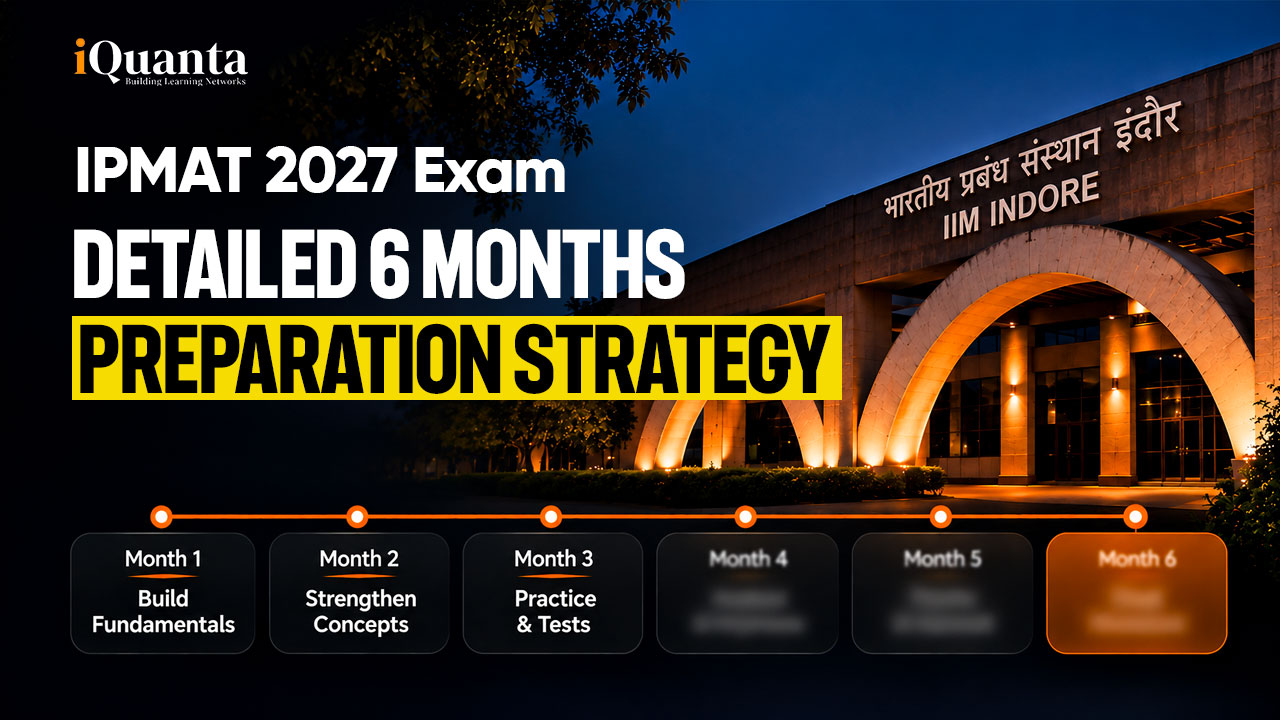
IPMAT 2027 Exam: Detailed 6-Month Preparation Plan
Month 1: Build Conceptual Clarity
- Understand the IPMAT 2027 syllabus and examination pattern.
- Identify strengths and weaknesses in Quantitative Ability and Verbal Ability.
- Start with basic Arithmetic, Algebra, Number System, and Geometry.
- Strengthen grammar fundamentals and build vocabulary.
- Develop a daily reading habit to improve comprehension skills.
Month 2: Strengthen Fundamentals and Practise Questions
- Cover important Quantitative Ability topics, including Percentages, Profit and Loss, Ratio and Proportion, Time and Work, and Averages.
- Practise Reading Comprehension, Para Jumbles, Sentence Correction, and Vocabulary.
- Begin practising moderate-level questions.
- For IPMAT Rohtak, include Logical Reasoning topics such as Arrangements, Series, and Coding-Decoding.
- Focus on improving calculation speed and accuracy.
Month 3: Complete Important Topics
- Cover the remaining important topics from Arithmetic, Algebra, Geometry, and Number System.
- Practise higher-level Quantitative Ability questions.
- Focus on Verbal Ability through regular reading and grammar practice.
- Give additional attention to IPMAT Indore’s Short Answer Quantitative Ability section.
- For IPMAT Rohtak, continue practising Logical Reasoning.
- Start attempting sectional tests to evaluate preparation.
Month 4: Previous Year Questions and Sectional Tests
- Solve previous year IPMAT question papers.
- Understand the difficulty level and types of questions asked.
- Identify frequently tested concepts and topics.
- Attempt regular sectional tests across the relevant sections.
- Analyse incorrect answers and work on weaker areas.
- Practise solving questions within a fixed time limit.
Month 5: Mock Tests and Performance Analysis
- Start attempting full-length IPMAT mock tests.
- Practise managing time across different sections.
- Analyse mock test performance to identify conceptual gaps.
- Focus on improving accuracy and question selection.
- Revise important formulas, grammar rules, and vocabulary.
- Work on reducing repeated mistakes.
Month 6: Final Revision and Exam Readiness
- Revise all important concepts and formulas.
- Practise selected previous year questions.
- Attempt full-length mock tests based on the target examination.
- Analyse performance and focus on weak areas.
- Revise important Quantitative Ability and Verbal Ability topics.
- Finalise an examination strategy based on time management, accuracy, and question selection.
Conclusion
IPMAT 2027 examination is just 6 months away and even candidates haven’t started their preparation then it is a high time that they should structure and plan their preparation with ease.