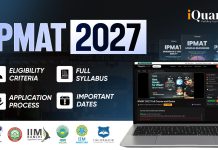
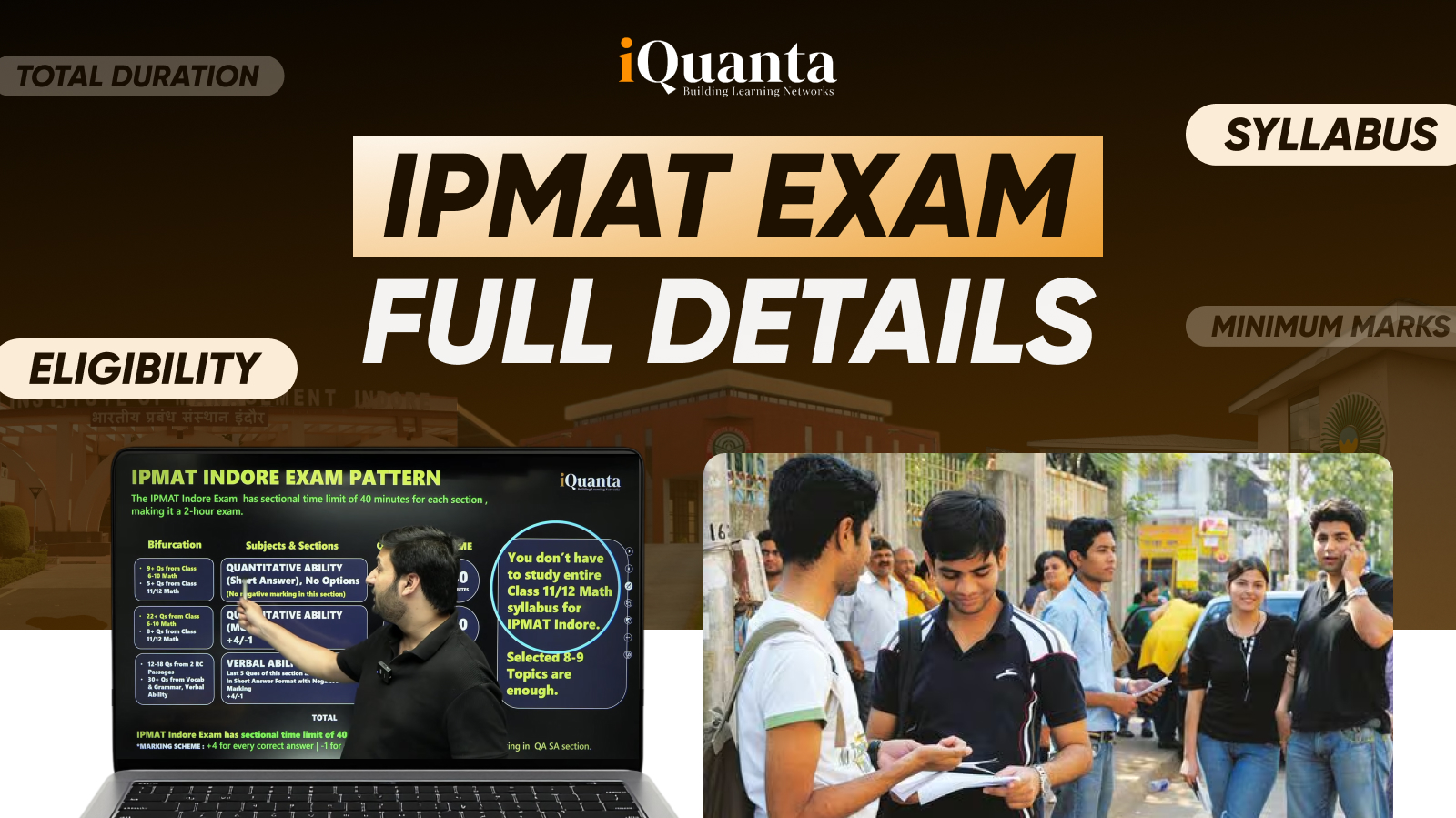
The IPMAT Exam is the gateway to top IIM colleges in India for a 5-year integrated program. Top colleges that offer admission to the IPM course include IIM Indore, IIM Rohtak, IIM Ranchi, IIM Jammu, and more. Today, the IPMAT (Integrated Programme in Management Aptitude Test) has become a go-to entrance exam for students who want to pursue the IPM (BBA+MBA) programme after completing Class 12. The exam patterns for IPMAT Indore, IPMAT Rohtak, and JIPMAT differ slightly.
For IPMAT Indore, students should aim to score 40-50 marks above the cutoff. For IPMAT Rohtak, the expected seat intake is 198, so you must prepare with the best approach. Clearing the JIPMAT exam will get you admission to either IIM Jammu (140 seats) or IIM Bodhgaya (120 seats). If your goal is to clear the IPMAT exam in 2027 and you want a structured guide, this article is the right place for you. Check the eligibility criteria, IPMAT syllabus, and more.
Join this free IPMAT preparation WhatsApp group to get free study material, strategies by toppers and experts, the latest updates and more
IPMAT Exam 2027: A Short Overview
| Basic Features | Generic Information |
| Name of the Exam | IPMAT Exam |
| Full Form | Integrated Programme in Management Aptitude Test |
| Course Name | IPM (BBA+MBA) |
| Duration of the Course and Class Mode | 5 Years (Offline Classroom Sessions) |
| Colleges Which Provide Admission Via IPMAT | IIM Indore, IIM Shillong, IIM Rohtak, IIM Ranchi, IIM Jammu, IIM Bodhgaya, IIFT Kakinada, IIM Amritsar, NIRMA University, IIM Sirmaur (BMS), TAPMI/NALSAR/NICMAR |
| Is Mathematics Compulsory? | Only for IIFT Kakinada, IIM Shillong, and IIM Amritsar |
| Mode of the Exam | Online |
| Frequency of the Exam | Once Every Year |
| IPMAT Exam Syllabus 2027 | Quantitative Aptitude Verbal Ability and Reading Comprehension Data Interpretation and Logical Reasoning |
| Mode of Language | English |
| Who Can Appear? | Candidates appearing for the Class 12th grade examination or who have appeared for it with a qualifying score. |
IPMAT 2027 Eligibility Criteria For Students
The standard basic requirements differ for IPMAT Indore, IPMAT Rohtak, and the JIPMAT exam. Only if you meet these prerequisites will you be eligible to appear for the IPMAT Exam in 2027. Below, we share the full breakdown of the necessary specifications required to appear for IPMAT Indore, IPMAT Rohtak, and JIPMAT.
IPMAT Indore 2027 Eligibility Criteria
| Head | IIM Indore IPM Eligibility Criteria |
| Exam Accepted | IPMAT Indore |
| Age | Candidate should have been born on or after August 01, 2007 (5 years of relaxation to the candidates from SC/ST/PwD category will be given, i.e. born on or after August 01, 2002). |
| Qualifying Exam | Candidate should have passed Standard XII/HSC or equivalent examination |
| Minimum Percentage | Not Required |
IPMAT Rohtak 2027 Eligibility Criteria
| Primary Components | Basic Information |
| Age Limit | Candidates must be 20 years old or younger to appear for the IPMAT Rohtak Exam. For SC and ST students, there’s a 5-year relaxation, i.e., 25 years until June 30, 2027. |
| Qualifying Exam Criteria | Candidates appearing for their HSC examination or who have cleared the XII examination with a satisfactory score are eligible to appear for the IPMAT exam. |
| Minimum Mark Requirements | Candidates from the General, EWS, and NC-OBC categories must have a qualifying score of 60% in Class 10 and 12. If you belong to the SC, ST and PwD category, you must have achieved 55% in the SSC or HSC examination. |
IPMAT Exam Pattern 2027
The IPMAT Indore exam pattern differs significantly from the IPMAT Rohtak and JIPMAT. IPMAT Indore has a separate timeline for each section, which doesn’t apply to JIPMAT. Check out the brief description below, which clearly outlines the actual exam pattern for IPMAT 2027.
IPMAT Indore 2027 Exam Pattern
| IPMAT Indore Syllabus 2027 | Time Limit | Total Number of Questions |
| Quantitative Aptitude (Short Answer) | 40 Minutes | 15 Questions |
| Quantitative Aptitude (Multiple Choice Questions) | 40 Minutes | 30 Questions |
| Verbal Ability | 40 Minutes | 45 Questions |
| 3 | 120 Minutes | 90 Questions |
IPMAT Rohtak 2027 Exam Pattern
| IPMAT Rohtak Syllabus 2027 | Duration of the Exam | Total No. of Questions |
| Quantitative Aptitude (QA) | 40 Minutes | 40 Questions |
| Verbal Ability and Reading Comprehension (VARC) | 40 Minutes | 40 Questions |
| Logical Reasoning (LR) | 40 Minutes | 40 Questions |
| 3 | 120 Minutes | 120 Questions |
JIPMAT 2027 Exam Pattern
| JIPMAT 2027 Syllabus | Total Time Limit (No Sectional Time Limit) | Total Questions |
| Quantitative Aptitude | Not Applicable | 33 Questions |
| Verbal Ability and Reading Comprehension | Not Applicable | 34 Questions |
| Data Interpretation and Logical Reasoning | Not Applicable | 33 Questions |
| 3 Sections | 150 Minutes | 100 Questions |
IPMAT 2027 Marking Scheme
IIMs follow a strict marking scheme to shortlist candidates from the IPMAT exam. For all three examinations, there are +4 marks for every correct response. Meanwhile, IPMAT Indore has no negative marking for short answers. However, IPMAT Indore applies -1 negative marking for every incorrect response, and it’s similar in the IPMAT Rohtak and JIPMAT exams. Let’s take you through the actual marking scheme followed in the IPMAT examination.
IPMAT Indore 2027 Marking Scheme
| Section | Per Correct Attempt | Every Wrong Attempt |
| Quantitative Ability (MCQs) (It will have 5 questions from LRDI in the last section) | +4 marks | -1 Mark |
| Quantitative Ability (SA) | +4 marks | Zero negative marking for the Short Answers section |
| Verbal Ability (MCQs) | +4 marks | -1 Marks |
| 3 Sections | – |
IPMAT Rohtak 2027 Marking Scheme
| Section (Multiple Choice Questions Only) | Every Correct Response | Every Incorrect Response |
| Quantitative Ability | +4 marks | -1 Mark |
| Verbal Ability | +4 marks | -1 Marks |
| Logical Reasoning | +4 marks | -1 Marks |
| 3 Sections | – |
JIPMAT 2027 Marking Scheme
| Section | Every Wrong Attempt | Every Right Attempt | Unanswered Question |
| Quantitative Ability | -1 Mark | +4 marks | 0 |
| Verbal Ability and Reading Comprehension | -1 Mark | +4 marks | 0 |
| Logical Reasoning and Data Interpretation | -1 Mark | +4 marks | 0 |
| 3 Sections Only | – | – |
IPMAT Exam Syllabus: IPMAT Indore, IPMAT Rohtak and JIPMAT
The IPMAT syllabus 2027 covers Quantitative Aptitude, Logical Reasoning, Data Interpretation, Verbal Ability, and Reading Comprehension. The Quants syllabus mainly comprises mathematical questions from the Class 6-10th grade. Candidates need a strategic mindset to cover the entire IPMAT syllabus through rigorous preparation.
IPMAT Indore Syllabus 2027
| Quantitative Aptitude Syllabus | |
| Category | Topics |
| Number System | Finding Unit Digit, Cyclicity |
| Simplification, BODMAS | |
| Remainder Theorems | |
| HCF & LCM, HCF & LCM of fractions | |
| Surds & Indices | |
| Concept of Factors | |
| Divisibility Rules in detail | |
| Factorials | |
| Mixed Questions with other topics | |
| Arithmetic | Percentages |
| Profit, Loss & Discount | |
| Ratio & Proportion | |
| Partnerships | |
| Average | |
| Mixture & Alligation | |
| Simple & Compound Interest | |
| Time & Work | |
| Pipes & Cisterns | |
| Time, Speed & Distance | |
| Boats & Streams | |
| Relative Speed, Linear Races | |
| Trains | |
| Circular Tracks TSD | |
| Mixed Questions with other topics | |
| Algebra | Algebraic Identities |
| Linear Equations | |
| Quadratic and Cubic Equations | |
| Nature of Roots, Discriminant | |
| Inequalities | |
| Logarithms | |
| Functions | |
| Modulus Functions | |
| Arithmetic Progressions | |
| Geometric Progressions | |
| Maximum/Minimum Values of Functions | |
| Range & Domain of Functions | |
| Binomial Theorem | |
| Geometry & Mensuration | Lines & Angles |
| Triangles & Circles, Theorems | |
| Quadrilaterals & Areas | |
| Polygons and Internal, External Angles | |
| Regular Polygons | |
| Coordinate Geometry | |
| Mensuration (Surface Area and Volumes of 3D Figures) | |
| Higher Mathematics | Matrices & Determinants |
| Set Theory & Venn Diagrams (3 sets) | |
| Relations & Functions | |
| Sequence & Series (Arithmetic & Geometric Progressions) | |
| Permutation & Combination | |
| Inequalities, Domain & Range | |
| Probability | |
| Modulus Functions | |
| Binomial Theorem | |
| Equations of Lines & Circles | |
| Trigonometry, Height & distance-based questions | |
| Mean, Median & Mode | |
| Verbal Ability and Reading Comprehension Syllabus | |
| Category | Topics |
| Grammar | Noun & Pronoun |
| Adverb & Verb | |
| Prepositions | |
| Conjunctions | |
| Direct & Indirect Speech | |
| Figures of Speech | |
| Articles | |
| Sentence Correction | |
| Active – Passive Voice | |
| Poetic Devices | |
| Subject-Verb Agreement | |
| Reading Comprehension | The meaning of a particular word used in the passage |
| Tone of the author | |
| Tone of the passage | |
| Main Idea of the passage | |
| Reasoning based upon the passage | |
| Idioms/Phrases from passage | |
| Other questions based on the Passage | |
| Verbal Ability | Error Spotting |
| Fill in the blanks | |
| Sentence Completion | |
| Para jumbles | |
| Sentence Improvement | |
| Vocabulary | Synonym & Antonyms |
| Spelling Errors | |
| One Word Substitution | |
| Phrasal Verbs | |
| Para completion | |
| Idioms & Phrases | |
| Odd one out | |
IPMAT Rohtak Syllabus 2027
| Quantitative Aptitude Syllabus | |
| Category | Topics |
| Number System | Finding Unit Digit |
| Simplification | |
| Remainder Theorems | |
| HCF & LCM | |
| HCF & LCM Of Fractions | |
| Surds & Indices | |
| Concept of Factors | |
| Divisibility Rules | |
| Factorial | |
| Arithmetic | Percentage |
| Average | |
| Age-based problems | |
| Partnership | |
| Profit, Loss & Discount | |
| Ratio & Proportion | |
| Simple & Compound Interest | |
| Mixture & Alligation | |
| Time, Speed & Distance | |
| Boats & Streams | |
| Algebra | Algebraic Formulae |
| Linear Equations | |
| Cubic Equations | |
| Quadratic Equations | |
| Indices & Surds | |
| Trigonometry | |
| Logarithms | |
| Inequalities | |
| Geometry | Basics of Geometry |
| Lines & Angles | |
| Triangles | |
| Circles | |
| Quadrilaterals | |
| Polygons | |
| Coordinate Geometry | |
| Mensuration (Volume & Surface Area) | |
| Height & Distance based on trigonometry | |
| Verbal Ability & Reading Comprehension Syllabus | |
| Category | Topics |
| Grammar | Noun & Pronoun |
| Adverb & Verb | |
| Prepositions | |
| Conjunctions | |
| Direct & Indirect Speech | |
| Figures of Speech | |
| Idioms & Phrases | |
| Etymology & Roots | |
| Articles | |
| Active – Passive Voice | |
| Subject-Verb Agreement | |
| Reading Comprehension | The meaning of a particular word used in the passage |
| Tone of the author | |
| Tone of the passage | |
| Main idea of the passage | |
| Inference-based questions | |
| Verbal Ability | Error Spotting |
| Fill in the blanks | |
| Sentence Completion | |
| Para jumbles | |
| Sentence Improvement | |
| Sentence Correction | |
| Vocabulary | Synonym & Antonyms |
| Spelling Errors | |
| One Word Substitution | |
| Odd one out | |
| Word Usage | |
| Analogy | |
| Logical Reasoning Syllabus | |
| Category | Topics |
| Logical Reasoning | Number and Letter Series |
| Coding-Decoding | |
| Logical Sequence Series | |
| Cubes and Dice cutting and colouring | |
| Venn Diagrams | |
| Blood Relations | |
| Syllogism | |
| Clock and Calendars | |
| Input output | |
| Linear and Circular Seating Arrangement | |
| Bar Graphs and Table-Based DI Sets | |
| Line Charts & Pie Charts | |
| Data Sufficiency | |
| Mirror & Water Image | |
| Ranking | |
| Inequalities | |
| Distance & Direction | |
| Pattern-based images | |
| Verbal Reasoning | Analogies |
| Statement & Conclusion | |
| Statement & Assumption | |
JIPMAT 2027 Syllabus
| JIPMAT 2028 Quantitative Ability Topics | Important Chapters |
| Number System | Finding Unit Digit, Factorials, Divisibility Rules, Simplification, HCF & LCM Of Fractions, HCF & LCM, Remainder Theorems, Surds & Indices, Concept of Factors |
| Algebra | Linear Equations, Quadratic Equations, Trigonometry (Only till 10th Grade), Algebraic Formulae, Cubic Equations, Indices & Surds |
| Arithmetic | Average, Percentage, Partnership, Ratio & Proportion, Age-based problems, Boats & Streams, Profit Loss & Discount, Time and Work Time, Speed & Distance, Simple & Compound Interest, Mixture & Alligations |
| Geometry | Quadrilaterals, Basics of Geometry, Coordinate Geometry, Trigonometry, Height & Distance in Trigonometry, Mensuration, Lines & Angles, Triangles, Circles, Polygons |
JIPMAT DILR Syllabus
| JIPMAT DILR Topics | Important Chapters |
| Verbal Reasoning | Statement & Assumption Facts & Inferences Analogies Statement & Conclusion |
| Analytical Reasoning & Data Interpretation | Bar Graphs and Table-based DI Sets, Data Interpretation Sets, Linear and Circular Seating Arrangement, Mirror & Water Image, Clock and Calendars, Pattern-based images, Cubes and Dice, Cutting and Colouring, Logical Sequence, Series Distance & Direction, Number and Letter Series, Data Sufficiency, Input-Output, Blood Relations, Line Charts & Pie Charts, Venn Diagrams, Coding-Decoding, Ranking, Inequalities, Syllogism |
Data Interpretation | Caselets, Bar Graphs, Distance & Direction, Data Sufficiency, Mirror & Water Images, Tables, Linear & Circular Arrangements, Pattern-based DI, Line Charts, Inequalities, Pie Charts, Ranking |
JIPMAT VARC Syllabus
| JIPMAT Syllabus VARC Topics | Important Chapters |
| Grammar | Adverb & Verb Noun & Pronoun Active – Passive Voice Direct & Indirect Speech Idioms & Phrases Etymology & Roots Subject-Verb Agreement Figures of Speech Prepositions Articles Conjunctions |
| Vocabulary | Synonyms & Antonyms Analogies Spelling Errors Odd One Out One-Word Substitution Word Usage |
| Reading Comprehension | Particular word meaning from the passage, Author’s Tone, Passage Tone, Original Passage Main Idea |
| Verbal Ability | Spot the error, Complete the sentences, Fill in the blanks, Para jumbles, Correct the sentences, Sentence Improvement |
6 Key Preparation Tips For the IPMAT Exam 2027
IPMAT, also known as the Integrated Postgraduate Management Aptitude Test, is a 5-year comprehensive course taught at top MBA colleges in India. The syllabus is comparatively tougher for IPMAT Indore than for IPMAT Rohtak and JIPMAT. By preparing diligently for the IPMAT exam, you will be familiar with the syllabus of other IPMAT exams. If you’re thinking about starting your preparation in the upcoming months, then here are some useful tips for your reference:
- Go through the complete IPMAT 2027 syllabus. Cross-check the important topics from QA, VARC and DILR that help you achieve maximum marks.
- Kindly dedicate maximum time to strengthen the mathematical concepts from Classes 6- 10 for the IPMAT Indore Quantitative Aptitude syllabus.
- After creating your IPMAT exam preparation schedule, start with simple topics to build confidence.
- Practice simple, medium and complex questions from every topic with 100% consistency. Make sure that you develop a good accuracy rate.
- Prepare to take full-length mocks after completing 50% of the IPMAT 2027 syllabus.
- Critically analyse and identify your weak areas and prioritise improving them. Understand recurring mistakes and fix them.

Frequently Asked Questions: IPMAT Exam Full Details
What is the best time to start preparation for the IPMAT Exam?
Start preparing for the IPMAT exam at least 12 months before the exam. Since IPMAT Indore has a high cutoff, it’s better to prepare smartly and strengthen your basic concepts. Since the syllabus is similar for IPMAT Rohtak and JIPMAT, you can prepare for all three exams.
Can I take the IPMAT 2027 exam with 6 months of preparation?
Yes, you can appear for the IPMAT exam with just 6 months of preparation. To do so, create a structured timetable and cover the high-weightage topics first. Dedicate separate time for practice, and don’t skip full-length mock tests.
How should I start my IPMAT preparation?
First, develop a strong understanding of the IPMAT syllabus 2027. Analyse carefully and segregate the high-weightage topics first. In the first few months, focus on upgrading your foundational knowledge in QA, VARC, DI and LR.
Is the IPMAT cutoff the same for IPMAT Rohtak, IPMAT Indore and JIPMAT?
No, the cutoff is not the same for IPMAT Indore, IPMAT Rohtak and JIPMAT. IIM Indore has the highest cutoff of the three. Candidates must clear the sectional cut-off to appear for the PI (Personal Interview) round.
Which is the toughest IPMAT exam?
Based on our research, IPMAT Indore is the toughest exam. This exam mainly features an advanced-level QA syllabus with -1 negative marking for wrong attempts. It also has a sectional time limit for each section, and the cutoff increases every year.