
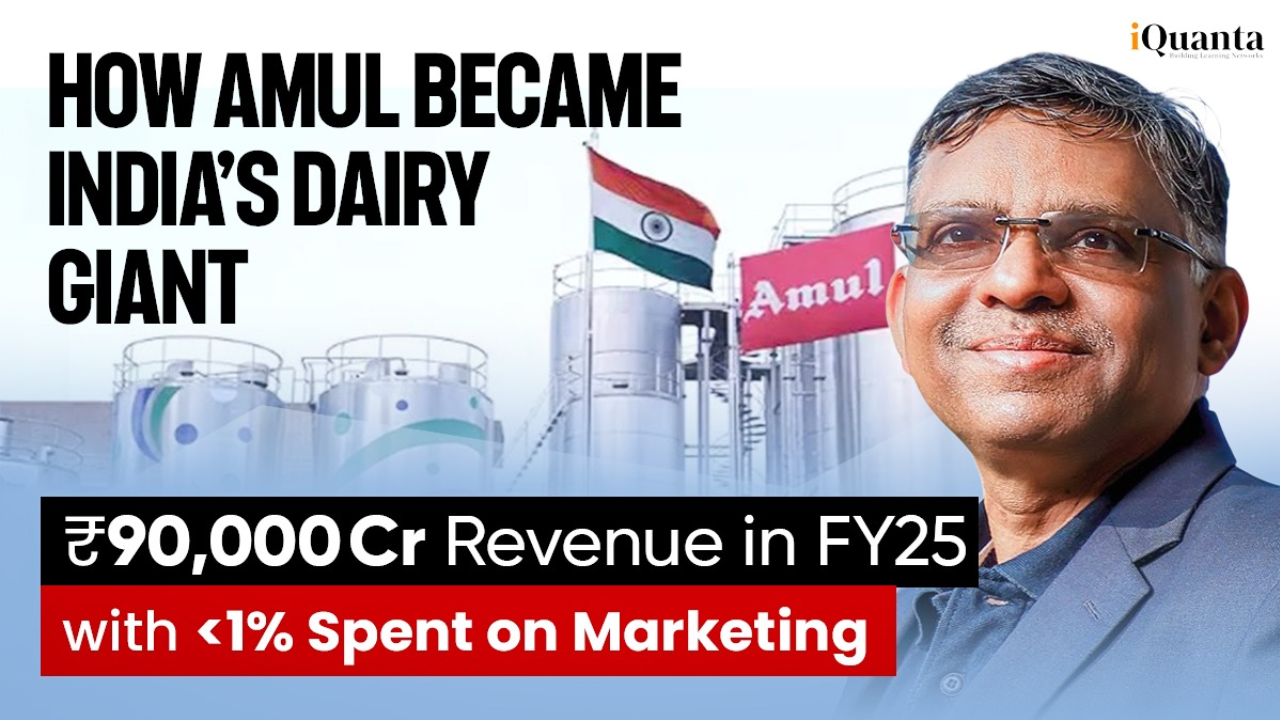
There are very few brands in India that manage to sit inside almost every household refrigerator while also carrying the weight of a genuine social movement behind their name, and Amul is easily the finest example of that rare combination, because the story of this dairy giant did not begin in a boardroom or a marketing agency but in the fields and cattle sheds of Kaira district in Gujarat, where a group of exploited milk farmers decided they had simply had enough of being cheated by a private dairy and its middlemen. What started as a quiet protest by a handful of frustrated farmers eventually grew into the Gujarat Cooperative Milk Marketing Federation, the organisation the world now knows through its beloved Amul brand, and today that same cooperative structure has helped Amul cross a staggering Rs. 90,000 crore in brand turnover for the financial year 2025 with less than 1% in marketing spend, a number that tells the story of patience, planning, and an unusual amount of trust placed by millions of ordinary farmers in a shared idea.
Join iQuanta’s diversified student community for free and prepare with other 4.1L+ peers. Get access to 24/7 doubt-solving, mentorship, free webinars, etc., all at one single platform

History Behind the India’s Dairy Giant Amul
Long before Amul became a household name, the milk producers of Kaira district were selling their milk to Polson Dairy, a private company that enjoyed something close to a monopoly over milk procurement in the region and that used this dominant position to underpay farmers while keeping prices artificially low and inconsistent. Farmers had no real bargaining power, no say in how prices were fixed, and no protection from the whims of traders who decided the value of their daily labour without ever consulting them, and this imbalance eventually became impossible to tolerate for the milk producers of villages like Samarkha, Kanjari, and Amreli, who began meeting quietly to discuss the injustice they were facing every single day.
Their frustration reached the attention of Sardar Vallabhbhai Patel, who advised them to form their own cooperative rather than continue depending on a private middleman who had no genuine stake in their wellbeing, and it was this advice that pushed local farmer leader Tribhuvandas Patel to organise the milk producers into a collective body that could process and market its own milk instead of selling raw milk at whatever rate the private dairy decided to offer. In December 1946, this collective effort formally became the Kaira District Cooperative Milk Producers’ Union, and that single decision by a group of determined farmers eventually blossomed into what the world now recognises as Amul.
The Arrival of Dr Verghese Kurien and the Birth of a Movement
While Tribhuvandas Patel gave the cooperative its founding spirit, it was the arrival of a young engineer named Dr. Verghese Kurien in 1949 that transformed a regional farmers’ union into a national institution capable of reshaping the entire dairy economy of India. Kurien, who had originally been sent to Anand almost by accident as part of a government bond obligation, chose to stay back and dedicate his career to strengthening the cooperative, and together with Tribhuvandas Patel and dairy scientist Harichand Megha Dalaya, he helped develop the technology needed to produce milk powder and condensed milk from buffalo milk rather than the cow milk that Western technology had been designed around, a breakthrough that allowed Indian farmers to compete directly with multinational companies that had previously dominated the market.
This technical achievement mattered enormously because it proved that a farmer-owned cooperative in a small Gujarati town could out-innovate large private corporations, and it gave the Kaira Union the confidence to expand its operations, eventually leading to the creation of the brand name Amul in 1955, a name derived from the Sanskrit word ‘Amoolya’, meaning ‘priceless’, chosen specifically to reflect the purity and value of the milk being produced by ordinary Indian farmers rather than large industrial players.
Rs 90,000 Crore in FY ’25 With <1% Marketing Spent
Perhaps the most surprising part of Amul’s ₹90,000 crore FY25 story is how little the brand actually spent to get there, because Jayen Mehta has repeatedly confirmed that Amul puts less than one percent of its revenue into marketing and advertising every year, and over the last five years that figure has averaged closer to 0.8 percent, which is remarkably low for a company competing against FMCG giants that routinely spend anywhere between eight and fifteen per cent of their revenue on brand building.
Amul manages this by following what is known as umbrella branding, meaning every single product, from butter and cheese to ice cream and paneer, is sold under one common Amul name rather than being launched as a separate brand with its own marketing budget, so a single Amul Girl hoarding or a single television campaign ends up promoting the entire product portfolio at once instead of just one item. Decades of consistent, witty topical advertising through the Amul Girl campaign, which is recognised as the longest running ad campaign in the world, has built a level of consumer trust that most brands can never fully buy no matter how much they spend, and that inherited goodwill is really what allows Amul to keep its promotional costs so far below industry norms even as its revenue keeps climbing toward the next big milestone.
Conclusion
Amul’s rise from a small protest by exploited Kaira district farmers in 1946 to a ₹90,000 crore brand in FY25, and eventually to the Rs. 1 lakh crore mark the following year, is proof that a genuinely farmer-owned business can outgrow and outlast private competitors backed by far bigger budgets. The cooperative kept faith with the people who actually produce the milk, spent barely a fraction of its revenue on marketing, and let decades of consistent quality and honest pricing do the talking instead, and that simple formula is what turned a village-level union into one of India’s biggest and most trusted business names.