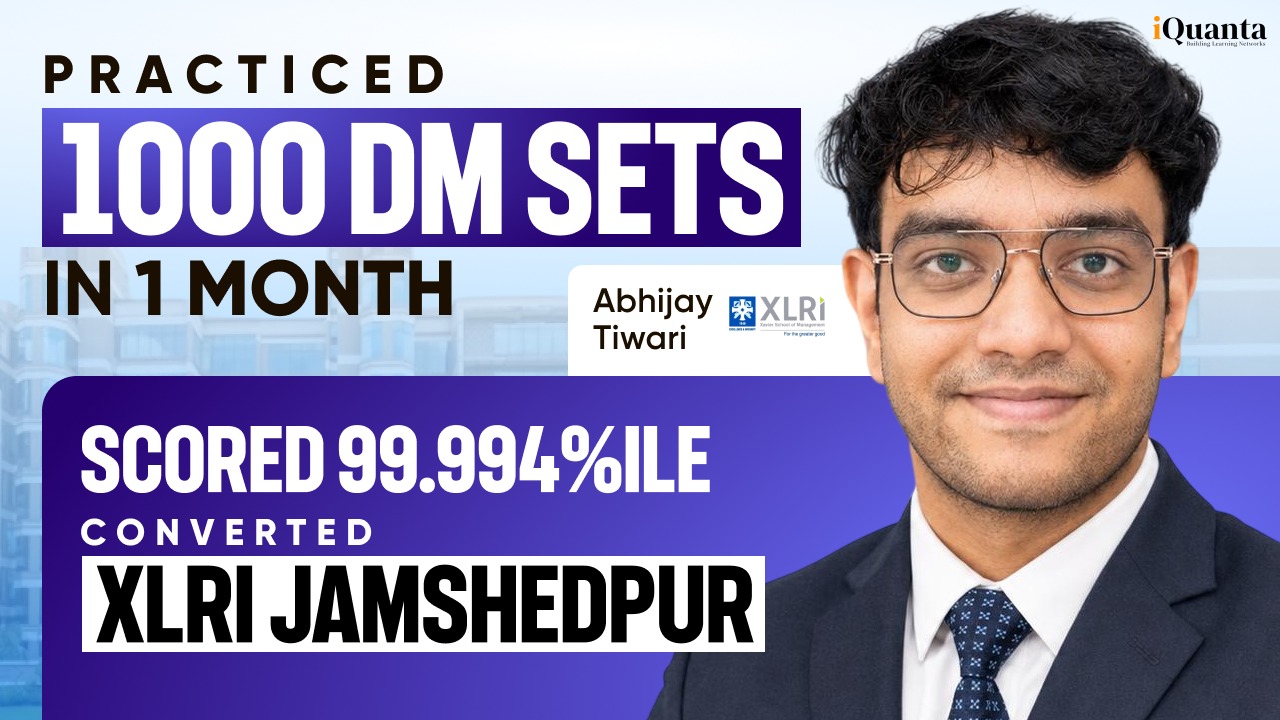
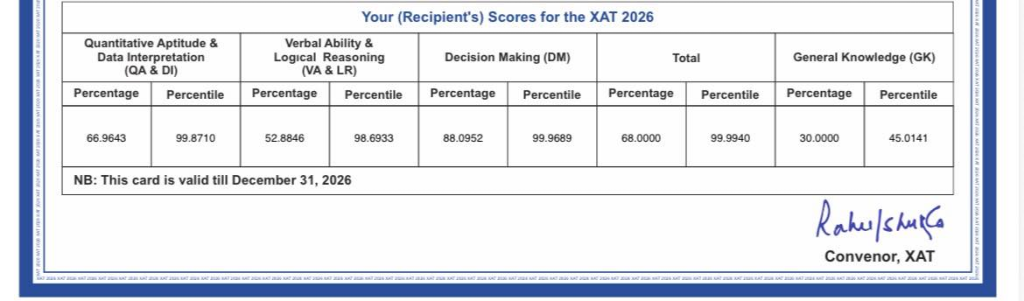
This iQuanta student finally proved that one drawback will not be your final destination if you follow the right preparation strategy. The CAT exam result didn’t work out as he expected, but the XAT exam completely changed the final outcome for Abhijay with an overall 99.994 percentile and finally converted to XLRI Jamshedpur BM. Talking about his scores, Abhijay got an outstanding XAT result with 99.87 in Quantitative Ability & Data Interpretation, 98.69 in Verbal Ability & Logical Reasoning, and 99.96%ile in the Decision-Making section.
This article covers the success story of a XAT topper, Abhijay Tiwari, about how he converted to one of the finest B-schools in the country and what is the main motivation behind his XAT preparation journey.
Join iQuanta’s diversified student community for free and prepare with other 4.1L+ peers. Get access to 24*7 doubt-solving, mentorship, free webinars, etc., all at one single platform.

About Abhijay’s Educational Qualifications
Abhijay is an engineer with 8 months of work experience and a gap year spent working inside his family’s business, watching his father run an MSME that he had built from scratch, which took just years of consistent effort and the kind of self-sufficiency that leaves a mark on you when you grow up seeing it every day. His academic profile across school and graduation stood at 9, 9, 7 which was decent. What he carried into this preparation instead was a quiet but deeply personal motivation rooted in the image of his father, a man who had built something real entirely on his own terms, and the early childhood aspiration to become someone like that led Abhijay here, to one of the finest business schools in the country.

How He Started His XAT Preparation Journey?
The stretch of time between a difficult CAT result and the XAT exam is one of the most psychologically demanding phases of any MBA journey because the motivation that kept you going for months takes a blow at the exact moment you need to pivot and rebuild your focus for something else entirely. Abhijay felt that weight clearly and he does not pretend otherwise but he also understood that XAT was still in front of him and that sitting with disappointment was a luxury he could not afford given how little time was left. He joined iQuanta, got into the material, and started building his days around structured practice across all three sections while very quickly identifying that Decision Making was the section that was going to decide everything for him and treating it with a level of daily seriousness that most aspirants never actually sustain through an entire month.
Major Challenges He Faced During XAT Preparation
The hardest part of Abhijay’s XAT preparation was Decision Making and not because the questions were beyond him but because the entire nature of that section resists the kind of preparation that most aspirants are used to and comfortable with. With VARC and Quantitative Ability you have a recognisable structure to work through and a clear sense of what you are building toward with each day of practice but Decision Making offers none of that because there is no fixed syllabus, no defined set of rules, no boundary that tells you where the section begins and ends and no single correct answer that holds reliably across every situation you encounter. What it actually tests is closer to judgment and the ability to look at a situation, weigh what is in front of you, and identify the response that is most legitimate and most viable given the specific context of that particular set and that is a cognitive ability that over 1.5 lakh aspirants are all trying to develop simultaneously with very little structural guidance on how to actually get there.
Abhijay’s answer to this was to build his perspective through volume because he understood that you cannot memorise your way through Decision Making and the only way to develop the kind of internal framework the section demands is to expose yourself to enough different situations that your mind starts to find its own consistent way of working through them. He solved 30 to 40 sets every single day without cutting corners and by the end of the month he had crossed 1000 sets in total and the result of all that effort showed up as a 99.96 percentile in Decision Making alone which is a number that reflects not just the hours he put in but the quality of thinking he was building through every single session. All of this was also happening while he was managing the emotional weight of a CAT season that had not gone as planned which meant that some days finding the motivation to sit down and grind through another 30 sets was genuinely difficult but he pushed through it anyway because the goal in front of him was personal enough and real enough to keep him moving even on the days when nothing else did.
How iQuanta Helped Him in His Preparation?
Abhijay worked through the entirety of iQuanta’s material as the foundation of his XAT preparation and when he talks about what made the difference, the material is always part of the answer because his entire strategy for Decision Making was built on volume and volume only works if you have a large, reliable, and high quality bank of sets to draw from every single day without running dry or repeating yourself to the point where the practice stops teaching you anything new. iQuanta gave him exactly that and the quality of the content meant he was not just accumulating hours but actually sharpening his judgment with every session he sat through. For a section as unconventional as Decision Making, having a resource that could sustain that kind of daily commitment across an entire month was not a small thing, it was the structural backbone that made the whole strategy possible.
Conclusion
Abhijay’s journey from a season where CAT did not go his way to a 99.994 percentile on XAT and a seat at XLRI Jamshedpur is worth paying attention to because it is built on something more transferable than luck or a perfect profile, and it shows you what focused, high-volume preparation with the right intent behind it can actually produce in a short window of time. He did not get here because everything lined up cleanly for him; he got here because he identified where he could compete, committed to a level of daily practice that most aspirants find hard to sustain, and refused to let one difficult season become the final word on what he was built for. His father built something big entirely on his own terms, and Abhijay is now walking into one of the finest management schools in the country carrying that same instinct and that same hunger for something that is genuinely his own. As he put it himself, with time your aspirations get balanced through optimization, and what you are really searching for is balance and perspective and not just a high-paying job because that outcome is not who you are, and for Abhijay, the outcome is XLRI Jamshedpur.