

With around a few months remaining for CAT 2026, we hope everyone has started appearing for CAT Mock Tests already. Mock tests give you a clear picture of the type of questions and difficulty level of the exam. Regularly appearing for mocks helps increase your Speed and Accuracy. While a lot of people appear for mocks, they don’t analyze the results. Appearing for these tests is only fruitful if you analyze your score and thereby work on improving it. CAT mock analysis and building a CAT mock strategy are important, as they will help you focus on your weaker areas. There are some features which are newly added to the iCAT 2026 mock test series, and the detailed information of all is mentioned on this page with CAT mock analysis.
Join iQuanta’s diversified student community for free and prepare with other 4.1L+ peers. Get access to 24/7 doubt-solving, mentorship, free webinars, etc., all at one single platform

Step 1: Appear For Tests
When you have selected which CAT mocks to take, go for its complete set because every institute designs its mock test series to cover the whole set of the problems that can be asked. If you have enough time, club it with mocks of other institutes to have more variety and see where you stand in the competition. You can start by taking 1-2 mocks every week as of now.
Also Read: Best CAT Mock Test Series
STEP 2: Building a CAT Mock Strategy
Building the best CAT mock strategy for oneself is a continuous process till you take a sufficient number of mocks and find what works best for you. As of now, start taking mocks with a fresh mind, don’t exhaust yourself before the test. This would help you realise your full potential.
CAT Mock Strategy – Quants
Round 1: Go through all the questions and Solve the easiest questions (sitters) there itself, the ones for which you know the solution. Mark for review the questions that you know how to solve but might take some time or that you have an idea about the concepts behind.
Round 2: Attempt the marked-for-review questions.
Round 3: If you get to this part at all) Attempt the unmarked questions
CAT Mock Strategy – VARC
While attempting the VARC section, your CAT mock strategy should be to either start with RCs or VA questions. Pick out the RCs which are familiar to you or topics which you find interesting. While reading an RC, your mind should be completely focused, keeping the note of the central idea, identifying the main points/arguments the author wants, and filtering out the redundant information present in the passage. While going through the RC questions, if you are confused between any two options, mark that question for review and move forward. Do not guess-estimate at that point in time. If you have time at the end, revisit and try solving again. This section should be allotted at least 30 minutes. The VA section should be allotted a maximum of 6-10 minutes because 4-5 out of the total questions are TITA with no negative marking.
CAT Mock Strategy – LRDI
There are two different CAT mock strategies for different type of aspirants: 1) Those who are solving less than 2 sets in a Mock consistently:
- In the first 5-6 minutes, go through the entire 4 sets along with their questions.
- Select 1-2 sets according to the relative difficulty level and use the next 30 minutes to solve them.
- If after trying to solve the question for 5 minutes and going through the data, you cannot solve it and get stuck in it, leave the set, ignoring your ego, and move forward. Do not waste 20 minutes on a single set.
2) Those who are solving more than 2 sets in a Mock consistently:
- Do not waste your time in selecting sets or categorising them, as these 5-6 minutes could be used to solve 4-5 more questions in the end.
- Once you start the set, take 4 minutes’ time to make some headway, if you can’t, let go of your ego and go to the next set. Don’t waste your time.
STEP 3: CAT Mock Analysis
The most important step is the CAT mock analysis. Merely appearing for the mocks will not improve your performance until you analyse your strengths and weaknesses. Spend a day and analyze your results section-wise. Note the time spent on every question, the topics and types of questions that you’re good at and the ones where you can improve. If you have taken iCAT mocks, you must know about the AI-based error tracker. The reason why many people get confused on how to analyse mocks is that we have made them personalised & tailor-made for each taker, where you’ll have a track of all the types of errors you made in one place. This will give you details on what type of errors you are making on any particular topic or section.
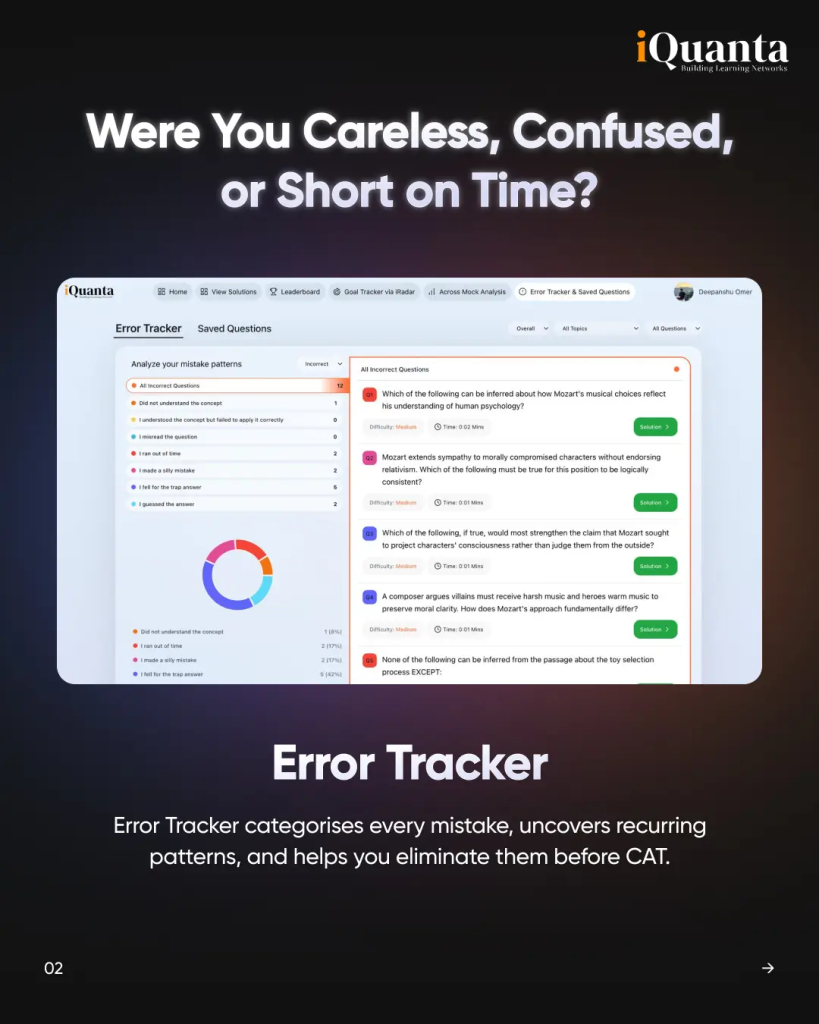
You can, moreover, select those types of questions where you are making similar types of errors. For example, you can simply select those questions where you are talking more than regular time from each section or topic and check those questions and solutions. (There will be 3 buttons on which topic you want to select, which type of error you want to select, or you want to select skipped ones or correct ones at one place).
You can also check those types of questions where you don’t know the concepts, this will help in focusing on those areas where you need to strengthen the concepts or where you need to increase the speed. Like this, there will be 8-10 types of identifiers, not just in those questions where you made an error but also in skipped questions and in correct ones too. In the iCAT mock, you get 35 CAT-level mocks along with 45 sectionals. You also get video solutions for each mock test.
1. CAT Mock Analysis: Quantitative Aptitude
The best way to analyse QA is to prepare an excel sheet for every mock. Fill this Excel sheet for every mock, then the CAT mock analysis for your weak and strong points needs to be done in the following manner:
- Topics where your accuracy is greater than 80% are your strong areas. Work upon these to minimise the time spent on these questions. Since your basics for these topics are strong, try to attempt the maximum number of questions.
- Topics where accuracy is 55 to 75% are your improvement areas, basics are strong, but these areas require practice.
- Topics where accuracy is less than 50% are your weak areas. You need to work upon these areas, as the concepts are not clear.
Solve the question you got wrong once again, find out the mistake, make a note of it and promise yourself to not repeat the mistake again. If it was just a calculation error, it means you need more time-based practice.
- While doing your CAT mock analysis, don’t neglect the answers you got right. People generally ignore the correctly attempted questions. But getting a question correct is not enough, it’s also important to get it correct in decent time. If you spend 3 or more minutes on one question, it has probably done more harm than good.
- Check if you can find any shortcut (other than the answer booklet) which is easier for you to understand. Post the question on the iQuanta app, you’ll probably get a better solution from our expert team or from peers who are preparing for the same examination.
- After the completion of your CAT mock analysis, practice the questions where you spent too much time, and if you are not able to solve similar questions within two minutes, in the next mocks, mark them and move forward. You can always come back if the time allows.
- Prepare a list of questions that you skipped but should have attempted. Try to solve these in the next mock.
And the kind of questions where you spent too much time but left them even though you could have attempted them require some good amount of practice to get familiar with. For the same, you can solve past year CAT questions on these topics, followed by topic-wise tests from any standard source. You can also solve questions from the repository of iQuanta Practice questions in the iQuanta Doubts Group (paid).
2. CAT Mock Analysis: VARC
Take a deep breath – you have successfully taken your mock. That is always the first step. But taking mocks without analysing them is a half-baked idea. The right CAT mock strategy to follow for CAT mock analysis will be to attempt the paper again, but without the added pressure of a timer. You can keep a tab on your time but don’t be in a rush. Take as much time as you need, understand the passage and then go on and select the answer. You can also select a second option (mark it as Choice 2) for the questions that you were really confused about. Complete the section. While doing your CAT mock analysis for VARC, make sure that you:
- Attempt all the RC’s that you missed the first time. Also, try to categorise the passages – science and technology, economics, philosophy, abstract or just an author’s take on any particular thing.
- Analyze the “TONE” for every RC in the mock test.
- Analyze the reason for the incorrect attempts. Try to understand the author’s point of view and compare it with your own. This will also help in cases of two similar options.
- Note down all the new words in the RCs and find their meanings. This would help you in improving your vocabulary.
- For non-RC questions, the CAT mock strategy would be to categorise the problems into summary, inference and para completion and check where you’ve made the maximum number of mistakes and mark the topic which you think requires your attention.
Improvement post-VARC CAT mock analysis
Post your VARC CAT mock analysis, see how much you were able to score without the clock ticking. This was the target score for your specific mock. Analyze to know what kind of questions you got wrong. Get into details; find out the genre of the RC and the type of question (Inference, Assumption, Central Idea, Specific Detail Question etc.) In case you were confused between two options and marked the incorrect options, keep a note of them as well. Read more from the genre you are not comfortable with. Solve more Questions from the specific topic in which you had difficulty and get your doubts cleared by posting in the iQuanta Group. If you still are not convinced by the answers, junk it – no point breaking your head over a single question. Just keep reading and work on the words you had difficulty with in the paper. And lastly, breathe! Enjoy your scores, and don’t let one bad mock bring you down. Get to the next mock.v
3. CAT Mock Analysis: LRDI
Now, coming to the CAT mock analysis for the LRDI section, follow these steps: For DI and LR, solve all the sets that you missed or could not solve. Note down the time taken to solve this. You must not take more than 15 minutes to solve a set. Check the new concepts in every mock test and make a list of these new concepts that you missed while covering those topics and practice more such questions. Also, analyze which all sets should have been selected in the test in the priority order and also which all should never be selected in the test. Selection of the set is the most important part in the mock, and its analysis must be done. Big Question: Which set to choose? The answer to this question lies within you. As you keep practising and solving different kinds of questions, you’ll find your comfort zone. When you start the test, skim through all the sets once in around 3-5 minutes and focus on those in which you feel more confident. It might happen that you start solving a set of your own choice but are still unable to crack it. Many people take it upon themselves and thus end up wasting a lot of time on such questions. Another possibility is that after spending around 10 unsuccessful minutes on a set, you’d feel that now you have to solve it anyhow, as you’ve already given too much time to it. This is a trap, and we urge you not to fall into it. In many LR sets, you’ll find a list of information, sometimes going up to more than 10 points. For solving such questions, you need to be very efficient. You have to reproduce the question on your sheet of paper while reading it, using shorthand notations. Make sure that you don’t keep returning to the descriptive part while solving each question. This will save you a lot of time and will also make the process of solving much easier. Many times, you might find yourself clueless in the midst of a question, with no idea on how to proceed further with the given information. This is where the CAT mock strategy plays its part. In those moments, you have to remember that all the information required for you to solve that particular question is present on your screen. Here, you can act a bit smart and also use the options to solve your question. People sometimes are so immersed in filling up the table at hand that they forget to look at the questions that follow. It is a good step to check out all the four questions if you ever get stuck. Looking at the options in the questions will give a better idea on how to solve it and also acts as a hint in cases there is a ‘Cannot be determined’ option. Sometimes, you might not be able to solve all 4 questions in a set due to some limitations. In those cases, it’s a good practice to solve 1-2 questions quickly and move on to the next set instead of wasting your time. In the end, if you’re left with 5-7 minutes and it’s too late to start a new set, you can return to these questions and try solving them again.
STEP 4: Prepare a Sheet
- (If you do not have iCAT mocks) Once you have completed your CAT mock analysis, make a sheet of the following:
- New Quant formulas
- New strategies used in DILR
- New grammar rules learnt in VA
- New words and their meanings
- (If you have iCAT mocks) You can check your Analysis dashboard after completing your mock. Check your accuracy, questions attempted and unattempted, and correct or incorrect answer along with the level of difficulty mentioned. You can download this report to keep a record.
STEP 5: Take Sectionals
After revision of the weak areas, take sectionals of the weaker sections and topic-wise tests of those you’re weak in before going for the next mock test.

STEP 6: Prepare Your Next CAT Mock Strategy
For your next mock, prepare a CAT mock strategy to complete the exam with maximum accuracy. Solve the questions from your strong areas first. Just aim at increasing accuracy, getting maximum right answers in minimum span of time. Be very selective and conservative with your 120 minutes. Don’t waste them on questions that aren’t worth it. Don’t give any question a second more than it deserves. So, pull up your socks and start appearing for all the mocks. This is the best opportunity to take risks and analyze your strengths and weaknesses.
How To Work On Your Weaker Areas For CAT?
Once you are done with the mocks and analysis in iCAT mocks, you’ll be redirected to the iRadar/Goal tracker page. Here, you’ll get a list of B-schools you can crack based on your current mock percentile. Additionally, your weaker areas and corrective measures will also be highlighted.
After your CAT mock analysis, it is essential that you start working on your weaker areas post-analysis. Now, how to ensure betterment in your next mock? The students enrolling in the course will be added to this secret group. A few pointers that I want you to keep in mind before you buy this:
- You have to dedicate two to three hours every day for you to get to 99 percentile. If you cannot take the time out, this exercise is not going to make any sense.
- This course is supposed to be rigorous practice, practice and more practice. It is supposed to fill the gap for people who cannot get to a 99.5 percentile.
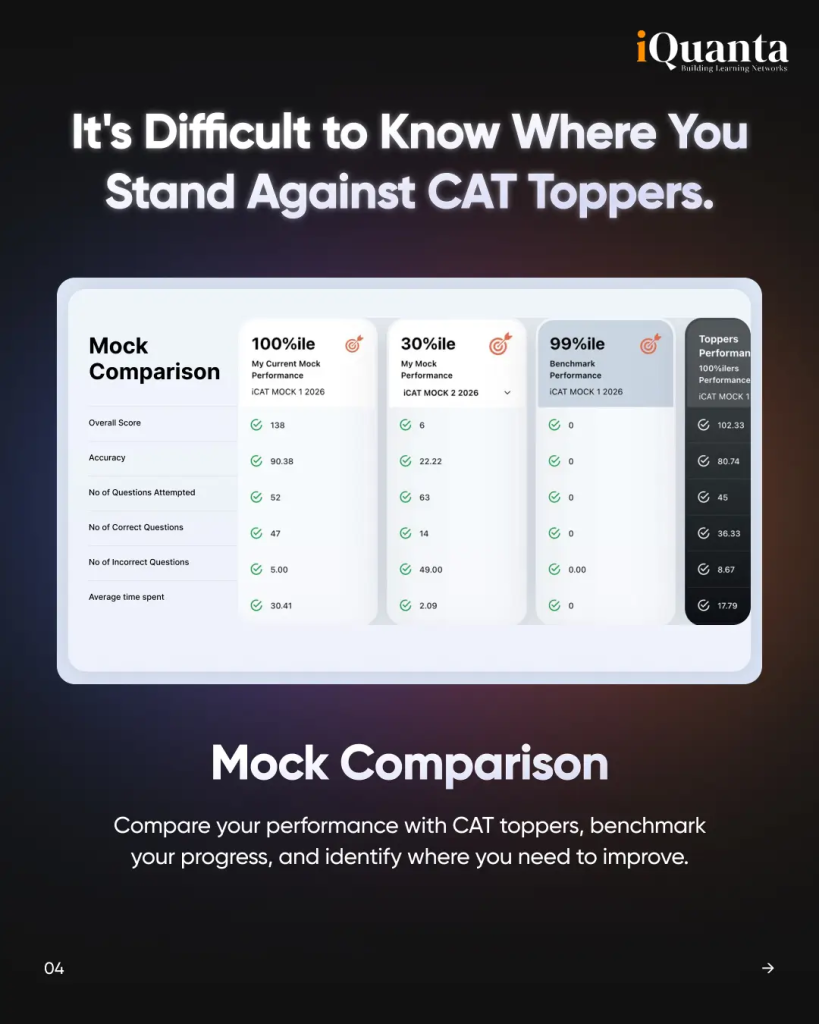
Newly Added Features of iCAT Mock Test Series 2026
This section covers all the newly added features this year about the iCAT 2026 mock test series.
AI Mentor
CAT mock tests are more effective in your preparation if attempted with a proper strategy and followed with a detailed performance analysis. But many students face issues with several questions, such as how to analyse performance, the best way to attempt the CAT mocks, how to improve scores, etc. To help you with all the relevant CAT exam mock queries, iQuanta has designed a personalised AI assistant, namely “AI Mentor”. Here you can ask any question related to the analysis, performance and strategy of solving mocks without any disturbance.
This is the one-stop solution for all your queries related to the CAT mock test 2026 without waiting for someone to get them resolved for you.

Personalised AI Analysis & Performance Report
This feature is really helpful for aspirants to analyse overall as well as sectional performance after attempting the CAT mock test. This gives an overall insight about how you have performed in your recent mock and where you really require improvement to increase your percentile. The CAT exam is a sectional test, which means you not only have to focus on your overall percentile but also on sectional percentiles, which add equal importance in a final CAT scorecard of aspirants.
What all will you get in a detailed performance report after giving a CAT mock test?
- You will get an overall CAT mock test summary such as score, percentile, accuracy, how many questions were attempted and marks left on the table.
- Detailed section-wise analysis: Review your sectional performance in a CAT mock. This will give you a detailed overview across QA, VARC and DILR.
- Your CAT mock accuracy and attempts: Here candidates can understand the accuracy of giving the CAT mock and your actual performance across VARC, DILR and QA.
- Time-management analysis: This is quite important because the CAT exam provides 40 minutes to complete questions across every section. This will help you to analyse how much time you have spent on a particular question and where you have taken more time to solve it.
- Overall mistake analysis: This encapsulates your mistakes while attempting the CAT mock test. It includes the calculator errors, conceptual mistakes, guesswork and more.
- Strengths and weaknesses: This pointer will help you to identify your strong and weak areas. This will help you perform better in the next CAT mock test.
- Topic-wise performance across sections: Tracking performance across topics is another strong way to analyse overall CAT mock test performance to determine preparation effectively.
- Get a clear roadmap for the next CAT mock attempt: Overall analysis to improve your next CAT exam mock attempt with a high percentile.

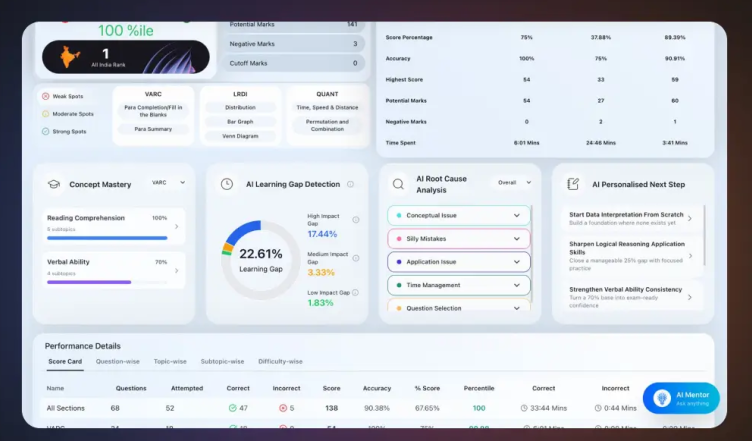
This new feature by iQuanta encapsulates the four main core parts to analyse CAT mock tests, such as Concept Mastery, AI-Learning Gap Detection, AI Root Cause Analysis and AI Personalised Next Step.
Concept Mastery
This feature will help you track across each concept after attempting the CAT mock test. Here you will get to know about how well you mastered each topic. Your performance in the CAT exam mock depends on your accuracy and attempt rate. Attempting CAT mocks rigorously gives you clear insights about identifying concepts that need more practice before appearing for the CAT exam.

AI-Learning Gap Detection
The AI-learning gap detection features will help aspirants with identifying the topic-wise knowledge gaps that limit their performance in the CAT mock tests.
Major factors you can check with this amazing feature after attempting CAT mocks:
- Categorises the knowledge gaps based on the respective CAT mock score.
- Helps you prioritise high-weightage topics first across sections. Because it will help you to maximize your scores in the next mock.
- With every CAT mock, aspirants will get the detailed insights to fill out these gaps across the sections.
AI-Root Cause Analysis
The AI root-cause analysis features actually work for you beyond your mock scores by providing the actual insights about where you lost your marks. This covers your conceptual mistakes while attempting the CAT mock test, application issues, time-management problems, silly mistakes across sections, selection of questions and more.
AI Personalised Next Step
This will give you an overall improvement suggestion after attempting the CAT mock test. This detailed report gives you an insight about targeted goals, practice strategies, and a topic-wise plan to maximize overall performance improvement in the next CAT mock test.
What’s New With iCAT Mock Test Series 2026?
This year’s iCAT mock has a unique addition of an AI mentor who will help you with any doubt related to your mock strategy and acts as a personalized mentor, learning gap detector, IIM Indore level mock and more. Candidates who haven’t even started the CAT 2026 mocks should start with the proper plan and solve as many mocks as possible. Because solving mocks rigorously will help you evaluate the exam-like conditions. You can directly attempt the CAT mock tests by clicking on the button specified below.
Click Below for iCAT Mock Test Series 2026