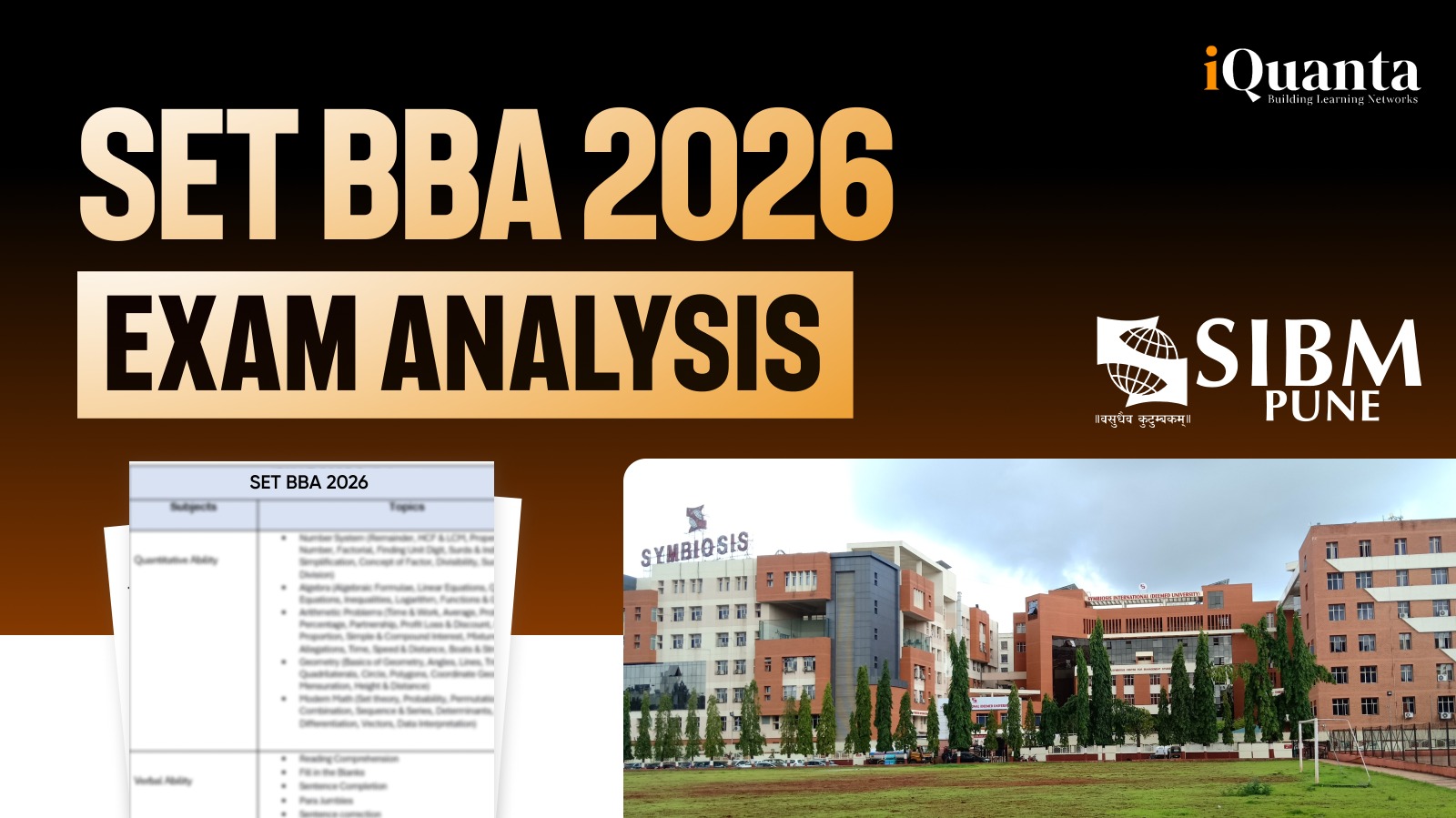
The SET test 01 was recently completed on May 2, 2026. The exam analysis of the same is quite indispensable for the candidates who have appeared for the exam and are planning to appear in the near future. As per the complete exam analysis, the overall difficulty level of the exam was easy, and most sections considered were balanced and direct, with a strong focus on accuracy over difficulty traps. This blog helps you to cover the detailed SET BBA 2026 exam analysis across the General Awareness analysis, Quantitative analysis, Logical Reasoning analysis, General English analysis and more. Let’s discuss the same in a detailed manner.
Join this free IPMAT preparation WhatsApp group to get free study material, strategies by toppers and experts, latest updates and more
SET BBA 2026 Exam Analysis: General Awareness
In the General Awareness section, questions were asked from different types of awards, including which categories have Nobel Prizes and what the highest awards are in various fields.
SET BBA 2026 Exam Analysis: Quantitative Analysis
The quant section was mostly arithmetic-based, with the majority of questions coming from percentages, profit & loss and simple and compound interest.
| Permutation & Combination | 1 |
| Probability | 1 |
| Geometry (Cylinder – Volume) | 1 |
| Data Interpretation (DI) | 2 |
| Coordinate Geometry (Midpoint) | 1 |
| Installments | 1 |
Note: Basic questions from geometry and no major algebra questions.
SET BBA 2026 Exam Analysis: Logical Reasoning
Overall, the Logical Reasoning section was also easy
- With 4-5 questions from critical reasoning (including course of action and statement-assumption type questions).
- Mirror image
- Calendars
- Number completion
- Along with 2 questions from series and coding/decoding.
SET BBA 2026 Exam Analysis: General English
The General English section was overall easy, with a stronger focus on grammar, especially prepositions, idioms, and phrases.
There were also questions from other topics as well. In addition, there were found:
- 1-2 spelling questions
- 1 simile/poetic device-based question
- approximately 2-4 questions from antonyms and synonyms